
A beachfront address in the UAE carries a premium that almost nothing else in the property market can match. It also carries a maintenance liability that most owners only discover around year eight, when the first rust stains appear beneath a balcony soffit and a surveyor explains that the reinforcement inside the slab has been corroding quietly since the building was three years old.
Salt air corrosion in the UAE is not a slow, gentle process. The Arabian Gulf is one of the most aggressive marine environments on the planet for built structures, and a coastal tower in Dubai Marina, Ajman or Abu Dhabi’s Corniche is exposed to a combination of salinity, humidity and heat that would be considered extreme almost anywhere else in the world.
This guide explains what salt air actually does to a coastal building, which components fail first and in what order, how to identify the damage before it becomes structural, and which specification and maintenance decisions genuinely extend service life. It is written for owners, facility managers and consultants responsible for assets within a few kilometres of the shoreline.
Why the UAE Coastline Is Unusually Hard on Buildings
The Gulf combines three aggressive conditions that are rarely found together: exceptionally high salinity, sustained high humidity, and year-round heat that accelerates every chemical reaction involved in corrosion.
The Gulf Is Saltier Than the Open Ocean
Open ocean salinity typically sits between 34 and 36 parts per thousand. The Arabian Gulf runs considerably higher, because it is shallow, poorly flushed and subject to enormous evaporation rates with very little freshwater input. Total dissolved solids in Gulf water have been measured in the range of 44,000 to 60,000 ppm, against roughly 8,000 ppm in a low-salinity sea such as the Baltic.
That matters because chloride ions are the single most aggressive component of seawater when it comes to attacking steel. A higher chloride concentration in the water means a higher chloride load in the spray and aerosol that the sea breeze carries inland every day.
Salt Travels Further Than Owners Expect
Airborne chloride does not stop at the beach. Onshore breezes carry marine aerosol several kilometres inland, and deposition rates fall with distance but do not disappear. Buildings that are two or three kilometres from the water still accumulate measurable salt on exposed surfaces, particularly on elevations facing the coast.
This is why the “we are not really a beachfront property” argument is usually wrong in the UAE context. Large parts of Dubai, Sharjah, Ajman and Abu Dhabi sit within the zone of meaningful marine influence.
Humidity Turns Deposited Salt Into an Active Electrolyte
Dry salt on a surface does very little. Salt that absorbs moisture becomes a conductive electrolyte film, and that is exactly what happens on the UAE coast almost every night of the year.
Sodium chloride deliquesces at around 75% relative humidity, and coastal UAE humidity routinely exceeds that overnight. The practical effect is that a coastal building spends a substantial part of every 24-hour cycle with a thin, salty, electrically conductive film sitting on its metals and its concrete. Our detailed guide to the impact of humidity on UAE properties covers this moisture cycle in depth.
Heat Accelerates Everything
Corrosion is an electrochemical reaction, and reaction rates climb with temperature. Research on Gulf marine exposure has shown chloride diffusion coefficients in concrete rising sharply with exposure temperature, with specimens held at 50°C showing substantially faster ingress than those at 22°C or 35°C. Summer surface temperatures on a UAE façade comfortably reach that upper figure.
Heat also drives thermal movement, which opens cracks and joints that then admit more salt. The interaction is covered in our analysis of how extreme heat affects building structures in Dubai.
Sabkha Ground Adds Attack From Below
Much of the UAE coastal plain is sabkha: salt flats with a shallow, highly saline water table. Coastal buildings are therefore attacked from two directions at once, with airborne chloride hitting the superstructure while saline groundwater attacks foundations, basement walls and ground slabs.
Sulphates in sabkha ground add a second mechanism, attacking the cement matrix itself rather than the reinforcement. This is why foundation waterproofing specification in coastal UAE projects is materially more demanding than inland equivalents.
How Salt Air Corrosion Actually Damages a Building
The dominant failure mechanism on coastal UAE structures is chloride-induced corrosion of embedded reinforcement, and it follows a predictable four-stage sequence.
Stage One: Chloride Ingress
Fresh concrete is strongly alkaline, with pore water around pH 13. That alkalinity forms a microscopic passive oxide layer on embedded steel which prevents it from rusting. Chloride ions from salt spray or saline groundwater penetrate the concrete cover over time, driven by diffusion, capillary absorption and wet-dry cycling.
Stage Two: Depassivation
Once chloride concentration at the level of the reinforcement passes a critical threshold, the passive layer breaks down locally. Published threshold values vary with binder type, but studies of marine-exposed concrete have found the tolerable chloride level dropping as supplementary cementitious content changes, with figures ranging from roughly 0.7% acid-soluble chloride by mass of cementitious material in plain Portland cement mixes down to around 0.2% in high fly ash mixes.
Depassivation is invisible. There is nothing to see on the surface, and this is the period during which most damage can still be prevented cheaply.
Stage Three: Active Corrosion and Expansion
Once corroding, steel converts to iron oxides that occupy several times the volume of the original metal. That expansion generates tensile stress inside the concrete cover, which has almost no tensile capacity.
Stage Four: Cracking, Delamination and Spalling
The cover cracks along the line of the bar, then delaminates, then falls away, exposing corroded reinforcement directly to the atmosphere. From that point deterioration accelerates sharply, because the steel now has unrestricted access to oxygen, moisture and chloride. Section loss begins to affect structural capacity.
The visible outcome is the familiar rust-stained, spalled soffit seen on older coastal buildings across the Emirates, and it is treated through concrete spalling repair rather than cosmetic patching. Our reference on visual signs of structural problems sets out how to read these symptoms.
Carbonation Runs in Parallel
Chloride attack is not the only mechanism. Atmospheric carbon dioxide reacts with concrete over time and progressively lowers surface alkalinity, which independently destroys the passive layer. Where carbonation and chloride ingress meet in the same element, corrosion initiates significantly earlier than either would produce alone. Applying an anti-carbonation coating as part of a planned corrosion protection coating programme addresses this second front.
Which Building Elements Fail First on the Coast
Salt does not attack a building uniformly. Exposure geometry, material choice and detailing determine the order of failure, and the sequence is consistent enough to be useful as an inspection priority list.
Balconies, Parapets and Exposed Slab Edges
These fail first, almost without exception. They are the most exposed elements on the building, they are thin, they often have reduced cover, and their upper surfaces collect standing salt water. A balcony soffit showing rust staining is the single most reliable early indicator of a coastal chloride problem.
Handrails, Balustrade Fixings and Anchors
Anywhere a metal fixing penetrates concrete or masonry is a concentrated risk point. Water tracks down the fixing, salt accumulates in the annulus, and corrosion begins both on the fixing and on the surrounding reinforcement. Specifying appropriate chemical anchors and correctly sealing every penetration is disproportionately important on coastal buildings.
Cladding Systems and Their Fixings
The panel usually outlasts the bracket. Cladding support systems sit in an unventilated cavity where salt-laden moisture condenses and lingers, and a corroded bracket represents a safety issue long before the visible façade shows anything at all. Mixed metals in the same assembly make it worse, since dissimilar metals in a chloride electrolyte form a galvanic cell that accelerates corrosion of the less noble metal.
Sealant Joints and Movement Joints
Sealants are the building’s first line of defence against water entering the structure, and they degrade under combined UV, heat and salt exposure. Once a joint splits, salt water is delivered directly into the substrate. Specifying durable products such as an MS polymer hybrid sealant or a high-movement polyurethane sealant and maintaining concrete expansion joint detailing on a planned cycle prevents a large share of coastal water ingress.
Roofs and Roof-Mounted Plant
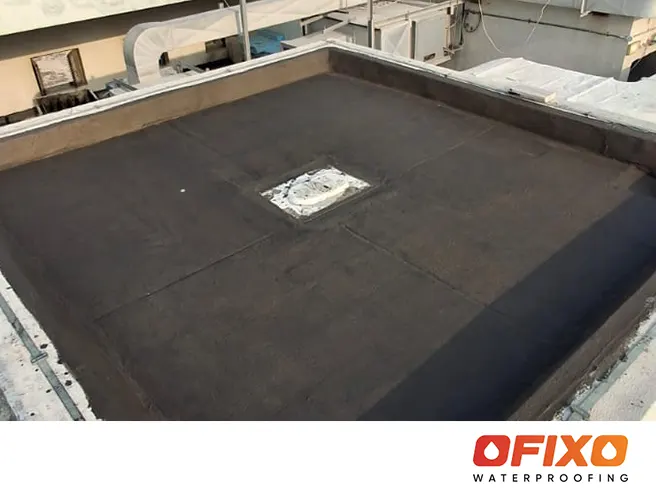
Roofs receive salt deposition continuously and then hold it in ponded areas. Chiller units, condenser coils, cable trays and steel supports mounted on coastal roofs corrode markedly faster than manufacturers’ general-purpose service life estimates assume.
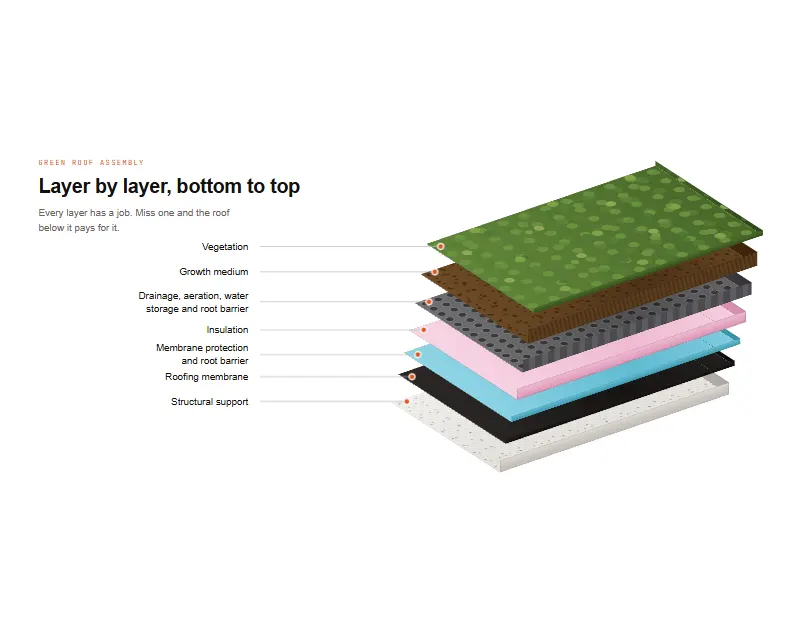
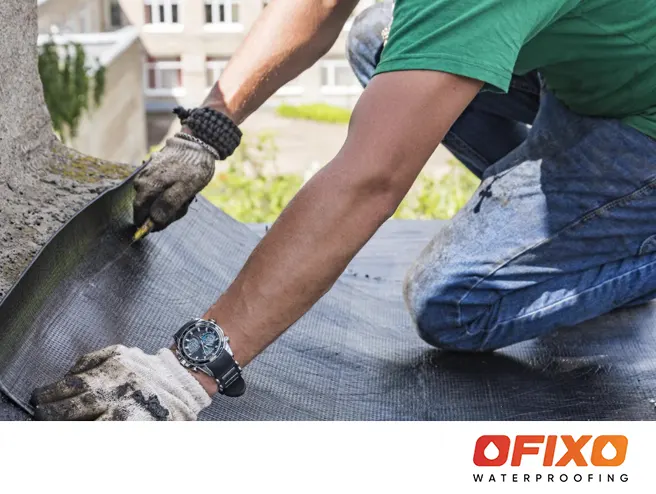
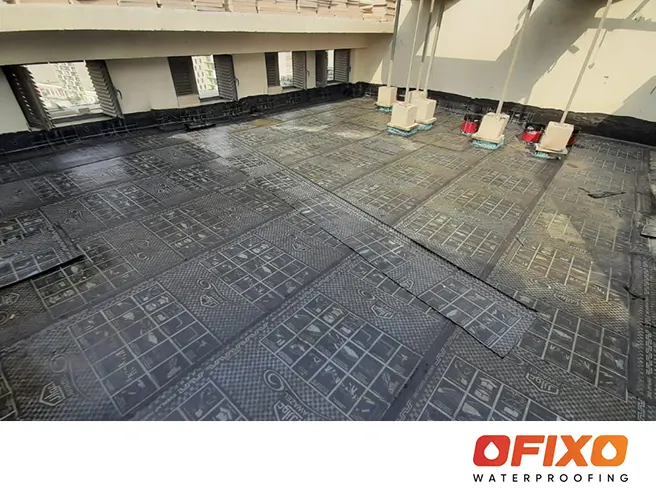
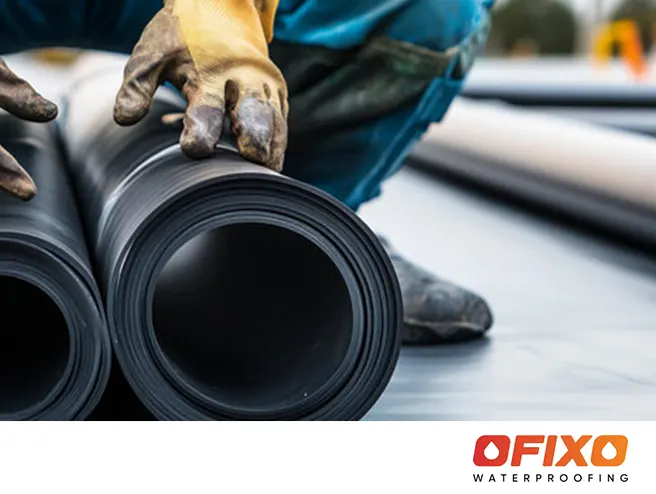
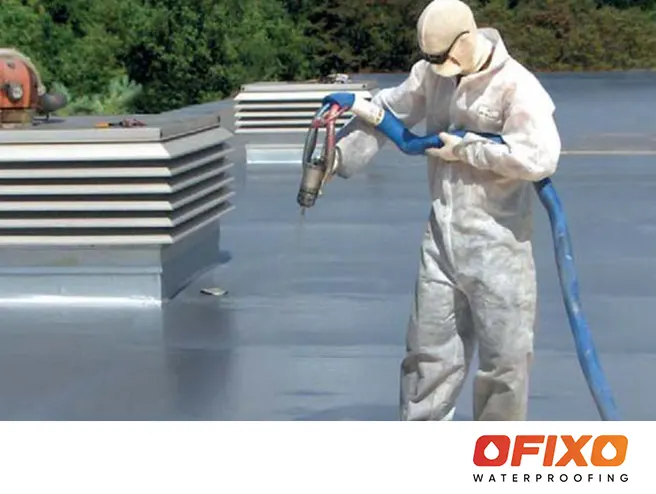
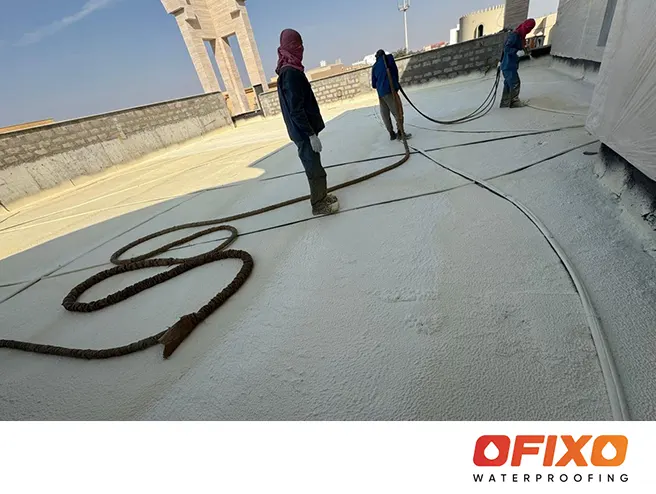
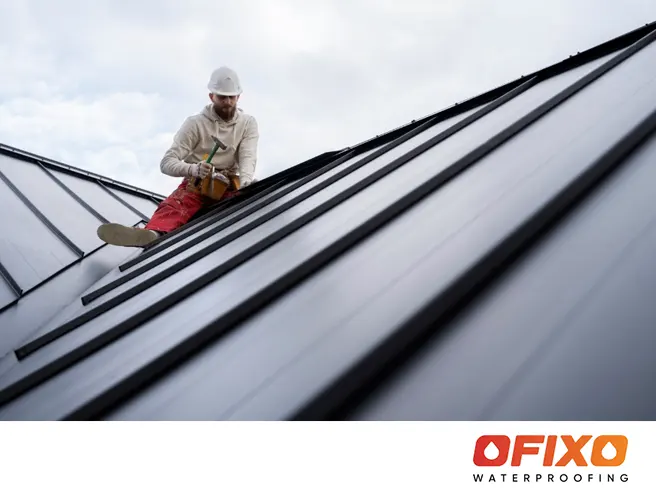
Membrane selection matters here. A robust roof waterproofing build-up using a chloride-resistant membrane waterproofing system, a TPO waterproofing membrane or an EPDM waterproofing sheet performs well in marine exposure. For plant decks and high-traffic areas, polyurea waterproofing applied as a seamless polyurea spray coating resists both salt and mechanical wear. Where profiled steel sheeting is involved, metal roof waterproofing should be applied before edge corrosion becomes perforation.
Basements, Car Parks and Lift Pits
Saline groundwater and salt tracked in on vehicles combine to make coastal basements a high-risk zone. Car park decks suffer particularly, because chloride-bearing water drips from vehicles directly onto the slab, and the resulting deterioration typically shows first as delamination around drainage points.
Effective basement waterproofing relies on correct waterstop detailing at construction joints, using a PVC waterstop or a hydrophilic waterstop, and on protecting the deck surface with a proper car park flooring system. Persistent water in a lift pit is a common coastal symptom and should be treated as a waterproofing defect rather than a pumping problem.
Swimming Pools and Water Features
Coastal pools face chloride from the pool water inside and marine aerosol outside, with the waterline and coping detail taking the worst of it. Sound swimming pool waterproofing is what keeps chloride out of the surrounding structure, and pool plant rooms need the same corrosion scrutiny as any other coastal plant space.
Water Tanks and Storage
Salt-laden air enters tanks through vents and covers, and coastal tanks show liner degradation faster than inland equivalents. Both water tank waterproofing and GRP lining for water tank applications should be inspected on a shorter cycle than the manufacturer’s standard recommendation, using a proper GRP tank lining kit for repairs.
Early Warning Signs of Coastal Corrosion
Chloride corrosion gives clear visual warnings for several years before it becomes a structural problem, provided someone knows what to look for.
Check for the following during routine inspections, prioritising the seaward elevation:
- Rust-coloured staining bleeding from concrete, particularly on balcony soffits and slab edges
- Fine cracks running in a straight line, parallel to and directly above a reinforcement bar
- A hollow sound when a concrete surface is tapped, indicating delamination beneath an intact surface
- Blistering, bubbling or flaking paint on concrete or render
- White salt deposits, efflorescence or crystalline growth on surfaces
- Rust weeping from cladding fixings, brackets, handrail bases or anchor points
- Pitting or white powdery corrosion on aluminium sections
- Sealant joints that are split, hardened or debonded at one edge
- Damp patches at the base of basement walls or persistent water in lift pits
- Corroded fasteners, hinges and ironmongery on external doors and gates
The hollow-sounding areas are the important ones. Delamination frequently exists behind a perfectly sound-looking painted surface, which is why coastal condition surveys use hammer tapping and, where warranted, half-cell potential mapping and chloride profiling to establish how far ingress has progressed.
Because salt-driven moisture problems are often concealed, a hidden moisture detection survey regularly identifies issues a visual walk-around misses, and our guidance on when expert inspection becomes necessary defines the point at which specialist assessment is justified. Anyone purchasing coastal property should read our checklist on what to look for in a pre-purchase building inspection, since chloride damage is routinely missed in standard handover snagging.
Coastal Building Protection: Getting the Specification Right
Every year of corrosion-free service life is bought at design stage far more cheaply than it can be recovered later. Five specification decisions dominate outcomes on UAE coastal projects.
Concrete Quality and Cover Depth
Low water-to-binder ratio concrete with a dense, well-cured pore structure slows chloride diffusion dramatically. Adequate cover to reinforcement then buys time proportional to the square of the depth, which is why an extra 15 mm of cover delivers a disproportionate durability gain. Both are cheap at construction stage and effectively impossible to retrofit.
Supplementary Cementitious Materials
Ground granulated blast furnace slag, fly ash and silica fume all refine pore structure and reduce chloride diffusivity substantially compared with plain Portland cement. Marine exposure trials along the Gulf coast have consistently shown these blends outperforming unmodified mixes. They also carry a lower carbon footprint, a trend discussed in our overview of sustainable building materials in the UAE.
Integral Waterproofing Admixtures
A crystalline admixture reacts with moisture and unhydrated cement to form insoluble crystals within the pore network, reducing permeability from within the concrete itself. On coastal work a crystalline concrete admixture is often specified alongside surface protection rather than instead of it, and a crystalline slurry coating provides the same chemistry as a retrofit to existing structures.
Corrosion Inhibitors
A migrating corrosion inhibitor penetrates hardened concrete and forms a protective film directly on the reinforcement, reaching steel that surface treatments cannot. Gulf exposure trials have specifically included MCI and calcium nitrite systems among tested protection strategies, and inhibitors are now routine on coastal repair work in the region.
Surface Protection Systems
The right surface treatment reduces chloride entry while still allowing the substrate to breathe. A penetrating acrylic concrete sealer closes surface porosity, while an anti-carbonation coating tackles the parallel carbonation mechanism. Choosing between systems is a genuine engineering decision, and our comparison of cementitious versus liquid applied membranes and our guide to polyurethane versus bitumen systems both set out the trade-offs.
Where concrete needs a rigid mineral barrier, cementitious waterproofing performs reliably in coastal exposure and tolerates the alkaline substrate without adhesion problems.
Repairing a Coastal Building That Is Already Corroding
Once corrosion is active, cosmetic repair makes the problem worse. Patching over corroding steel traps the reaction, and the newly repaired area frequently becomes the anode that drives fresh corrosion in the surrounding sound concrete, an effect known as incipient anode or halo failure.
Proper coastal repair follows a defined sequence:
- Survey and map. Establish the extent of delamination, chloride concentration at bar level and, where relevant, corrosion potential across the element. Repair scope should follow data, not visible damage.
- Break out fully. Remove concrete behind the reinforcement, not just up to it, so the bar can be cleaned on all sides. Break out beyond the visibly damaged area to sound, chloride-free material.
- Clean and prime the steel. Abrasive clean to bright metal, then apply a zinc rich rebar primer. Replace bars where section loss is significant.
- Bond the interface. Use an epoxy bonding agent or an SBR bonding agent depending on the repair system and substrate condition.
- Reinstate with the right mortar. A polymer modified repair mortar handles most patch repairs, a structural high build repair mortar suits deep vertical and overhead work, and a flowable micro concrete is used where formwork and larger volumes are involved.
- Treat cracks separately. Structural cracks are resin injected rather than filled. Concrete crack repair using epoxy injection resin restores monolithic behaviour, while concrete crack injection and polyurethane injection seal water-bearing cracks. Active leaks are stopped with water leakage injection before any repair mortar goes on.
- Protect the whole element. Apply corrosion inhibitor and a surface protection system across the full element, not just the patched area, to avoid creating an incipient anode.
- Restore the finish. Concrete resurfacing re-establishes a uniform profile and appearance across repaired and unrepaired areas.
Where section loss has reduced structural capacity, repair alone is insufficient. Structural strengthening restores load path, and on coastal buildings it carries an additional advantage: CFRP wrapping using carbon fibre CFRP fabric or CFRP laminate plates does not corrode, unlike bonded steel. Where column strengthening using steel plate is preferred, the plate itself needs a full coastal protection specification and a properly selected structural epoxy adhesive. Settlement or foundation problems on coastal ground may require underpinning.
The full restoration picture is set out on our concrete restoration page.
A Maintenance Programme That Actually Works on the Coast
Coastal buildings need shorter maintenance intervals than inland equivalents. Treating a seafront tower on the same schedule as an inland one is the most common and most expensive mistake in UAE property management.
Quarterly. Wash exposed elevations with fresh water to remove accumulated chloride before it concentrates. This is the highest-value, lowest-cost intervention available to any coastal owner, and it is routinely skipped. Rinse roof plant, condenser units, exposed steelwork and balcony balustrades at the same time. Clear all drainage.
Twice yearly. Inspect sealant joints, cladding fixings, handrail bases and roof penetrations. Repair any breach immediately, since each one is a direct chloride pathway into the structure.
Annually. Carry out a full envelope condition survey, including hammer tapping of accessible concrete surfaces on the seaward elevation. Schedule this for the cooler months, when inspection access is practical. Our pre-summer building preparation checklist covers the wider seasonal scope, and dust deposits interact with salt in ways explained in our guide to sandstorm damage to UAE buildings.
Every three to five years. Renew surface protection coatings and reapply corrosion inhibitor treatments before the previous system reaches end of life.
Every seven to ten years. Commission a full structural durability assessment including chloride profiling, so that intervention is planned against measured data rather than visible symptoms.
For portfolios, formalising this into an annual maintenance contract is almost always cheaper than reactive callouts, because inspection frequency rises and defects get caught while they remain cosmetic. Planned building maintenance across commercial assets, or targeted villa maintenance for coastal residential property, delivers the same protection at different scales. To size the budget, see our framework for annual building maintenance budget planning and our guidance on building an unexpected repair reserve.
Commercial owners will find further operational detail in our notes on office building maintenance best practices, and first-time coastal owners should start with building care basics for new homeowners.
The Financial Case for Acting Early
Corrosion repair costs escalate by roughly an order of magnitude at each stage of progression. Applying a protective coating to sound concrete is a routine maintenance line item. Repairing localised spalling is a project. Structural strengthening of a compromised frame is a capital event that usually involves scaffolding, access restrictions and disruption to occupiers.
Beyond the direct cost, envelope condition is one of the clearest signals of asset quality that any prospective tenant or buyer receives. Rust staining on a coastal façade tells a viewer that maintenance has been deferred, whatever the actual condition of the structure. The relationship is examined in our analysis of how building condition affects property value in Dubai.
Frequently Asked Questions
How far inland does salt air corrosion affect buildings in the UAE?
Marine aerosol carries several kilometres inland on onshore breezes, with deposition heaviest within the first kilometre and declining with distance. Most of the developed coastal strip in Dubai, Sharjah, Ajman and Abu Dhabi sits within the zone of meaningful marine influence, and buildings on saline sabkha ground face chloride exposure from groundwater regardless of their distance from the shoreline.
How quickly can salt air damage a new coastal building?
Corrosion initiation is invisible and depends heavily on concrete quality, cover depth and binder type. A well-specified structure with dense concrete, adequate cover and supplementary cementitious materials can remain corrosion-free for decades. A poorly specified one in the same location can show first-stage damage within five to eight years. The difference is set at design and construction stage, not afterwards.
Does painting a coastal building protect it from corrosion?
A decorative paint film offers limited protection. Effective systems are chosen specifically for low chloride permeability and high carbon dioxide resistance while remaining vapour permeable, so trapped moisture can escape. A film that blocks water vapour can hold moisture against the substrate and accelerate the very problem it was meant to prevent.
Is stainless steel immune to salt air corrosion?
No. Standard 304 grade stainless pits and stains readily in a chloride-rich marine atmosphere. Marine grade 316 performs considerably better but still requires regular fresh-water washing to prevent tea staining and pitting, particularly in sheltered areas that rain never rinses.
Can existing corrosion damage be stopped, or only repaired?
Both, depending on stage. Where chloride has reached the steel but corrosion has not yet cracked the cover, migrating corrosion inhibitors and surface protection can substantially slow progression. Once spalling has begun, physical repair is unavoidable, but the same protective measures then prevent recurrence in adjacent areas.
How often should a coastal UAE building be washed with fresh water?
Quarterly as a minimum for exposed elevations, and more frequently for seafront properties in the first row. Fresh water washing removes accumulated chloride before it concentrates and begins penetrating, and it is by a wide margin the cheapest protective measure available.
Which is more damaging in the UAE, salt or humidity?
Neither in isolation. Dry salt is largely inert and clean humidity is manageable. The damage comes from the combination, because humidity dissolves deposited salt into a conductive electrolyte film that drives electrochemical corrosion. On the UAE coast that combination is present for a significant part of every day.
Protecting Coastal Property in the Emirates
Salt air corrosion is not an unfortunate event that happens to some coastal buildings. It is a certainty on all of them, and the only genuine variable is how long the structure resists and how much it costs to intervene when it stops resisting.
The measures that work are unspectacular: dense, well-covered concrete at construction stage, appropriate coatings and inhibitors, sealed penetrations, working drainage, and a fresh water wash every quarter. The measures that fail are cosmetic patching over active corrosion and maintenance schedules copied from inland buildings.
Effective waterproofing underpins all of it, since every chloride pathway into a structure is ultimately a water pathway. If you are unsure how your coastal asset has weathered its exposure, the right first step is a condition survey covering envelope, roof, balconies and below-ground elements. Ofixo Technical Services has been protecting structures across the Emirates since 2003, and our teams can assess the damage, specify the remedy and carry out the work. Contact our team to arrange an inspection.