
Active Leak Specialists · Dubai & UAE
Live Leakage Injection – Stops Active Water Leaks Without Excavation.
Specialist polyurethane resin injection for stopping active water leaks through cracks, joints, and pipe penetrations – applied from the inside (negative side) without needing to excavate, drain tanks, or shut down buildings. The only waterproofing method that works on actively-flowing water. Same-day response across Dubai for basements, lift pits, water tanks, swimming pools, and structural leaks.
- Same-day mobilisation
- Works on active leaks
- No excavation needed
About the Service
What is Live Leakage Injection?
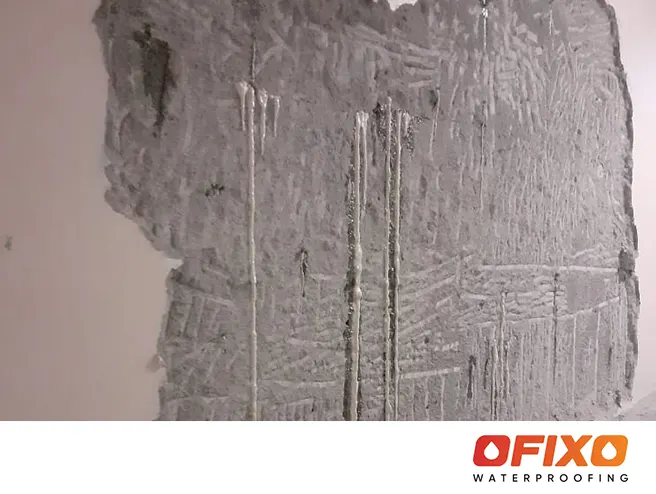
Live leakage injection is a specialist waterproofing method that uses polyurethane resin, injected under pressure into cracks, joints, and pipe penetrations through small drilled ports, to stop active water leaks without needing to drain the area, excavate from outside, or wait for the substrate to dry. The resin reacts with water on contact – that’s what makes it the only method that works on actively-flowing leaks.
Used as the emergency-response companion to conventional waterproofing systems: when a basement floods, a lift pit fills, a water tank cracks, or a roof leak appears that can’t wait for the dry season. Injection stops the leak permanently – the cured resin becomes part of the structure. Often the only viable solution when excavation is impossible (live buildings, occupied tenancies, paved-over foundations).
Why It Matters
Four Reasons Injection Is the Right Call.
Conventional waterproofing systems all share one requirement: a dry, accessible substrate. Injection is the only method that works when that’s impossible – making it the emergency-response specialty across our entire waterproofing portfolio.
Works on Active Leaks
The PU resin reacts chemically with water on contact – actually using the leak’s water to trigger expansion or curing. The only waterproofing method designed to work on a wet, flowing substrate.
No Excavation Required
Treatment is applied from inside (the negative side) through small drilled ports. No need to dig up the foundation, demolish the basement floor, or shut down the building.
Immediate Result
The leak typically stops within minutes of the resin reaching the void. Verifiable on-site – no waiting for cure cycles before knowing if it worked.
Permanent, Not Patch
The cured resin becomes a permanent part of the structure – bonded to the concrete substrate, flexible enough to handle structural movement. Not a temporary sealant fix.
The Technical Choice
Hydrophilic vs Hydrophobic – The Choice That Decides Success.
Polyurethane injection resins come in two fundamentally different chemistries. Choosing the right one for the leak you’re treating is the single most important technical decision in the whole process.
Hydrophilic PU Resin
Type A · Water-loving · FlexibleReacts with water to form a flexible, rubber-like gel that EXPANDS up to 8× its volume. Penetrates hairline cracks (0.1mm+) because it’s water-thin before curing. The default choice for damp substrates, hairline cracks, and joints that need ongoing movement tolerance.
- Hairline cracks under 1mm wide
- Damp substrates with continuous seepage
- Construction joints requiring flexibility
- Negative-side basement wall leaks
Hydrophobic PU Resin
Type B · Water-repelling · RigidReacts with water to form a rigid, closed-cell foam that physically blocks the water path. Higher pressure resistance than hydrophilic resin. The default choice for high-flow leaks, active gushing water, and substrates where rigidity is needed over flexibility.
- High-flow active leaks (gushing water)
- Larger cracks (1mm+)
- Lift pit floods and tank leaks
- Permanent rigid sealing
We carry both resin types on every emergency response and choose on-site based on the leak we find. Often the right answer is a combination: hydrophobic to stop the flow, hydrophilic to seal the surrounding hairlines.
When to Call Us
Six Scenarios Where Injection Is the Right Call.
These are the situations where conventional waterproofing fails – and injection becomes the only viable option. If you recognise any of these, injection is probably what you need.
Basement Wall Leaks
Active water seepage through basement walls or slabs – typically through hairline cracks at construction joints or rebar penetrations. Injected from inside, no excavation needed.
Lift Pit Floods
Active flooding in lift pits where the pit can’t be drained for conventional waterproofing – typical for live buildings where the lift can only be offline briefly.
Water Tank Cracks
Active leaks from concrete water tanks or pool shells where draining the tank for re-lining would mean weeks without water supply. Injection stops the leak from outside.
Construction Joint Failure
Active leaks at cold joints between separately-cast concrete pours – particularly common in basement walls, retaining walls, and below-grade slabs.
Pipe Penetration Leaks
Water entering around pipe and conduit penetrations through walls or slabs – where the original sealing collar has failed and water is actively passing through.
Façade Crack Leaks
Active water ingress through cracks in concrete façade panels, parapet walls, or expansion joints on tall buildings where external rope access is needed for traditional repair.
Our Buyers
Four Buyer Types We Mobilise For.
Injection is rarely a planned project – it’s almost always a response to an active leak someone needs stopped fast. The buyers reflect that urgency.
Facility Managers
FM teams across Dubai towers and commercial buildings – calling us when an active leak has appeared overnight and the building can’t wait for a scheduled refurbishment cycle.
Main Contractors
Construction contractors during defects liability period – calling us when a leak has been reported by the client and needs to be fixed within the warranty obligation.
Building Owners
Villa and apartment owners with active basement, bathroom, or water tank leaks – calling us when conventional waterproofing isn’t viable due to access constraints.
Other Waterproofing Contractors
Other contractors who don’t carry injection capability in-house – subcontracting us for the injection scope while they handle surrounding waterproofing work.
Step by Step
Our 6-Step Injection Process.
From the first site inspection to the final flood-test verification – every injection job follows the same disciplined sequence. Typical jobs complete in 4–8 hours on-site.
-
01
Site Inspection & Leak Mapping
Locate every active leak source – visual inspection, moisture meter readings, and dye-testing where the leak path isn’t obvious. Map every crack and joint that needs treatment.
-
02
Drill Injection Ports
Drill small-diameter (typically 10–14mm) angled ports at 30° to the substrate, spaced 200–300mm apart along each crack. The angled drilling intersects the crack at depth.
-
03
Install Packers
Insert mechanical packers (zerk-fit injection nipples) into each port. Tighten to seal the packer against the substrate – this is what allows pressurised injection without back-flow.
-
04
Choose Resin Type
Assess the leak: hydrophilic for damp/hairline conditions, hydrophobic for active high-flow leaks. Often a combination – hydrophobic first to stop flow, hydrophilic to seal hairlines.
-
05
Pressure Inject Resin
Pump resin into each packer at 60–200 bar pressure. Watch for resin emerging from adjacent ports – that confirms continuous fill. Continue until back-pressure indicates the void is sealed.
-
06
Remove Packers & Test
After cure time (typically 30–60 minutes), remove packers and patch the ports with cementitious mortar. Verify leak has stopped by visual inspection over 24 hours.
Why Ofixotech
Six Reasons Dubai Calls Ofixotech First.
Injection is a niche specialty within waterproofing – most contractors don’t carry the equipment, the resins, or the experience. Here’s what makes us the call when an active leak appears.
Same-Day Mobilisation
Active leaks don’t wait. We mobilise to Dubai sites within hours of the call – equipment, resins, and crew arriving on-site to start work the same day.
Both Resin Types Carried
Hydrophilic AND hydrophobic resins on every truck – meaning we can choose the right chemistry on-site after seeing the leak, not commit to one before we know what we’re dealing with.
Specialist Injection Equipment
Two-component injection pumps capable of 200+ bar pressure – the equipment most general contractors don’t own. Required for proper resin penetration into hairline cracks.
Works With Other Contractors
We act as a specialist subcontractor for other waterproofing companies and main contractors – handling just the injection scope while you handle surrounding works. No competition, only collaboration.
Live-Building Access
Experienced working in occupied buildings, active basements, and operational facilities. We minimise disruption to tenants, operations, and surrounding works.
Documented Warranty
Manufacturer product warranties on cured resin (typically 10+ years) plus our written workmanship guarantee – documented at handover for insurance claims and FM records.
Active Leak You Need Stopped Today?
Same-day mobilisation across Dubai. Call us and we'll inspect the leak, identify the right resin, and stop the flow – typically within hours.
or WhatsApp +971 55 770 5568
Answered
Live Leakage Injection FAQs.
The questions Dubai facility managers, building owners, and contractors ask most about polyurethane resin injection.
What is polyurethane (PU) resin injection for leaks?
Polyurethane resin injection is a specialist technique for sealing active water leaks through concrete cracks, construction joints, and pipe penetrations – even while water is still flowing. A low-viscosity resin is pumped under pressure through packers drilled along the leak path. On contact with moisture it reacts in seconds, expanding into a flexible foam that bonds to the substrate and chokes off the water flow.
It is the go-to system for stopping live leaks where excavation or surface waterproofing is impractical – basements, tunnels, lift pits, water tanks, and below-grade slabs across Dubai.
How quickly can you stop a leak that is already flowing?
For a typical crack or joint leak, sealing is achieved within minutes of the first injection – reaction time of hydrophobic PU resin against water is 30 to 90 seconds. A full repair on a single defect, including drilling packers, injection, and observation, is usually finished the same day.
For emergency mobilisation we aim to be on site within 24 hours of your call across Dubai and the wider UAE, with our injection rig and resin stocks travel-ready.
Hydrophilic vs hydrophobic PU – which one do you use?
Both, depending on the defect. Hydrophobic PU reacts with water to form a closed-cell foam that aggressively expels water from the crack and bonds permanently. It is the right choice for active leaks under hydrostatic pressure – basement walls, tunnels, water tanks.
Hydrophilic PU reacts to form an elastic gel that absorbs moisture and stays flexible. It is preferred for joints with on-going movement, where a rigid foam would crack under cycling. Our crews carry both resin families and switch on site based on the actual leak behaviour.
Where is live leakage injection most commonly used in Dubai?
The five recurring application zones across UAE projects are:
- Basement walls and slabs with active groundwater ingress
- Lift pits sitting below the water table
- Below-ground concrete water tanks (potable and fire-reserve)
- Tunnels, service ducts, and infrastructure shafts
- Annular gap leaks around pipe and cable penetrations through retaining walls
We also inject construction-joint leaks in podium decks and around expansion joints in older buildings where the original waterstop has failed.
How long does a PU injection repair last?
When the right resin is matched to the defect, the repair is permanent for the design life of the structure. The cured PU foam is chemically stable, resistant to ageing, and unaffected by the wet-dry cycling typical of below-grade structures. Independent test data shows minimal property loss after decades of service.
We back our injection work with a documented workmanship warranty – re-injection at no cost if the same defect re-leaks within the warranty period, subject to no new structural movement or independent damage to the substrate.
Can you inject while the building is occupied and services are running?
Yes. PU injection is one of the few waterproofing techniques that can be carried out without taking the structure out of service. There is no excavation, no demolition, no torch work, and no solvent fumes. Our crews coordinate with your facilities team to phase the work around occupancy and live mechanical / electrical services.
For lift pits and plant rooms we stage injection around the building owner’s maintenance windows. For occupied basements and parking levels we work in zones with full isolation barriers and clear signage – minimum disruption to tenants.
What does live leakage injection cost in Dubai?
Pricing is by linear metre of leak path or by defect (packer count, resin volume), not by area. For a typical single-crack basement leak, expect a fixed quote in the AED 1,500 to AED 4,500 range once we have inspected the defect. Larger projects (multi-room basements, full lift-pit treatment, distributed cracking) are scoped on a measured-rate basis after a free site survey.
We do not charge a call-out fee for the inspection. The quote you receive is fixed, itemised by defect, and includes the workmanship warranty.
What preparation work is needed before the injection?
Very little, which is why injection is such a cost-effective fix. Our crews mark the leak path, drill packers at a 45-degree angle through the crack at staggered intervals (typically 150-300 mm centres), and clean the holes. No surface coatings, no scaffolding, no excavation. The drill marks are routed and filled with cementitious mortar after injection so the finished surface stays clean.
For visible architectural surfaces we can also colour-match the patch mortar to the existing concrete or paint finish on request.