
Fibre Reinforced Polymer Specialists · Dubai
CFRP Wrapping – Carbon Fibre Reinforced Polymer for Concrete Strengthening.
Specialist CFRP strengthening across Dubai – externally-bonded carbon fibre fabric or pre-cured plates that add tensile capacity to existing concrete beams, columns, slabs, and walls. Up to 10× the tensile strength of steel at one-fifth the weight, applied without reducing headroom or adding seismic mass. The default strengthening scope when consultants need capacity without geometry change.
- 10× tensile strength of steel
- 1/5 the weight
- Zero headroom impact
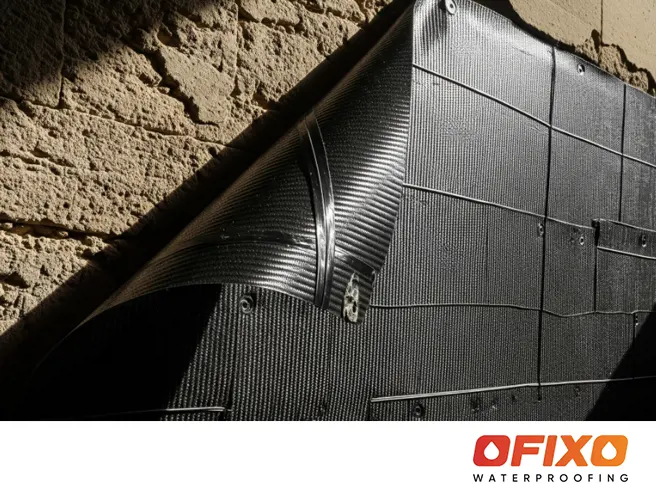
Externally-Bonded Reinforcement
What is CFRP Wrapping?
CFRP (Carbon Fibre Reinforced Polymer) wrapping is the externally-bonded application of unidirectional or bi-directional carbon fibre fabric – or pre-cured carbon fibre plates – to existing concrete members. Saturated with high-strength epoxy resin, the cured laminate becomes a permanent external reinforcement that takes tensile load in concert with the existing rebar.
Carbon fibre has roughly 10× the tensile strength of structural steel at one-fifth the weight – making it the default strengthening specification for Dubai high-rises, parking structures, and infrastructure where engineers need significant capacity addition without headroom penalty, dead load increase, or geometry change. Engineered by your structural consultant per ACI 440.2R; executed by our specialist team with manufacturer-backed product systems.
The Engineering Case
Four Reasons CFRP Wins the Specification.
Steel plate bonding, RC jacketing, and CFRP all add structural capacity. CFRP wins on most Dubai projects for four specific reasons engineers cite at specification stage.
Zero Dimensional Impact
CFRP laminate is 1–3mm thick. Adds no measurable thickness to the member, doesn’t reduce headroom, doesn’t change architectural appearance once finished. Critical for occupied buildings where dimensional change isn’t viable.
Zero Seismic Mass
Carbon fibre weighs ~1.6 g/cm³ vs steel at 7.85 g/cm³. The added strengthening doesn’t increase the building’s seismic mass – important for seismic-sensitive projects where steel jackets would adversely affect dynamic behaviour.
Corrosion-Proof
Carbon fibre doesn’t corrode. Unlike steel plate bonding or supplementary rebar, CFRP remains effective in chloride-laden coastal Dubai exposure without the long-term degradation that affects steel-based strengthening.
Fast, Low-Disruption Install
Fabric is lightweight, manually applied, requires no heavy lifting equipment. A single beam strengthening package: 1–2 weeks including cure. Suitable for live buildings with limited access windows.
Technical Breadth
Four Distinct CFRP Strengthening Applications.
CFRP isn’t one solution – it’s a portfolio of strengthening interventions. The application drives the fabric orientation, layer count, and termination details. Engineers specify per the design deficiency.
Application 1 · Beams · Slabs · Tension Face
Flexural Strengthening
Unidirectional CFRP fabric or pre-cured plate bonded to the tension face of beams and slabs – increasing bending moment capacity. The most common CFRP application in Dubai, used when changes of use or design deficiencies require higher bending capacity.
Application 2 · Beams · Webs · U-Wrap
Shear Strengthening
CFRP fabric applied to beam webs in U-wrap or full wrap configuration – increasing shear capacity at supports and discontinuities. Specified when shear demand exceeds shear capacity due to load increase or stirrup deficiency.
Application 3 · Circular · Rectangular · Ductility
Column Confinement
Continuous CFRP wrap around columns – confining the concrete core, increasing both axial capacity and ductility (critical for seismic retrofit). Multi-layer wraps for higher confinement; pre-formed shells for rectangular columns.
Application 4 · Flat Slabs · Column Heads
Slab Punching Shear
Targeted CFRP application around column heads on flat slab construction – addressing punching shear deficiency, a common code-upgrade requirement when slab thickness can’t be increased. Often specified for car parks and slab refurbishments.
The Technical Decision
When CFRP Wins. When Steel Plate Wins.
Both systems add structural capacity through externally-bonded reinforcement. Both use epoxy adhesives. Both work. The decision between them comes down to four specific criteria that engineers evaluate at design stage.
Carbon Fibre Wrapping
Lightweight · Corrosion-proof · This page
External carbon fibre reinforcement with 10× the tensile strength of steel at one-fifth the weight. Corrosion-proof, dimensionally neutral, fast install. The default specification for most Dubai strengthening scopes.
- Capacity addition without geometry change
- Corrosive exposure (coastal, marine, chemical)
- Seismic-sensitive structures
- Occupied buildings with access constraints
Steel Plate Bonding & Jacketing
Heavy-end · Compressive · Different service
Steel plates epoxy-bonded to concrete or mechanically anchored, plus full RC or steel jackets around columns. Higher modulus than CFRP, lower cost per strength unit, suitable for compressive scenarios.
- Very high capacity addition required
- Compressive strengthening (column jackets)
- Cost-driven specifications
- Non-corrosive interior environments
Most strengthening projects use CFRP – it wins on weight, corrosion, headroom, and install speed. Steel plate enters scope only on heavy-load, compressive, or cost-driven specifications. We deliver both; engineers specify based on actual demand.
Step by Step
Our 6-Step CFRP Installation Process.
Bond is everything in CFRP. Six steps from substrate survey to verified pull-off – every step witnessed, every product traceable to manufacturer batch.
-
01
Substrate Survey & Repair
Survey member to identify any existing damage requiring repair before CFRP (corrosion, spalling, cracks). Coordinate with Concrete Restoration team where present. Substrate must be sound before bonding.
-
02
Surface Preparation
Diamond grinding or sandblasting to remove laitance, lifting roughness profile per manufacturer spec (typically CSP-3 to CSP-5). Round corners on columns/edges to minimum 25mm radius. Dust extraction throughout.
-
03
Primer Application
Apply two-component epoxy primer to prepared substrate – penetrates the concrete pore structure and creates the chemical bond layer. Strict moisture and temperature control (below 80% RH, substrate temp 10°C–35°C).
-
04
Saturant & Fabric Application
Apply saturating epoxy resin (first coat). Place CFRP fabric in design orientation, work into resin with grooved roller to expel air and ensure full wet-out. Apply second saturant coat. Multiple layers if specified.
-
05
Cure & Pull-Off Testing
Allow 72-hour cure to design strength. Conduct pull-off bond testing per ACI 440.2R (typically 1.4 N/mm² minimum pull-off strength for cohesive failure in concrete). Witness with consultant where required.
-
06
Protection & Handover
Apply protective topcoat – UV-resistant for exposed locations, intumescent for fire-rated members. Full handover documentation: design drawings, batch records, installation logs, pull-off test results, photographs, warranty pack.
Why Ofixotech
Six Reasons Engineers Specify Ofixotech for CFRP.
CFRP scope is unforgiving on bond quality – get the prep or saturation wrong and the laminate debonds within months. Here’s why we’re the specialist execution partner for CFRP across Dubai.
Trained CFRP Installers
Dedicated FRP application crews – not generalists doing it between concrete jobs. Manufacturer-trained on Sika CarboDur, BASF MBrace, Fosroc Nitowrap, and Mapei FRP systems. Skill drives bond quality.
Manufacturer Partnerships
Sika, BASF, Fosroc, Mapei – direct relationships with the FRP manufacturers, including technical witnessing on critical projects. Datasheets, batch records, warranty backing on every installation.
Pull-Off Testing Capability
On-site pull-off bond testers calibrated per ACI 440. We don’t just install – we verify, document, and provide the test results that consultants need for design sign-off.
ACI 440 Compliance
ACI 440.2R (design and construction of externally bonded FRP systems for strengthening concrete structures) applied throughout. Method statements aligned to international standard; documented in handover pack.
Environmental Control
Substrate temperature monitoring, humidity control, surface moisture verification before bonding – the variables most installations skip and the variables that determine 25-year bond performance.
Documented Warranty
Manufacturer product warranty (typically 10–25 years on cured FRP systems) plus our written workmanship guarantee (typically 2 years on installation). Combined warranty pack at handover for asset register.
CFRP Strengthening on Your Project?
Share your structural drawings or consultant's design intent – we'll review, provide constructability input, and quote within 48 hours.
or WhatsApp +971 55 770 5568
Answered
CFRP Wrapping FAQs.
The questions structural consultants and engineering teams ask most about CFRP strengthening in Dubai.
Should I specify CFRP or steel plate bonding?
Default to CFRP unless you have a specific reason for steel. CFRP wins on weight (1/5 of steel), corrosion resistance (carbon doesn’t corrode), dimensional impact (1-3mm vs 8-12mm typical for steel plates), and seismic mass. Steel plate enters scope when (a) very high capacity addition is required beyond CFRP’s economic range, (b) the strengthening is in pure compression, or (c) the project is cost-driven and the environment is non-corrosive. For most Dubai high-rise, infrastructure, and refurbishment work, CFRP is the answer. See our Steel Plate Bonding page for the alternative.
What standards govern CFRP design and installation?
ACI 440.2R (design and construction of externally bonded FRP systems for strengthening concrete structures) is the global reference, applied throughout the UAE. ICRI Guideline 03742 covers FRP-strengthening of concrete. ICRI 03739 covers surface preparation for FRP. Project-specific requirements from Dubai Municipality and the consulting engineer’s specification take precedence. Manufacturer installation method statements always followed.
How is the bond verified?
Pull-off bond testing per ACI 440.2R – typically a minimum 1.4 N/mm² pull-off strength with cohesive failure mode (failure in the concrete, not at the bond line). Tests conducted at quality hold points and witnessed by the consulting engineer where the specification requires. Results documented in handover pack with batch records and photographs.
What manufacturers do you use?
Sika CarboDur and Sikawrap, BASF MBrace, Fosroc Nitowrap, Mapei FRP Carboplate / Carbofib, and Toray UT (where specified). Direct manufacturer relationships for technical witnessing, batch records, and warranty support. Specific product selection depends on the consultant’s design and the project requirements.
How long does cure take?
Initial cure: 24 hours to handle. Working cure: 48-72 hours. Full design strength: 7 days at 20°C. Cure time accelerates at higher temperatures (typical Dubai ambient gives 5-7 day cure). Pull-off testing typically at 7 days. Programme integration usually treats cure as the critical path; subsequent trades pre-planned around cure window.
Can CFRP be installed in occupied buildings?
Yes – most CFRP work happens in live buildings. Low-noise, low-dust process compared to most strengthening alternatives. Surface preparation (diamond grinding) is the noisiest step; resin application is quiet. Coordinate with FM on access windows; protect surrounding finishes from epoxy splashes. Dubai operational sites: most CFRP scopes complete within standard 8AM-6PM access.
What’s the service life of CFRP?
Design service life typically 50+ years in protected interior environments; 25-50 years in exposed exterior environments with appropriate UV-protective topcoat. The carbon fibre itself doesn’t degrade; the limiting factor is the epoxy adhesive’s long-term durability under UV exposure and thermal cycling. UV-resistant topcoats extend exterior service life substantially.
What’s the typical cost vs steel jacketing or new construction?
CFRP typically costs 30-60% of the equivalent steel jacketing scope, and a small fraction (5-15%) of demolishing-and-replacing the member. The economic case is dramatic when downtime cost is factored: CFRP can complete in days where new construction would require months. Project-specific quotes provided after structural drawings review.