
For Engineers & Contractors · Dubai & UAE
PU Injection – Polyurethane Resin Systems for Crack Repair and Water-Stop.
Specialist polyurethane resin injection for engineers, structural consultants, and main contractors specifying water-stop, crack injection, curtain grouting, and concrete consolidation work across Dubai projects. Both hydrophilic and hydrophobic resin chemistries supplied – pressure-injected through purpose-drilled ports at 60–200 bar. Specification support, method statements, and certification documentation available for tender submissions.
- 60–200 bar injection
- 0.1mm crack penetration
- Method statements supplied
Technical Reference
What is PU Injection?
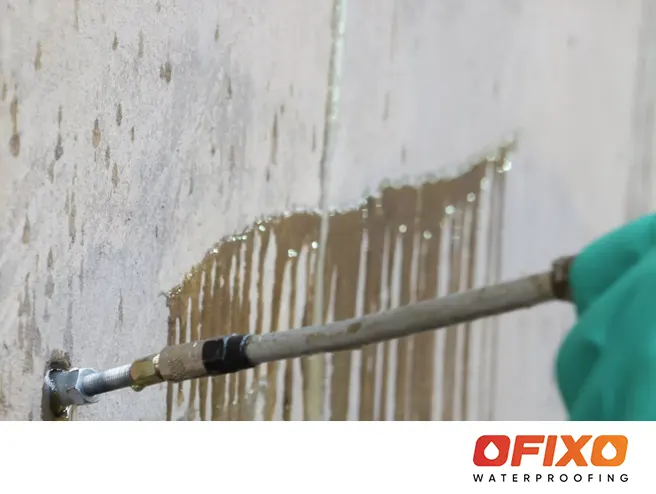
PU (polyurethane) injection is a technical specialist method for sealing cracks, joints, and voids in concrete structures by pressure-injecting reactive polyurethane resin through purpose-drilled ports. The resin reacts on contact with substrate moisture – either forming a flexible swelling gel (hydrophilic chemistry) or a rigid closed-cell foam (hydrophobic chemistry) – sealing the void permanently.
Used across six application categories – water-stop, crack injection, curtain grouting, concrete consolidation, joint sealing, and soil stabilisation. Specified by structural consultants and engineers in below-grade structures, infrastructure repair, and remedial waterproofing scopes. For active leak response specifically, see our Live Leakage Injection page – same chemistry, consumer-facing positioning.
vs Other Injection Methods
Four Reasons Engineers Specify PU.
Injection grouting includes polyurethane, epoxy, acrylic, and cementitious systems – each with different applications. Here’s why PU is the default specification for waterproofing-related injection across Dubai projects.
Works on Wet Substrates
Unlike epoxy injection (which requires bone-dry conditions), PU reacts WITH water – making it the only system that works on damp or actively-leaking substrates. Critical for below-grade and active-leak scenarios.
Penetrates Hairline Cracks
Low-viscosity PU resins (200–400 mPa·s pre-mix) penetrate cracks as fine as 0.1mm – finer than epoxy can typically reach. The high pressure (60–200 bar) drives the resin through micro-fissures.
Flexible OR Rigid
Two chemistries give specifiers a choice: hydrophilic (flexible gel for movement-active joints) or hydrophobic (rigid foam for high-flow water-stop). Spec the right one for the loading profile.
Fast Cure, Same-Day Verification
Cure times of 30–60 minutes mean the leak-stop or crack-seal can be verified on the same site visit. No 7-day cementitious cure delays the rest of the construction programme.
Technical Applications
PU Injection Covers Far More Than Active Leak Repair.
While active water-stop is the most familiar use case, PU injection is specified across six distinct application categories – each with its own resin grade, port spacing, and pressure profile.
Water Stop Injection
Stopping active water flow through cracks, joints, and pipe penetrations. The emergency-response application – typically hydrophobic resin for high-flow leaks, hydrophilic for hairline seepage.
Structural Crack Injection
Filling and sealing structural cracks in concrete elements – not necessarily waterproofing. Hydrophilic PU bonds across the crack, restoring monolithic behaviour and preventing further widening.
Curtain Grouting
External soil-side injection from inside the structure, forming a curtain of cured resin in the soil behind a basement wall. Used when external excavation is impossible.
Concrete Consolidation
Filling voids and honeycombing in poorly-compacted concrete – restores structural integrity by displacing trapped air and bonding loose aggregate. Common remedial scope for defects discovered post-strip.
Construction Joint Sealing
Sealing cold joints between separately-cast concrete elements – particularly common in basement walls, retaining walls, and below-grade slabs where the original waterstop has failed.
Soil Stabilisation
Stabilising loose or water-saturated soil beneath foundations or around excavations – the resin permeates soil voids and cures to consolidate the soil mass.
Spec Sheet
PU Injection Resin Technical Specifications.
The properties engineers need for tender specification, method statement preparation, and authority submittal. Indicative typical values – actual product datasheets supplied per project.
| Property | Hydrophilic PU | Hydrophobic PU | Test Method |
|---|---|---|---|
| Resin chemistry | Single-component PU | Single-component PU | – |
| Reaction with water | Forms flexible gel | Forms rigid closed-cell foam | On-site observation |
| Volume expansion | Up to 8× volume | 20–40× volume | Manufacturer’s data |
| Viscosity (pre-mix, 25°C) | 200–400 mPa·s | 100–300 mPa·s | ASTM D2196 |
| Min. crack penetration | ≥0.1mm | ≥0.3mm | Field demonstration |
| Injection pressure | 60–150 bar typical | 100–200 bar typical | Equipment gauge |
| Cure time (initial) | 2–4 minutes | 30–60 seconds | Manufacturer’s data |
| Cure time (full) | 30–60 minutes | 30–45 minutes | Manufacturer’s data |
| Service temperature | −20°C to +80°C | −20°C to +90°C | Manufacturer’s data |
| Elongation at break | 300–600% | ≤5% (rigid) | ASTM D412 |
| Service life (sealed) | 10–25 years typical | 10–25 years typical | Manufacturer’s data |
Datasheet values are indicative – exact properties depend on the specific manufacturer and product grade selected per project. Full manufacturer datasheets and method statements supplied on tender request.
Product Families
Hydrophilic vs Hydrophobic – Choose by Loading Profile.
Both chemistries are pressure-injected through the same equipment, drilled through the same ports. The choice depends on whether the joint or crack will continue to move after sealing, and on the water flow you’re trying to stop.
Hydrophilic PU
Flexible gel · Movement-tolerantSpec when the joint will continue to move post-cure – thermal cycling, settlement, or vibration. Default for joint sealing, hairline crack repair on movement-prone elements, and substrates that need ongoing flex tolerance.
Hydrophobic PU
Rigid foam · Pressure-resistantSpec when the goal is to permanently block water flow with maximum pressure resistance. Default for active high-flow leak response, water-stop work, and rigid structural infill where post-cure flex is not required.
Method Statement
Six-Stage PU Injection Method.
Standard method sequence for PU injection work – adapted to the specific application and substrate per project. Full method statement and risk assessment available on request for tender submissions.
-
01
Substrate Survey
Visual and instrument-aided survey to identify cracks, joints, and voids requiring injection. Mark all treatment areas. Confirm substrate suitability and any concurrent works requiring coordination.
-
02
Port Drilling
Drill injection ports (typically Ø10–14mm) at 30–45° angles, spaced 200–300mm apart along the crack line. Angle and spacing calculated to intersect the crack at design depth.
-
03
Packer Installation
Install mechanical zerk-fit packers in each drilled port. Tighten to seal the packer against the substrate – packers retain injection pressure without back-flow.
-
04
Resin Selection
Confirm resin chemistry (hydrophilic / hydrophobic) per the design specification and on-site conditions. Prime injection equipment with selected product.
-
05
Pressure Injection
Pump resin via two-component injection pump at 60–200 bar working pressure. Observe resin emergence at adjacent ports to verify continuous fill. Continue until back-pressure indicates void is filled.
-
06
Cure & Make Good
Allow 30–60 minutes initial cure. Remove packers and patch ports with non-shrink cementitious mortar. Document the work photographically and provide handover including warranty paperwork.
Why Ofixotech
Six Reasons Engineers Specify Ofixotech.
PU injection is a specialist scope most contractors subcontract. Here’s why we’re the right specialist subcontractor for engineers and consultants writing the specification.
Specification Support
We help structural consultants select the right resin grade, pressure profile, and port spacing before the spec is finalised – saving redesign cycles during construction.
Two-Component Pumps
Specialist 200+ bar plural-component injection equipment – the kit most general contractors don’t own. Required for proper resin penetration into hairline cracks.
Both Resin Families
Hydrophilic AND hydrophobic resins always carried – site selection per the actual condition encountered, not committed before mobilising.
Subcontractor-Friendly
We work as a specialist sub for main contractors and waterproofing companies – no competition for the broader scope, just clean delivery of the injection package.
Tender Documentation
Method statements, risk assessments, manufacturer datasheets, insurance certificates, and sample warranty wording supplied for tender submissions within 24 hours.
Programme-Aligned
We mobilise to your construction or remediation programme – same-day site visits, defined work windows, and clear handback so the next trade can proceed.
Specifying PU Injection on a Project?
Request the full specification pack – datasheets, method statements, risk assessments, and pricing – typically within 24 hours of enquiry.
or WhatsApp +971 55 770 5568
Answered
PU Injection Technical FAQs.
The technical questions engineers, structural consultants, and contractors ask most about specifying PU injection on Dubai projects.
What types of PU injection systems do you specify, and how do they differ?
Four polyurethane families cover almost every PU injection scope on Dubai projects:
- Single-component hydrophobic PU foam – water-reactive, expands up to 40× volume, used to choke off live leaks under hydrostatic pressure.
- Single-component hydrophilic PU gel – elastic, swells on water contact, used in moving joints and cyclic cracks where rigid resin would re-fracture.
- Two-component rigid PU resin – high-modulus, semi-rigid, used for soil stabilisation and void/honeycomb filling where load transfer matters.
- Two-component flexible PU resin – used for curtain injection behind retaining walls to form a continuous waterproof barrier in the soil.
Most projects use two or three of these families together. Selection per defect is driven by water activity, movement, and structural intent.
What hydrostatic pressure can PU injection systems withstand?
The resin systems we specify carry independent test data up to 30 bar hydrostatic resistance – well in excess of any below-grade Dubai head condition (a 30 m water column is approximately 3 bar). For specifier reference the typical performance band is:
- Hydrophobic foam: 30 bar tested resistance, in-situ design typically rated to 10-15 bar for warranty work
- Hydrophilic gel: 5-10 bar, design typically rated to 5 bar with mechanical packers backing the resin
- Two-component rigid resin: full structural transfer; pressure is not the design driver
For any application above 5 bar continuous head (deep basements, water tanks, lift pits below the table) we always specify hydrophobic foam as the primary system.
Which standards do your PU systems carry, and how should they be referenced in the spec?
Each resin family carries the standards relevant to its application:
- EN 1504-5 – the umbrella standard for concrete injection products. Every PU resin we specify carries CE marking under this standard.
- ETAG 005 – European Technical Approval for liquid-applied waterproofing kits, referenced for curtain-injection schemes.
- WRAS (UK) / NSF 61 (US) – for potable-water contact applications. Variant-specific – request the exact compliance certificate per product, as not every member of a family is potable-rated.
- ISO 9001 – manufacturer quality system.
In the specification, reference the standard rather than the brand – it gives you tender flexibility while protecting the performance baseline.
Can PU injection be used inside potable water tanks?
Yes, but the resin must be the potable-rated variant – hydrophobic foam carrying WRAS or NSF 61 certification specifically for contact with drinking water. The generic hydrophobic foam used for basement walls is NOT automatically food-grade and should not be specified for potable applications without the certificate.
The injection technique is the same. The difference is in the procurement: the spec must call out potable-grade resin explicitly and the contractor must supply the per-batch certificate at the time of work. We handle both certified and non-certified work and treat them as separate scopes for traceability.
What is the long-term durability of injected PU – 10, 20, 30 years out?
Independent ageing studies on hydrophobic PU foam show minimal loss of sealing performance over 30+ years in below-grade service. The resin is chemically stable in alkaline concrete pore water, resistant to typical groundwater salts and chlorides, and unaffected by the wet-dry cycling that plagues some membrane systems.
The known failure modes are not durability-related – they are spec-related: rigid epoxy / rigid PU used on a moving crack will re-fracture. Hydrophilic gel allowed to dry out completely (no further water contact) will eventually shrink. Both are matters of correct material selection at design stage, not material ageing.
How does PU injection interact with adjacent waterproofing materials – membrane, PVC waterstop, bitumen?
Compatibility matrix for the materials commonly adjacent to injection scope on Dubai projects:
- Bituminous membranes (APP / SBS) – fully compatible. PU injects behind existing bitumen without bond degradation.
- PVC and TPO waterstops – compatible; PU bonds well to clean PVC face.
- Polyethylene (HDPE) – sheet drains, capillary breaks – PU does NOT bond to PE. Specify a primer or mechanical anchor at this interface if continuous bond is required.
- Cementitious crystalline coatings – compatible; can be applied over PU once cure is complete.
- Epoxy coatings – compatible; sequence so PU is fully cured before epoxy overlay.
For the few incompatible interfaces (HDPE primarily) the spec needs a transition detail. We provide that detailing as part of our scope.
What method-statement controls should the engineer require for PU injection work?
Six controls that should appear in any structural PU injection method statement:
- Resin batch certificate (manufacturer’s test data per batch shipped)
- Packer drilling schedule – angle, depth, spacing – with drawing markup
- Injection pressure log per packer (recorded by the technician, signed)
- Resin volume reconciliation – estimated vs. actual per defect
- Through-thickness fill verification (visual bleed observation at far face) for one-sided injection
- 7-day post-injection inspection for any post-cure migration or weeping
We provide all six as standard deliverables in our QA pack – the engineer signs them off before warranty issue.
When is PU injection NOT the right specification – and what is recommended instead?
Three cases where injection is the wrong tool:
- Diffuse moisture migration across a large area – if the entire wall face is damp, not a discrete crack/joint, the issue is permeability not a leak path. Specify a negative-side crystalline or cementitious coating, or rework the positive-side waterproofing.
- Structural deficiency masquerading as a leak – if the crack is the consequence of an inadequate structural detail (under-reinforcement, missing waterstop at construction joint), injection treats the symptom not the cause. Strengthening or detailing rework should run in parallel.
- Large voids and honeycombing – voids above 10 mm are not crack injection scope. Specify a flowable repair grout or epoxy mortar instead.
On any project, we provide this assessment before quoting injection – if the right specification is something else, we say so.