

Most construction specifications used in the UAE were written somewhere else. They originated in European or North American codes, developed for climates where the main enemies are frost, freeze-thaw cycling and persistent rain. Those documents are excellent engineering. They were simply not written for a place where a rooftop reaches 80°C in July, where salt-laden air condenses on every surface overnight, and where a year and a half of rain can arrive in a single afternoon. Closing that gap is precisely the work experienced waterproofing companies in Dubai do every day.
That mismatch is the reason UAE weather building protection has to be treated as a distinct discipline rather than a regional adjustment to standard practice. Buildings here face five environmental stresses simultaneously, and each one accelerates the others.
This guide sets out what those stresses actually do to a structure, why generic specifications underperform in the Emirates, which materials and systems genuinely hold up, and how to build a protection strategy for a property that already exists. It is written for owners, developers, facility managers and consultants who need to understand where their money is best spent.
Five Climate Stresses, Acting at Once
The defining feature of the UAE climate is not any single extreme. It is the combination, and the fact that all five stresses peak in overlapping seasons.
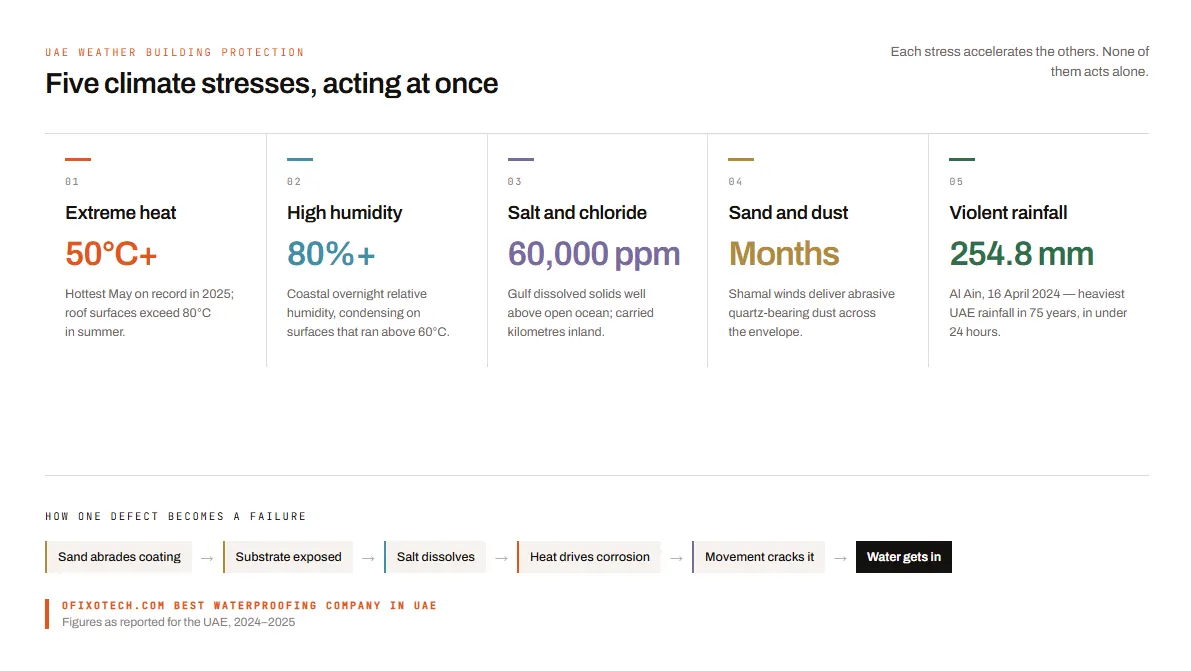
Extreme heat. The UAE recorded its hottest May on record in 2025, with temperatures passing 50°C. The previous month set an April record with a national average daily high of 42.6°C. Climate researchers at Khalifa University have observed that the UAE summer already lasts roughly ten days longer than it once did, with projections pointing toward a summer season stretching to six months.
High humidity. Coastal relative humidity routinely exceeds 80% overnight for much of the year, producing condensation cycles on surfaces that spent the day above 60°C.
Salt and chloride. The Arabian Gulf carries total dissolved solids in the range of 44,000 to 60,000 ppm, well above open ocean levels, and onshore winds carry that chloride several kilometres inland.
Sand and dust. Summer shamal winds deliver months of abrasive quartz-bearing dust across every exposed surface of the building envelope.
Rare but violent rainfall. On 16 April 2024, the UAE recorded its heaviest rainfall in 75 years. Khatm Al Shakla in Al Ain received 254.8 mm in under 24 hours, and Dubai Airport recorded 144 mm, roughly a year and a half of normal rainfall in one day, against a national annual average of only 140 to 200 mm.
Any one of these is manageable in isolation. Together they produce a degradation environment that has no real equivalent in the climates where most standard specifications were developed.
Why Generic Specifications Underperform Here
A material that performs well for thirty years in London can fail in eight in Sharjah, and the reasons are usually predictable.
Service Life Assumptions Do Not Transfer
Manufacturer durability claims are typically derived from temperate testing regimes. A coating rated for a fifteen-year life under moderate UV and thermal cycling may deliver a fraction of that under UAE conditions, because chemical degradation rates roughly double for every 10°C rise in temperature. A membrane that experiences a 40°C daily swing here rather than a 15°C swing elsewhere is doing several times the work.
Thermal Movement Is Larger and Faster
Surface temperatures on dark UAE roofs can exceed 80°C in summer while dropping to 25°C overnight. Every joint, seal and interface has to accommodate that daily cycle, thousands of times over the building’s life. Sealants and movement joints specified for temperate movement ranges split early, and each split becomes a water and chloride pathway. Our guide to how extreme heat affects building structures in Dubai covers the mechanics in detail.
Drainage Is Sized for the Wrong Rainfall Pattern
Because annual rainfall is low, drainage on many UAE buildings is designed conservatively. The problem is that UAE rain does not arrive evenly. It arrives as intense, short-duration events, and a drainage system sized on annual averages is overwhelmed by an event delivering a year’s rain in hours. April 2024 demonstrated this across thousands of buildings simultaneously, with total property damage estimated at between 2.9 and 3.4 billion US dollars.
Degradation Mechanisms Compound
This is the most important point and the most frequently missed. Sand abrades a coating, which exposes the substrate. Humidity dissolves deposited salt into an electrolyte that reaches the exposed substrate. Heat accelerates the resulting electrochemical reaction. Thermal movement cracks the weakened material. The next rain event drives water through the crack.
No single mechanism explains the failure. The building fails because five of them are operating on the same defect at the same time.
Heat: The Stress That Amplifies Every Other One
Heat rarely destroys a building on its own. What it does is accelerate every other degradation process while simultaneously opening the pathways those processes need.
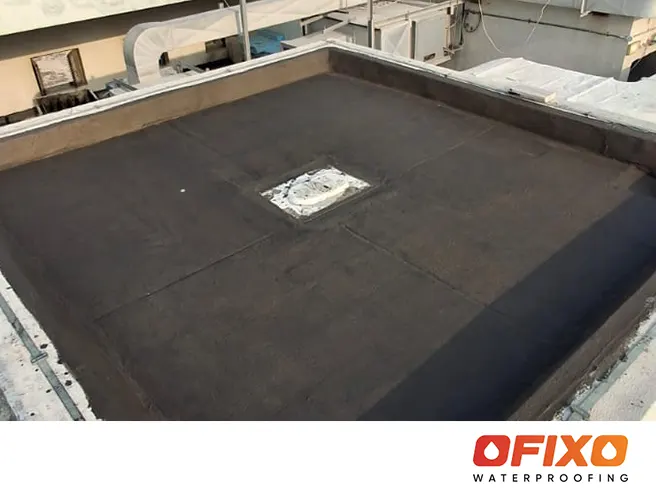
Roof membranes take the worst of it. Bituminous systems oxidise and embrittle under sustained UV and heat, losing flexibility precisely when thermal movement demands the most from them. Selecting the right system for UAE exposure matters more than almost any other envelope decision, which is why our comparison of polyurethane versus bitumen systems and our breakdown of cementitious versus liquid applied membranes are worth reading before specification is locked.
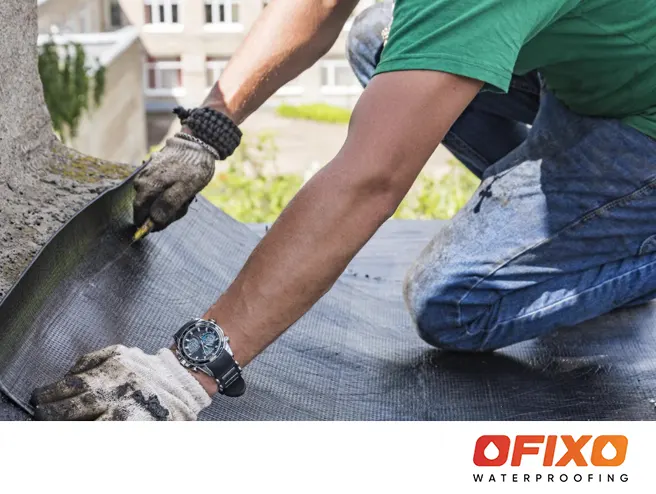
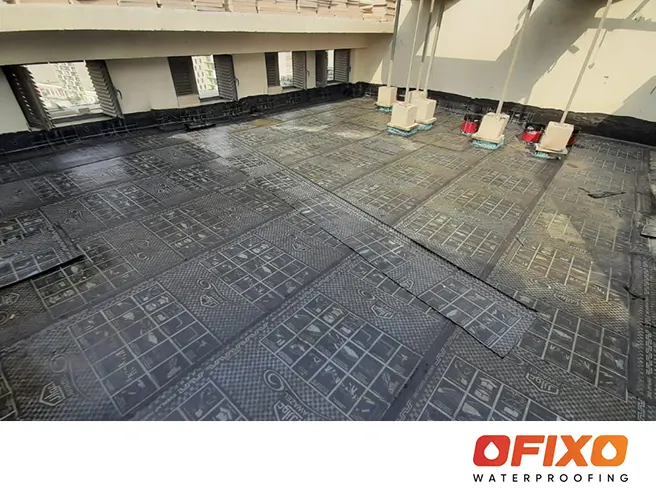
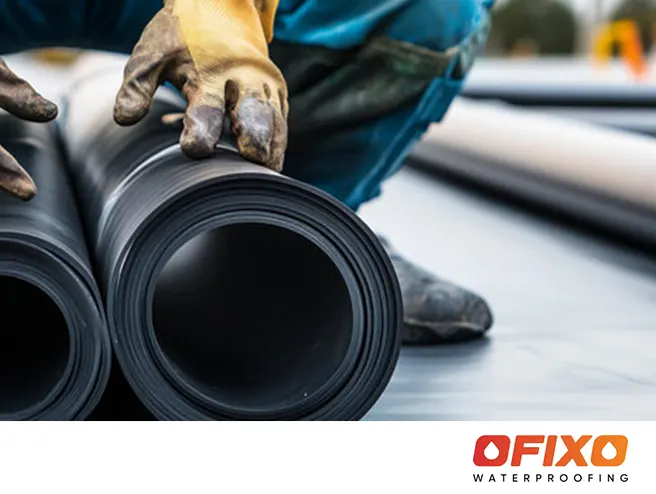
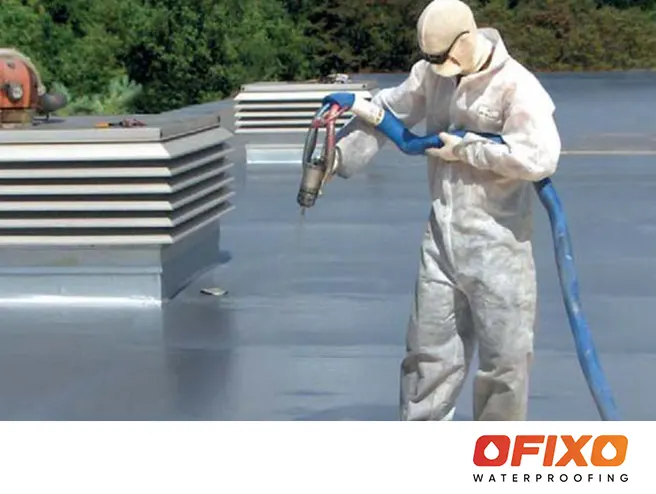
In practice, a properly detailed roof waterproofing build-up for UAE conditions uses heat-stable materials throughout. Reinforced membrane waterproofing handles thermal cycling well, single-ply options such as a TPO waterproofing membrane or a PVC waterproofing membrane offer high reflectivity that reduces surface temperature directly, and EPDM waterproofing retains elasticity across a wide temperature range.
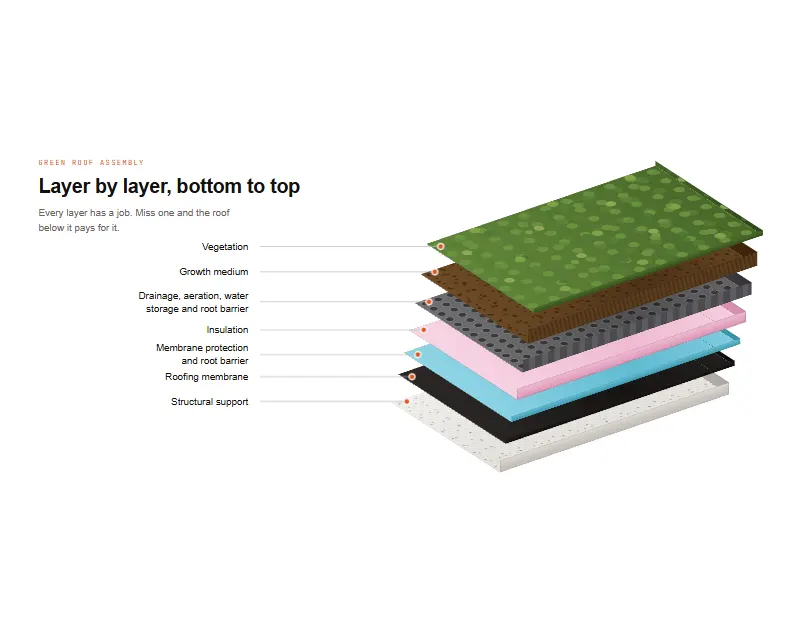
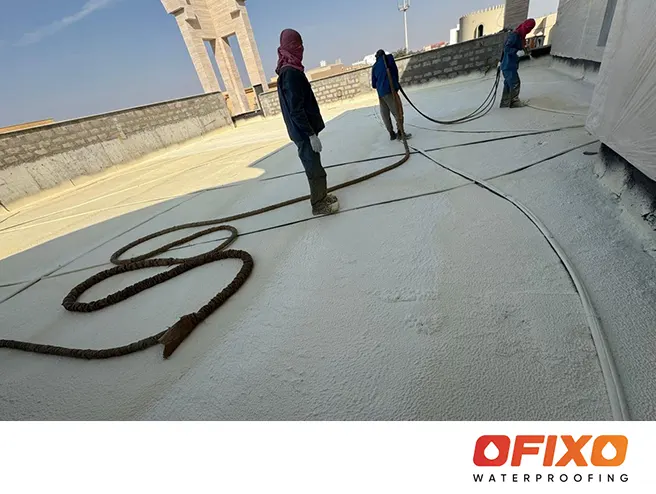
Thermal load can also be reduced rather than merely resisted. Insulation boards such as XPS insulation board in an inverted roof configuration protect the membrane from both temperature extremes and physical damage, while green roof systems shade the waterproofing layer entirely.
Humidity: The Quiet Mechanism
Humidity causes less visible damage than the other stresses and considerably more expensive damage, because most of it happens inside the construction where nobody is looking.
The mechanism is straightforward. Warm, moisture-laden outdoor air meets air-conditioned surfaces and condenses. Interstitial condensation forms inside wall build-ups, above ceilings and around cold bridges such as slab edges and structural penetrations. That moisture supports mould growth, degrades insulation performance, corrodes concealed fixings and delaminates finishes.
In wet areas, the same physics operates continuously. Proper bathroom waterproofing is what stops a slow leak becoming a structural problem two floors down, and where moisture has already migrated into the structure, water leakage injection can seal active paths without demolition.
Because humidity damage is concealed by definition, detection matters. Our guide to hidden moisture detection in UAE buildings explains the diagnostic methods, and our full analysis of humidity impact on UAE properties covers the underlying cycles.
Salt: The Structural Threat
Of the five stresses, chloride attack is the one that eventually threatens structural capacity rather than just serviceability.
Airborne chloride and saline sabkha groundwater penetrate concrete cover, break down the passive layer protecting embedded reinforcement, and start a corrosion process that expands, cracks and spalls the cover concrete. By the time it is visible, it has usually been running for years.
Defence operates on three levels: dense, well-covered concrete that slows ingress; a migrating corrosion inhibitor that protects the steel directly; and surface systems including an anti-carbonation coating and a penetrating acrylic concrete sealer that reduce what reaches the concrete in the first place. Together these form a corrosion protection coating strategy rather than a single product choice.
Below ground, foundation waterproofing and properly detailed basement waterproofing keep saline groundwater out of the structure, with construction joints sealed using a PVC waterstop or a bentonite waterstop strip.
Our dedicated guide to salt air corrosion on UAE coastal properties covers the full mechanism, warning signs and repair sequence.
Sand: Continuous Mechanical Wear
Wind-driven sand functions as low-grade sandblasting applied to the building envelope for months at a time. Quartz is harder than glass, paint, anodised aluminium and every common architectural finish, so the material always loses.
Abrasion strips coating thickness, pits glazing permanently, erodes sealant joints and removes the mineral surfacing from exposed roof membranes. Deposited dust then blocks drainage, silts lift pits and holds moisture against surfaces overnight.
The specification responses are abrasion-resistant coatings such as polyurea waterproofing on high-wear decks, durable joint materials including an MS polymer hybrid sealant, and scheduled clearance of roof gutter systems before and after the shamal season. Our detailed treatment of sandstorm damage to UAE buildings sets out the full picture.
Rainfall: Rare, Sudden and Extremely Expensive
April 2024 forced a reassessment of a long-held assumption in UAE property management, which was that waterproofing and drainage are lower-priority items in a desert climate.
They are not. Low annual rainfall means defects stay hidden for years, because there is no regular rain event to reveal them. When an extreme event does arrive, every one of those latent defects fails at once, across an entire portfolio, on the same afternoon.
Building for this pattern means designing drainage for intensity rather than annual volume, keeping outlets and gutters genuinely clear rather than nominally maintained, and treating below-ground waterproofing as a primary system. It also means maintaining concrete expansion joint integrity, since joints are the first place a sudden hydraulic load finds a way in, and keeping lift pit protection in working order.
Where water has already entered a structure, polyurethane injection and concrete crack injection seal active pathways from within the concrete. Our overview of why waterproofing is essential for Dubai buildings explains why the desert climate argument gets this exactly backwards.
What Climate Resistant Construction Actually Requires
Effective climate resistant construction in the UAE comes down to a manageable set of decisions, most of which cost little at design stage and are expensive or impossible to retrofit.
Concrete Durability
Low water-to-binder ratio, supplementary cementitious materials such as slag or fly ash, generous cover to reinforcement, and proper curing in high ambient temperatures. A crystalline admixture adds integral waterproofing to the mix itself.
Envelope Continuity
A waterproofing system is only as good as its weakest detail. Parapet upstands, drainage outlets, service penetrations and movement joints cause the overwhelming majority of failures, not the field of the membrane. Detailing deserves more attention than product selection.
Materials Rated for Actual Conditions
Specify against measured UAE exposure rather than manufacturer general-purpose ratings. That means high UV stability, wide service temperature range, chloride resistance and mechanical abrasion resistance as explicit criteria. Regional supply also matters, and interest in locally appropriate specification is growing, as covered in our review of sustainable building materials in the UAE.
Accommodating Movement
Design joints for the real thermal range, specify high-movement sealants such as a polyurethane sealant or a weather-resistant silicone sealant at glazing interfaces, and treat joints as maintenance items with a defined replacement cycle rather than permanent construction.
Protection at Floor and Deck Level
Car parks, plant rooms and industrial floors face heat, chloride, dust and vehicle traffic together. A proper car park flooring system protects the structural deck, while industrial epoxy flooring handles the mechanical and chemical load in production environments.
The Regulatory Picture
UAE authorities have progressively formalised climate-appropriate construction, and compliance is no longer optional in the major emirates.
Abu Dhabi introduced the Estidama Pearl Rating System in 2010, the first mandatory sustainability building standard in the region. All new development in the emirate requires a minimum Pearl 1 rating, government-funded buildings require Pearl 2, and the programme has been credited with reducing energy and water consumption by more than 33% against the pre-Estidama baseline.
Dubai Municipality issued its Green Building Regulations and Specifications and subsequently launched the Al Sa’fat rating system, which is administered through the building permit process and is mandatory for new construction in the emirate.
These frameworks focus primarily on energy, water and indoor environmental quality rather than durability. That distinction matters. Meeting Al Sa’fat or Estidama does not by itself guarantee a building will resist chloride, abrasion and thermal cycling over a forty-year life. Durability specification remains a separate discipline that owners need to pursue deliberately.
Protecting a Building That Already Exists
Most UAE property owners are not specifying new construction. They are managing an existing asset that was built to whatever standard applied at the time, and the practical question is what to do now.
Start with a survey, not a product. Establish actual condition across roof, façade, below-ground elements and drainage before spending anything. Our reference on visual signs of structural problems covers what to look for, and our guidance on when expert inspection is needed defines the threshold for specialist involvement. Buyers should work through our pre-purchase inspection checklist before committing.
Fix water first. Every other degradation mechanism depends on moisture. Roof and below-ground waterproofing delivers more protection per dirham than any other intervention.
Address structural damage properly. Where corrosion has reached the point of cracking or spalling, concrete restoration is the correct route. Concrete spalling repair using a polymer modified repair mortar and a zinc rich rebar primer restores sound cover, concrete crack repair restores monolithic behaviour, and concrete resurfacing re-establishes a uniform finish.
Strengthen where capacity has been lost. Where section loss has affected load path, structural strengthening is required. CFRP wrapping is particularly suited to UAE conditions because carbon fibre does not corrode, and underpinning addresses foundation-level problems.
Then maintain deliberately. Retrofitted protection only works if it is inspected and renewed on schedule.
A Realistic Annual Protection Cycle
UAE conditions justify shorter intervals than most international maintenance guidance assumes.
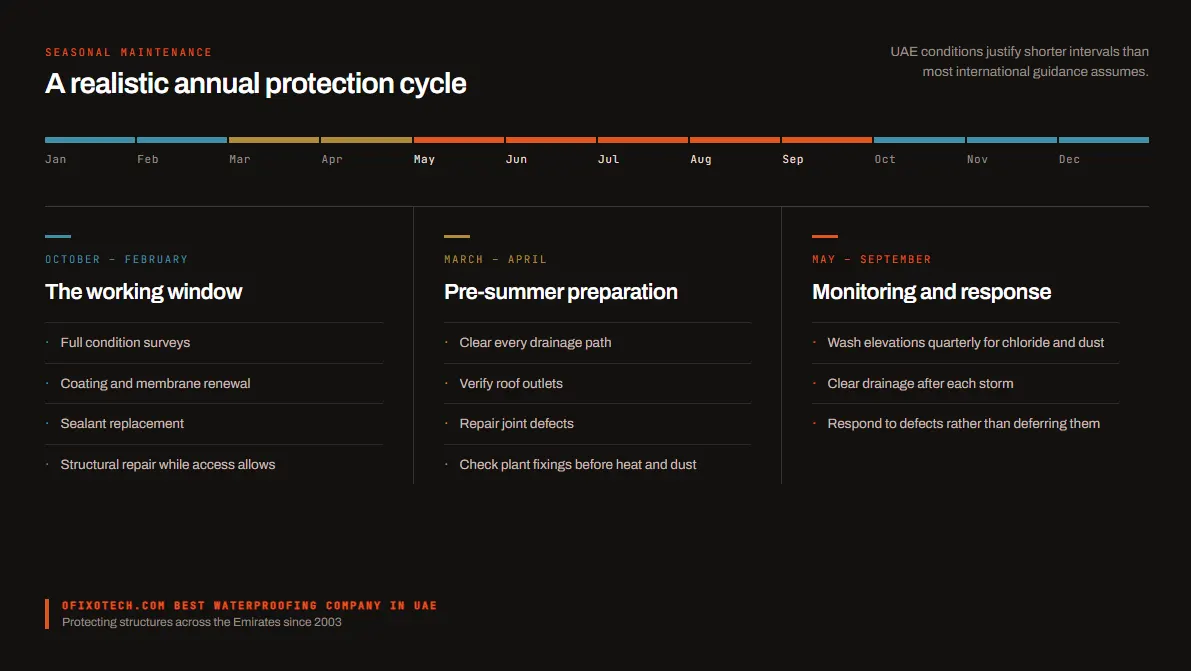
October to February. The working window. Full condition surveys, coating and membrane renewal, sealant replacement and structural repair are all best executed while temperatures allow proper application and inspection access.
March and April. Pre-summer preparation. Clear every drainage path, verify roof outlets, repair joint defects and check plant fixings before the heat and dust arrive. Our pre-summer building preparation checklist covers the full scope.
May to September. Monitoring and reactive response. Wash exposed elevations quarterly to remove chloride and dust, clear drainage after each significant storm, and respond to defects rather than deferring them to the cool season.
Formalising this into an annual maintenance contract is almost always cheaper than reactive callouts. Planned building maintenance across commercial portfolios, villa maintenance for residential property, and warehouse maintenance for industrial assets apply the same logic at different scales.
For budgeting, see our framework for annual building maintenance budget planning and our guidance on building an emergency repair reserve, since climate-driven failures rarely arrive on schedule.
The Cost of Getting It Wrong
Protection costs scale by roughly an order of magnitude at each stage of deterioration. Applying a coating to a sound surface is a maintenance line item. Repairing localised spalling is a project. Strengthening a compromised frame is a capital event involving scaffolding, access restrictions and disruption to occupiers.
The April 2024 floods made the aggregate figure visible: property damage across the UAE was estimated at between 2.9 and 3.4 billion US dollars from a single day of rain. A meaningful share of that was preventable through drainage capacity and waterproofing that had been treated as low priority precisely because it so rarely rains.
Envelope condition is also among the clearest quality signals any prospective tenant or buyer receives, a relationship examined in our analysis of how building condition affects property value in Dubai.
Frequently Asked Questions
Which UAE climate factor causes the most building damage?
Chloride-induced corrosion of reinforcement is the mechanism most likely to become structural, and therefore the most expensive. Heat is the most pervasive, because it accelerates every other process. Practically, damage almost always results from several factors acting together rather than any single one.
How often should a UAE building be inspected?
Comprehensive envelope surveys annually, with more frequent checks of high-risk elements such as roof drainage, sealant joints and cladding fixings. Coastal and seafront properties warrant quarterly attention. Anything less means defects are found after they have caused damage rather than before.
Is a newer building safe from these problems?
Newer buildings generally benefit from improved regulation and better materials, but they are not exempt. Detailing errors, inadequate cover and unmaintained drainage produce failures in buildings under ten years old. Compliance with a green building rating does not equal durability, since those systems target energy and water performance rather than long-term envelope resistance.
Can weather protection be added to an existing building?
Most of it, yes. Waterproofing systems, protective coatings, corrosion inhibitors, sealant renewal and drainage upgrades are all retrofittable. Concrete cover depth and mix design are the significant exceptions, which is why those two decisions dominate service life outcomes at construction stage.
Does the UAE climate genuinely require different specifications?
Yes. The combination of sustained heat, high humidity, chloride exposure, abrasive dust and intense episodic rainfall is not represented in the testing regimes behind most temperate-climate specifications. Materials should be selected against measured UAE exposure conditions, and maintenance intervals should be shorter than international guidance suggests.
What is the single most valuable protective measure for an existing property?
Keeping water out. Every other degradation mechanism depends on moisture, so functional waterproofing and genuinely clear drainage deliver more protection per dirham than anything else available. It is also the measure most commonly deferred.
Building for the Climate You Actually Have
The UAE climate is not going to become gentler. Summers are lengthening, temperature records are being reset in consecutive years, and the 2024 rainfall event demonstrated that low average rainfall provides no protection against extreme single events.
Buildings specified, protected and maintained for these conditions hold their finish, their structure and their value. Buildings treated to generic international standards degrade quietly for a decade and then present a bill that dwarfs what protection would have cost.
The decisions that matter are not exotic: durable concrete with adequate cover, waterproofing systems selected for real exposure, joints detailed for real movement, drainage sized for real storms, and maintenance intervals set by the climate rather than by convention. Choosing the right contractor matters as much as choosing the right product, and our guide to choosing a waterproofing company in Dubai sets out what to verify before appointing anyone.
If you are unsure how your property is holding up against UAE conditions, the right starting point is a condition survey covering envelope, roof, drainage and below-ground elements. Ofixo Technical Services has been protecting structures across the Emirates since 2003, and our teams can assess the condition, specify the remedy and carry out the work. Contact our team to arrange an inspection.