
Water never appears where it gets in. It travels along a slab soffit, runs down the outside of a conduit, tracks across a beam and finally shows itself on a ceiling three rooms away from the actual defect. That single fact is why most leak repairs in this country fail the first time, and why waterproofing companies in Dubai spend more time diagnosing than repairing.
The temptation is to seal the stain. Someone repaints the ceiling, the patch reappears six weeks later a little further along, and the cycle repeats until somebody finally opens up the right area.
This guide sets out how to work out where water leakage is actually coming from in a UAE building: how to tell a plumbing failure from an envelope failure, what each symptom genuinely indicates, the diagnostic sequence that narrows it down without demolition, and which repair matches which cause.
The Short Answer
Find the source before you fix anything. With water leakage from a ceiling or a wall, the visible damp patch marks where water left the structure, not where it entered, and the two can be metres apart horizontally and a floor or more apart vertically.
The first question to settle is whether the water is coming from a pressurised pipe, from a drainage line, or from outside the building envelope. Those three have completely different diagnostic routes and completely different repairs, and almost every wasted repair in this market comes from guessing which one it is.
Plumbing Leak or Envelope Leak?
This is the distinction that saves the most money, and you can usually settle it in a day without opening anything up.
A pressurised plumbing leak runs continuously whether or not anyone is using water, and it does not care about the weather. A drainage leak appears only when the fixture above is used, so it comes and goes in a pattern that matches occupancy. An envelope leak follows the weather or the irrigation schedule, appearing after rain, after the landscape irrigation runs, or after a tank overflows.
Three tests separate them.

In the UAE a fourth possibility deserves naming, because it is missed constantly: condensation. A chilled water pipe or duct with failed insulation drips continuously in summer and produces damp that looks exactly like a leak. It runs hardest on the most humid days and stops in winter. Our guide to humidity in UAE properties covers the mechanism.
Reading the Symptom
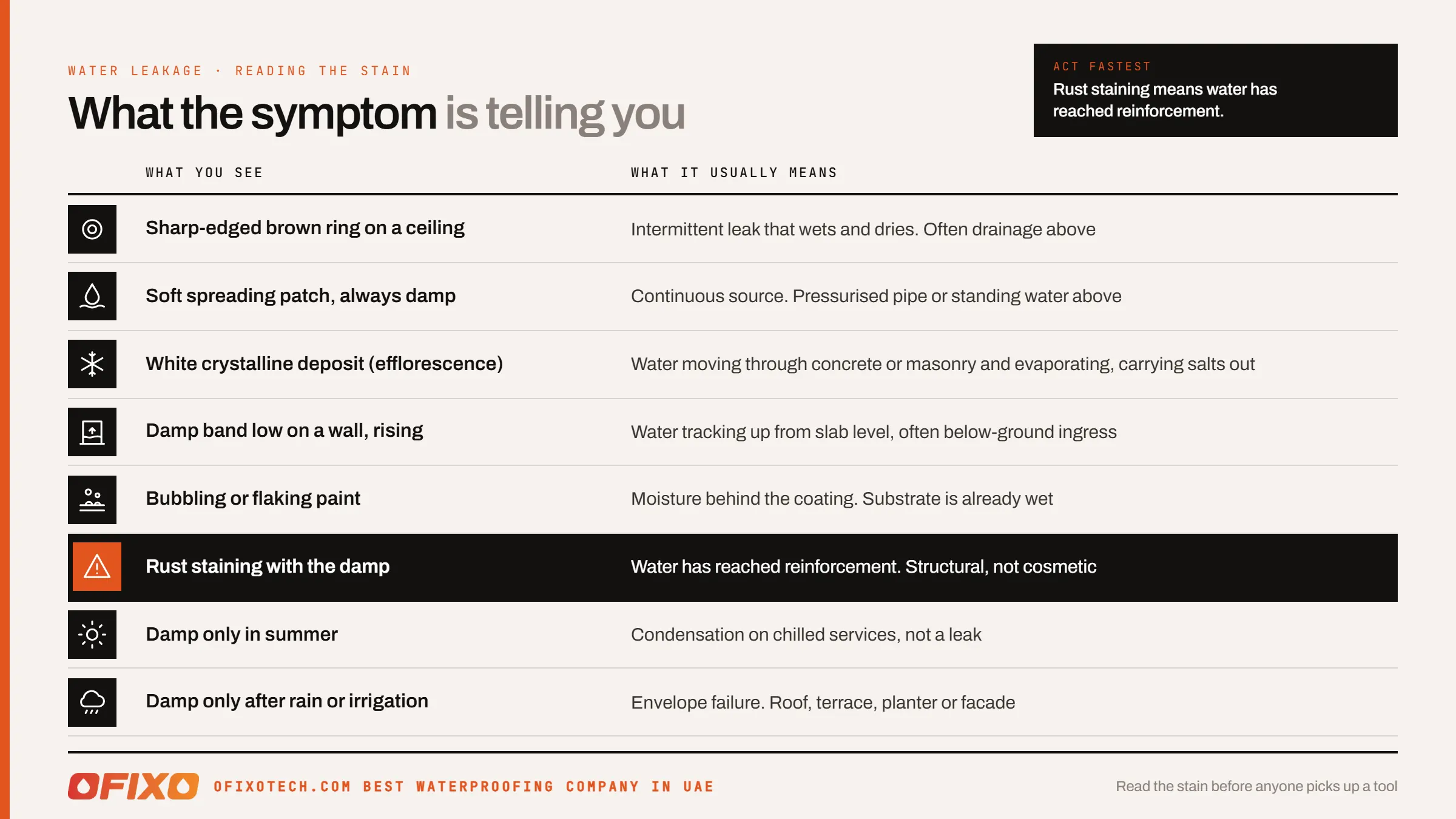
Each type of staining carries information. Learning to read it narrows the search before anyone picks up a tool.
| What you see | What it usually means |
|---|---|
| Sharp-edged brown ring on a ceiling | Intermittent leak that wets and dries. Often drainage above |
| Soft spreading patch, always damp | Continuous source. Pressurised pipe or standing water above |
| White crystalline deposit (efflorescence) | Water moving through concrete or masonry and evaporating, carrying salts out |
| Damp band low on a wall, rising | Water tracking up from slab level, often below-ground ingress |
| Bubbling or flaking paint | Moisture behind the coating. Substrate is already wet |
| Rust staining with the damp | Water has reached reinforcement. Structural, not cosmetic |
| Damp only in summer | Condensation on chilled services, not a leak |
| Damp only after rain or irrigation | Envelope failure. Roof, terrace, planter or facade |
The rust-staining row is the one to act on fastest. Water seepage that has reached reinforcement starts a corrosion process that expands and cracks the cover concrete, and at that point the repair moves from waterproofing into concrete restoration. Our reference on visual signs of structural problems covers how to read those indicators.
Where Water Actually Gets In
Entry points cluster in a predictable set of places. Work through them in order of likelihood for the symptom you have.
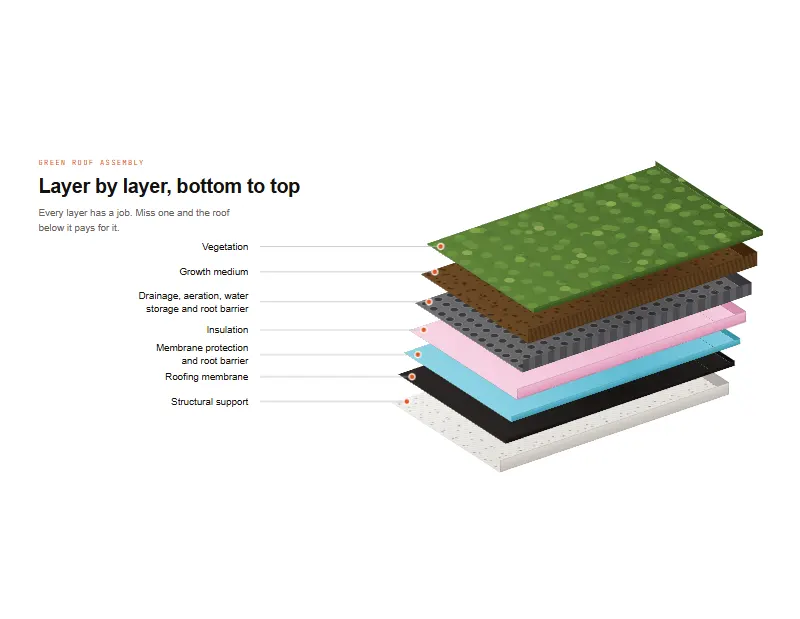
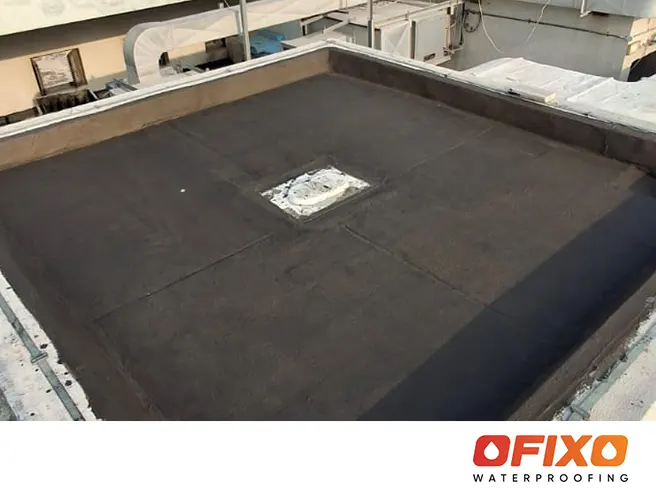
Roof and terrace. The obvious candidate, and often correct when the timing matches rainfall. Look for ponding that persists more than 48 hours, membrane that has lost its surfacing, open laps, blocked outlets and previous patch repairs. A failed roof waterproofing layer in this climate produces no symptom for years, because there is so rarely enough rain to reveal it.
Wet areas above. Bathrooms, kitchens and laundries are the single most common source of inter-floor leaks in Dubai apartment buildings. A failed tanking layer leaks into the unit below and the substrate has usually been wet for months before anyone complains. Correct bathroom waterproofing is the only durable fix, and it means lifting tiling rather than resealing a joint.
Balconies and terraces. Thin sections, full exposure and marginal drainage detailing. Falls that direct water back toward the building, blocked outlets and split perimeter sealant deliver water straight into the slab edge. Balcony waterproofing and terrace waterproofing defects typically show first as staining on the soffit below, which is why water leakage from a ceiling so often traces back to the balcony one floor up rather than to any pipe.
Planters and landscaping. Raised beds hold soil and water above a membrane permanently, and daily irrigation means the defect runs year round rather than only when it rains. Our guide to planter drainage in Dubai covers why these fail.
Below ground. Saline groundwater pushes against basement walls and slabs continuously. Symptoms are a damp wall at slab level, efflorescence, a musty smell in parking levels and pumps running constantly. This is where water seepage through the structure is most persistent, because the pressure never lets up, and it needs basement waterproofing rather than the surface damp proofing treatments sold for the symptom.
Movement joints. Building movement joints that have been painted over, filled with the wrong material or never maintained split under thermal cycling and admit water directly. Proper expansion joint treatment restores both movement capacity and watertightness.
Lift pits. Standing water in a pit is almost always a below-ground waterproofing defect rather than a pumping problem, and lift pit treatment addresses the cause.
Tanks and pools. A leaking water tank or pool loses volume continuously and delivers water into the surrounding structure. Check water tank waterproofing and swimming pool waterproofing where the leak sits near either.
A Diagnostic Sequence That Works
Work from cheapest and least invasive upward. Most leaks are identified before step five.
- Log the pattern for a week. Photograph the patch with a date and a ruler for scale. Note rainfall, irrigation times and use of fixtures above. Pattern alone resolves a surprising number of cases.
- Run the meter and isolation tests. Settle plumbing versus envelope before anything else.
- Inspect directly above and uphill. Water travels down and sideways, never up. Map everything above the patch: fixtures, the roof area, the terrace, planters, service risers.
- Check drainage. Clear the roof outlets, balcony drains and gutters, then wait for the next rain or run a hose test. A partially blocked outlet turns any water event into ponding, and roof gutter clearance alone resolves a fair share of roof leaks.
- Flood test the suspect area. Plug the outlet, hold 25 to 50 mm of water for 24 to 48 hours and watch below. This is the definitive test for a terrace, a wet area or a planter base.
- Bring in instruments. If the first five steps have not found it, the source is concealed and needs detection equipment rather than more guessing.
Professional Leak Detection Methods
When visual inspection runs out, four methods cover almost everything, and none requires breaking open the structure first.
Moisture meters and thermal imaging. Non-invasive mapping of where moisture actually sits behind finishes, which frequently reveals that the wet area extends well beyond the visible stain and points back toward the source. Our guide to hidden moisture detection in UAE buildings explains what each instrument can and cannot show.
Acoustic detection. Pressurised leaks make noise. Acoustic equipment picks up the signature of water escaping a pipe under pressure through slabs and walls, which is the standard route for a supply-side leak buried in screed.
Tracer dye. Non-toxic dye introduced into a suspect drain, tank or pool, then watched for at the leak point. Simple, cheap and conclusive when the suspect is a specific vessel or line.
Tracer gas. Hydrogen or helium mix introduced into an isolated line and detected at the surface where it escapes. The most sensitive method, used when acoustic detection cannot separate the signal.
Professional water leak detection costs a fraction of exploratory demolition, and the comparison is not close. Opening the wrong wall costs the opening, the reinstatement and the time, and leaves the leak running. It is also the only reliable way to tell genuine water leakage from condensation or from rising damp in a ground-floor wall, three problems that look identical behind a painted finish and need three different repairs.
Matching the Repair to the Cause
Once the source is known, the repair follows from it. Three broad routes cover most cases.
Active leak, water currently flowing. Injection seals the pathway from inside the concrete without excavation. Water leakage injection is the standard approach for live ingress through cracks, construction joints and penetrations, using a fast-reacting PU injection foam that expands on contact with water. For slower seepage through a hairline crack, polyurethane injection or an acrylic injection gel suits better.
Structural crack, dry or weeping. Where the crack affects how the element carries load, it is resin injected rather than filled. Concrete crack repair with an epoxy injection resin restores monolithic behaviour across the crack, while concrete crack injection handles the water-bearing cases.
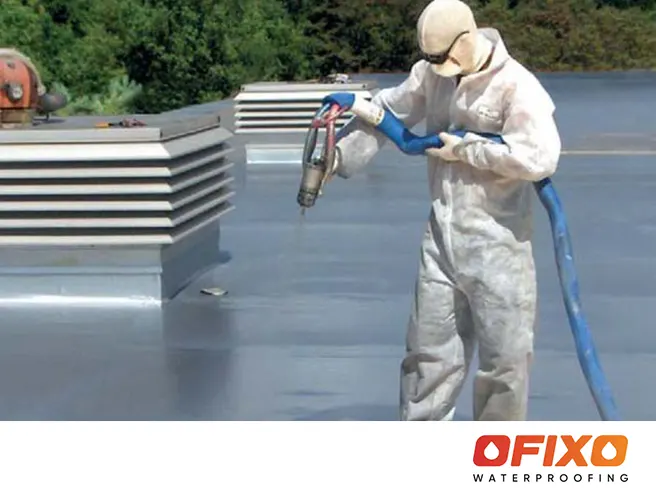
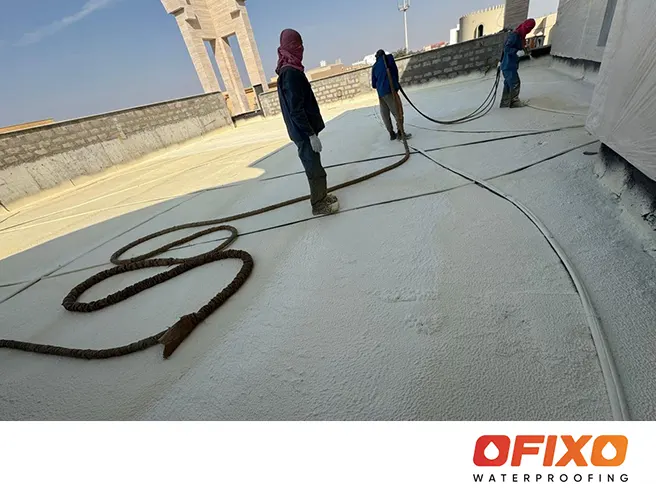
Failed waterproofing layer. Injection stops water but does not restore a membrane. Where the barrier itself has reached the end of its life, the layer has to be replaced, and patching one area of a failed roof usually just moves the leak. Our waterproofing services cover the full range, and the system choice depends on the substrate and exposure.
One caution worth stating plainly. Injection is often sold as a complete repair when it is really a control measure. It seals the pathway the water is using today. If the underlying membrane has failed across a wide area, water will find the next pathway, and you will be injecting again within a year or two. Ask any contractor proposing injection whether it is fixing the cause or buying time, and get the answer in writing.
Where Water Has Already Reached the Structure
Prolonged leakage stops being a nuisance and becomes a structural matter once chlorides and moisture reach the reinforcement.
The sequence is predictable. Water carries chlorides into the concrete cover, the passive layer protecting the steel breaks down, the steel corrodes, and the expanding corrosion product cracks and detaches the cover. The visible endpoint is rust-stained, spalled concrete, treated through concrete spalling repair using a polymer modified repair mortar after the exposed steel has been cleaned and primed.
Two things matter here. Patching over corroding steel makes the problem worse, because the repair becomes an anode that drives fresh corrosion in the surrounding concrete. And the water has to be stopped first, because reinstating cover while the source is still running simply restarts the clock.
The coastal dimension is covered in our guide to salt air corrosion on coastal properties.
Who Is Responsible for the Repair?
In a Dubai apartment building, responsibility usually turns on where the defect sits rather than where the damage shows.
A defect inside a unit, such as failed bathroom tanking, generally sits with that unit’s owner, even though the damage appears in the apartment below. A defect in common property, such as the roof membrane, an external wall, a podium planter or a riser, generally sits with the owners association and is funded through the service charge.
This is why establishing the source matters legally as well as technically. A moisture survey that locates the defect is the evidence that settles who pays, and attempting the repair before that is established tends to make the dispute worse. Our guide to apartment maintenance responsibility sets out the boundaries, and the position is contractual, so specific advice is worth taking before committing to works.
Buyers should note that leak history is among the defects most often concealed at sale, as covered in hidden property issues in Dubai.
Frequently Asked Questions
Why does the damp patch appear far from the leak?
Water follows the path of least resistance, which means running along the underside of a slab, down the outside of conduits and across beams until it finds a low point or a joint to escape through. Horizontal travel of several metres is routine, so the stain marks the exit, not the entry.
How do I know if it is a leak or condensation?
Condensation runs hardest on the most humid days, affects chilled surfaces such as water pipes and ducts, and largely stops in winter. A leak follows rainfall, irrigation or fixture use instead. If the damp is worst in August and absent in January with no change in rainfall, suspect insulation failure on chilled services rather than ingress.
Can a ceiling leak be fixed without breaking the ceiling?
Frequently, yes. Where the source is an active crack or joint in the slab above, injection seals it from one side with only small drilled ports. Where the source is a failed membrane or a pipe within the floor build-up, access is usually unavoidable, but detection work means opening the right place once rather than several wrong places.
What is efflorescence, and is it serious?
Efflorescence is the white crystalline deposit left when water passes through concrete or masonry and evaporates at the surface, carrying dissolved salts with it. The deposit itself is harmless, but it is proof that water is moving through the element, so it should be treated as a symptom to trace rather than a stain to clean off.
How much does leak detection cost compared with just repairing?
Detection is almost always the cheaper route, because the alternative is exploratory opening-up. One wrong wall costs the demolition, the reinstatement and the delay, with the leak still running. Detection narrows the work to a single correct opening.
Will injection permanently stop a leak?
It permanently seals the specific pathway it treats. Whether that permanently stops the leak depends on whether the underlying barrier is otherwise sound. On a single crack in an otherwise good structure, injection is a complete repair. On a roof whose membrane has reached end of life, it is a holding measure, and the membrane still needs replacing.
How quickly should a leak be dealt with?
Quickly, because the cost escalates by stages. A sealed crack is a small job. Wet insulation and damaged finishes are a larger one. Corroded reinforcement and spalled concrete is a capital repair involving access equipment and disruption. The jump between those stages is roughly an order of magnitude each time.
Find It Before You Fix It
Almost every expensive leak repair in this market started as a cheap one that was aimed at the wrong place. The stain gets sealed, the source keeps running, and the damage spreads quietly behind the finishes until it reaches the reinforcement.
The discipline that avoids it is unglamorous: log the pattern, settle plumbing against envelope with the meter and isolation tests, inspect everything above, flood test the suspect area, and bring in detection equipment before anyone picks up a breaker. For portfolios, folding leak inspection into an annual maintenance contract catches these while they are still cosmetic, and our guidance on when expert inspection is needed sets the threshold for calling specialists.
If you have water appearing somewhere and no clear idea where it is coming from, that is the problem worth solving first. Our teams locate the source, specify the repair and carry it out, and our completed project portfolio includes leak rectification across towers, villas, basements and industrial sheds throughout the Emirates. Book a free survey and we will trace it.