Protection board is the line item that gets cut when a tender comes back over budget. It is easy to argue away: the membrane is already installed, it has passed its flood test, and a few millimetres of board seems like belt and braces. Then the blockwork crew walks a loaded wheelbarrow across the terrace and nobody finds the puncture until the following rainy season. A large share of the remedial work handled by waterproofing companies in Dubai traces back to damage done after the membrane was signed off.
The opposite mistake is just as common. Protection board gets specified across an entire roof out of habit, on areas nothing will ever touch, adding cost and in some cases creating a water trap between the board and the membrane.
This article sets out what a protection board in waterproofing actually does, the situations where it is genuinely non-negotiable, the situations where it is money wasted, how the types compare, and the compatibility trap that catches people out on single-ply roofs.
What a Protection Board Is
A protection board is a sacrificial physical layer placed over a cured waterproofing membrane to absorb mechanical damage, from both follow-on construction work and whatever sits on the membrane for the rest of its life.
It is not part of the waterproofing. It carries no water. Remove it and the membrane still works, right up until something drops on it.
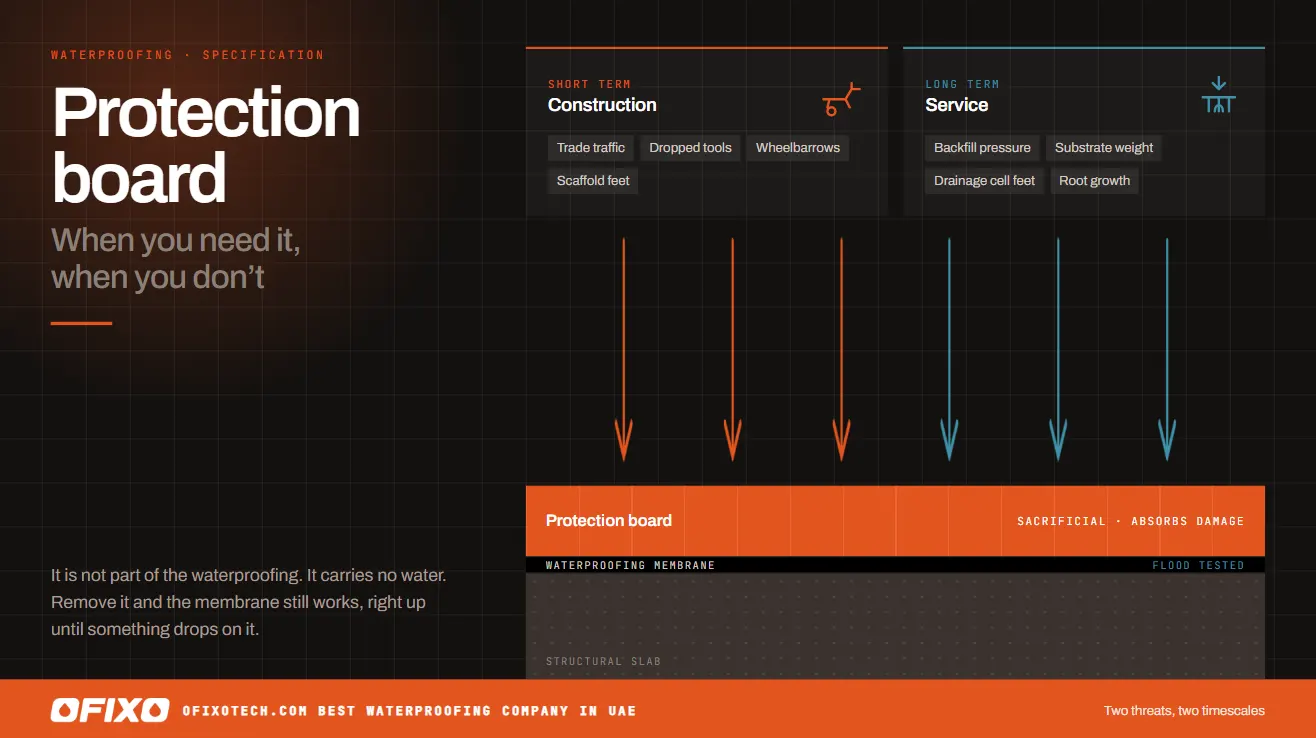
The important thing is that it protects against two completely different threats on two different timescales. The short-term threat is construction: trade traffic, dropped tools, material storage, wheelbarrows, scaffold feet, reinforcement bars dragged across a terrace. The long-term threat is service: backfill pressure, substrate weight, drainage cell feet, root growth, vehicle loads, maintenance access.
Specifications routinely address one and forget the other. A board sized for construction traffic may be inadequate under a loaded planter, and a board perfect under backfill may be the wrong product if the real risk is six weeks of blockwork above it.
Four layers that get confused with each other
Half the confusion around protection board comes from treating four distinct layers as interchangeable. They are not.
| Layer | What it does | Typical product |
|---|---|---|
| Protection | Absorbs impact and point loads | Bitumen board, cement board, XPS, heavy fleece |
| Separation | Keeps incompatible materials apart | Thin geotextile, polythene |
| Drainage | Gives water a horizontal path | Drainage cell, drainage board |
| Insulation | Reduces heat transfer | XPS, EPS, mineral wool |
One product can do more than one job. XPS insulation in an inverted roof protects as well as insulates. A drainage composite with a bonded fleece drains and filters. But a layer only does the job its properties support, and assuming otherwise is how a 120 g/m² filter fabric ends up being called the protection layer on a drawing.
When You Need a Protection Board
Protection is mandatory wherever the membrane will be buried, loaded, trafficked, or exposed to other trades. In practice that covers six situations.
Anything buried. Basement tanking, retaining walls and below-ground structures are backfilled against, often with whatever fill is on site. Angular fill against a membrane with no protection will puncture it, and once the excavation is closed there is no access to repair. Effective basement waterproofing and foundation waterproofing treat the protection layer as part of the system, not an optional extra.
Under screed, paving or ballast. Anything laid over the membrane is placed by people with tools, and the material itself exerts load. A protection layer takes the abuse and separates the membrane from a screed that will shrink and crack independently of it.
Trafficked decks. Car park slabs, podium decks and service areas carry wheel loads and point loads from jacks, bollards and plant. Deck coatings handle wear at the surface, but the waterproofing below needs its own protection. A properly built car park flooring system accounts for both.
Green roofs and planters. The non-negotiable case, covered in its own section below.
Where follow-on trades work above the membrane. This is the one most often missed, because it is a programme problem rather than a design problem. If MEP, blockwork, cladding or landscaping crews will be on that slab after the membrane goes down, the membrane needs protecting from the moment it passes its test, even if the final build-up includes no protection layer at all. A temporary protection board is cheap. Tracing a puncture under finished landscaping is not.
Where the membrane is thin or unreinforced. Covered below under liquid systems.
When You Do Not Need One
Specifying protection board everywhere is not caution, it is cost without benefit, and occasionally it causes harm.
Exposed roofs designed to be exposed. A mineral-surfaced cap sheet, a reinforced single-ply or a UV-stable liquid system is designed to sit in the open and take light foot traffic. Burying it under a board removes the UV stability you paid for and traps moisture between board and membrane. Where there are defined maintenance routes, walkway pads along those routes are the right answer, not a board across the whole field.
Where the drainage layer already protects. Many drainage composites and dimpled membranes include a bonded geotextile that provides adequate protection for the loads involved. Adding a separate board duplicates the function and the cost. Check the manufacturer’s data before specifying both.
Inverted roofs with insulation above the membrane. Closed-cell XPS insulation board over the membrane already provides a substantial protective layer. A separate protection board below the insulation is usually redundant, though a thin separation fleece may still be needed for compatibility.
Where a better membrane is cheaper than a board. Upgrading from a single-layer to a reinforced two-layer system, or specifying a tougher polyurea waterproofing build-up, sometimes costs less than membrane plus board while removing an interface and a trade. Worth pricing both ways on larger areas.
Where it would trap water. A rigid, non-draining board laid on a deck with inadequate falls creates a space where water sits against the membrane indefinitely. If the falls are marginal, fix the falls or use a draining protection layer. Do not add a board and hope.
Comparing the Options
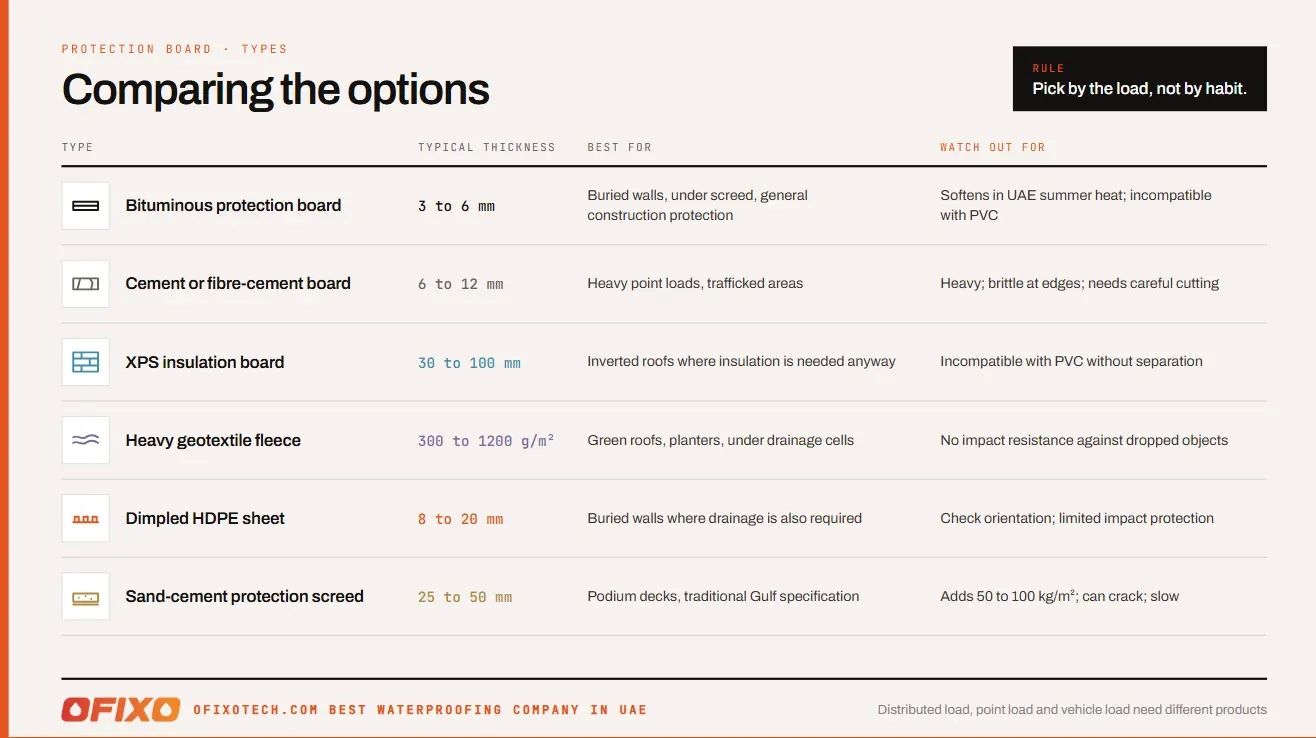
Pick by the load, not by habit. Distributed load from substrate or backfill is handled well by fleece and flexible boards. Point load from a dropped scaffold clamp needs rigidity. Vehicle load needs a rigid board or a screed.
The Compatibility Trap
This is the detail that produces the most surprising failures, because the materials look entirely innocuous together.
PVC membranes contain plasticisers that keep them flexible. Those plasticisers migrate into bitumen and into polystyrene on direct contact, and as they leave, the membrane hardens, shrinks and eventually cracks. A bituminous protection board laid straight onto a PVC waterproofing membrane, or PVC laid directly on polystyrene insulation, will degrade the membrane over years rather than protect it.
The fix is a separation layer, typically a thin geotextile, between the two. It costs very little and it is left out constantly, because nothing looks wrong at the time and the consequence arrives five years later as inexplicable cracking.
Two related rules worth carrying. Check the membrane manufacturer’s compatibility schedule before selecting any protection product, particularly for TPO and EPDM systems, which have their own restrictions. And remember that bituminous systems are generally tolerant of bituminous boards, which is why an APP modified bitumen membrane and a bitumen board are a common pairing, but even there the board can soften and bond to the membrane in UAE summer temperatures, which makes future investigation difficult.
Liquid Systems Need More Protection, Not Less
A common assumption is that a seamless liquid applied membrane is inherently tougher than a sheet because it has no laps. The seamlessness is a genuine advantage, and it is the main reason liquid applied waterproofing suits complex geometry. It says nothing about puncture resistance.
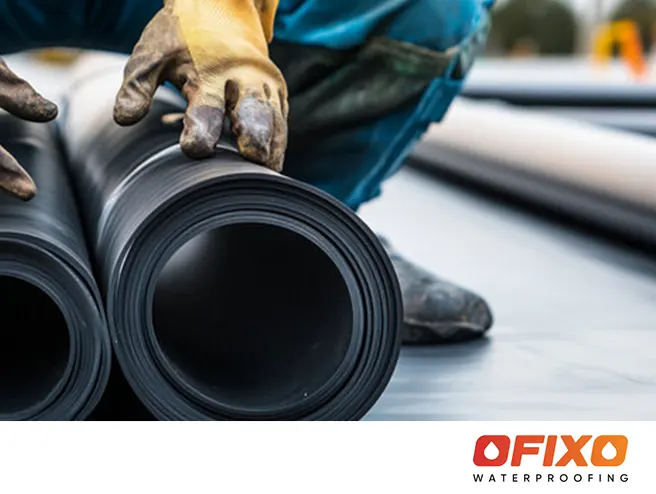
A typical liquid system cures to one and a half to three millimetres. A reinforced two-layer bituminous build-up is six to eight. On mechanical damage alone, the sheet wins comfortably, and the gap widens where the liquid system is applied without a reinforcing fleece.
So liquid membranes buried under anything need protection as a rule, not as a judgement call. A PU liquid membrane under a planter or a podium build-up should always have a protection layer above it. Our comparison of cementitious versus liquid applied membranes and our guide to polyurethane versus bitumen systems both cover the selection trade-offs in more detail.
The same logic applies to cementitious waterproofing, which bonds well and resists water admirably but is rigid and will craze under impact.
Green Roofs: Where It Is Never Optional
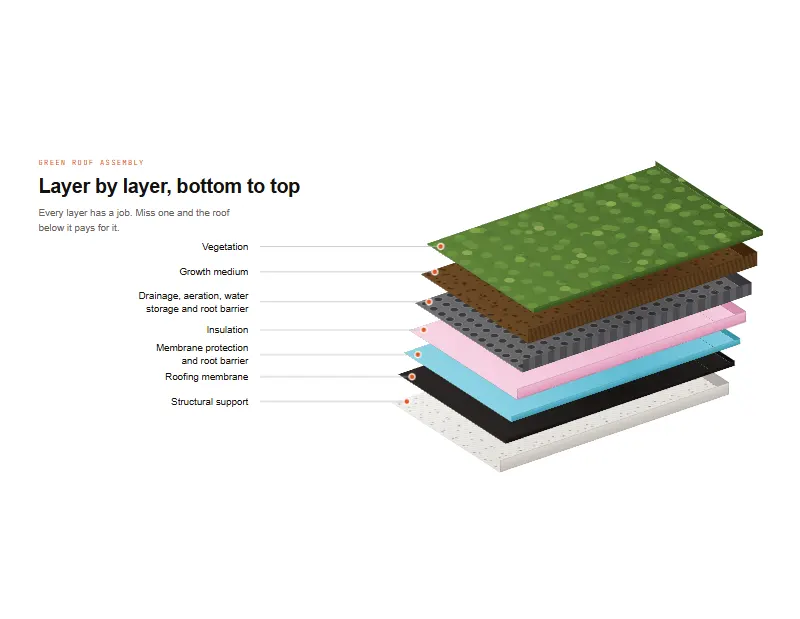
A planted roof is the one build-up where no competent specification omits the protection layer, because the membrane faces four simultaneous threats that exist nowhere else.
Drainage cells sit on moulded feet or ribs that concentrate load into small contact points. Substrate and saturated water impose a permanent distributed load, often over a tonne per square metre on intensive schemes. Roots actively seek weaknesses. And maintenance traffic continues for the life of the roof, with people walking, kneeling and working directly over the membrane.
In a green roof system, the protection layer is a heavy geotextile fleece, 300 g/m² as a minimum and 500 g/m² or more where the substrate is deep or vehicles have access. It sits above the root barrier and below the drainage cell. Our guide to where the drainage cell and filter fabric belong sets out the full order, and the same principles apply to raised beds, covered in our article on planter drainage in Dubai.
The reason this matters more than anywhere else is access. On an exposed roof a puncture is findable and repairable in an afternoon. Under 400 mm of saturated substrate and established planting, locating a leak means a moisture survey, then excavation, then reinstatement. The protection layer is the cheapest insurance in the entire build-up.
Board or Screed on a UAE Podium?
Sand-cement protection screed remains the default on many Gulf podium decks, largely through inertia. It is worth comparing honestly.
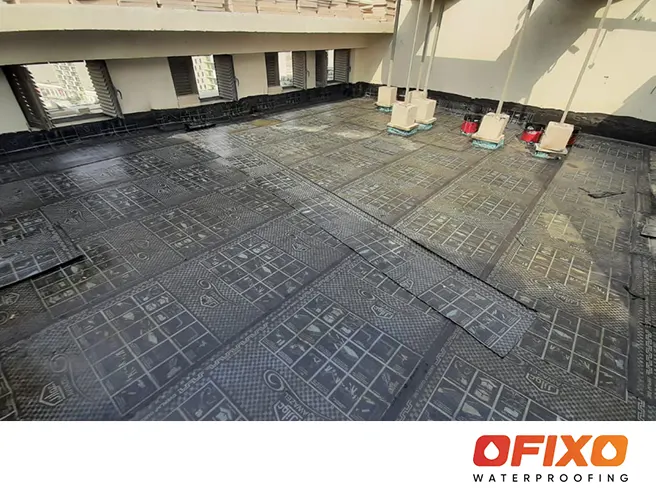
Screed is cheap per square metre, familiar to every subcontractor, and provides excellent protection once cured. Against that, it adds 50 to 100 kg/m² of dead load, it takes time to lay and cure on a programme that rarely has spare time, and a screed that cracks and moves can abrade the membrane beneath it rather than protect it. Laying screed also means a wet trade working directly over finished waterproofing, which introduces its own risk.
Boards cost more per square metre, install in a fraction of the time, add almost no load, and go down immediately after the flood test so the membrane is protected sooner. On structures where dead load is tight, or where the programme cannot absorb a curing period, boards usually win on total cost once the structural implications are priced. Where added mass is wanted for ballast, screed still has a place.
Sequencing: The Part That Actually Fails
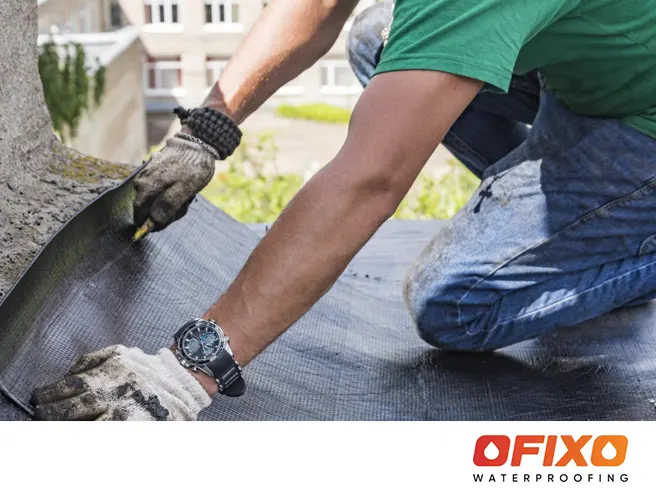
Most membrane damage happens in the window between the waterproofing being finished and the protection going down. On a busy site that window can run for weeks.
The sequence that works is short. Complete the membrane. Flood test it for 24 to 48 hours, witnessed and signed. Fix any defects and retest. Then install the protection layer the same day the test is signed off, before any other trade is permitted access to that area.
Three site rules make the difference. Nobody walks on an unprotected membrane, including the waterproofing crew once testing is complete. No materials are stored on an unprotected membrane, ever, including protection board itself stacked in bundles. And where protection cannot go down immediately, a temporary layer such as plywood sheeting on fleece covers the working routes until the permanent build-up starts.
In UAE summer conditions there is a fourth. Membranes are softer at 50°C deck temperature than the manufacturer’s test data assumes, so indentation resistance drops just as construction activity peaks. Our overview of how extreme heat affects building structures explains the thermal background, and the wider specification argument sits in why UAE buildings need special weather protection.
What to Put on the Drawing
A specification that says “protection board to waterproofing” will be priced by six contractors six different ways. Name five things instead:
- Material and thickness, or mass per unit area for a fleece
- Compatibility confirmation with the specified membrane, in writing from the membrane manufacturer
- Which areas get protection and which do not, marked on the drawing rather than left to interpretation
- Timing, as a hold point: no trade access until protection is installed and signed off
- Overlap and fixing, since loose-laid boards migrate and expose joints at exactly the point they are needed
Add a flood test hold point before the protection goes down. Once the board is installed, testing the membrane means removing it.
Frequently Asked Questions
Is a protection board the same as a drainage board?
No. A protection board absorbs mechanical damage; a drainage board creates a void that moves water horizontally to an outlet. Some composite products do both, but a plain protection board has no drainage function and a thin drainage board offers limited impact resistance. Check what the product is rated for rather than assuming from the name.
Can geotextile be used instead of a protection board?
For distributed loads such as substrate, backfill or drainage cell feet, a heavy fleece of 300 g/m² or more is the correct protection layer and is what green roof specifications call for. For impact loads such as dropped tools or construction traffic, fleece is not sufficient and a rigid board is required.
Does a protection board go above or below the insulation?
It depends on the roof type. In a warm roof the insulation sits below the membrane, so protection goes above the membrane. In an inverted roof the insulation sits above the membrane and usually serves as the protection itself, though a separation fleece may still be needed for compatibility between polystyrene and certain membranes.
How thick should a protection board be?
Three to six millimetres of bituminous board suits general construction protection and buried walls. Six to twelve millimetres of cement board suits heavy point loads and trafficked areas. For fleece, specify by mass: 300 g/m² minimum on extensive green roofs, 500 g/m² and above for intensive build-ups or vehicle access.
Can a protection board be installed later if it was missed?
Only while the membrane is still exposed. Once a screed, substrate or paving is in place, adding protection means removing everything above the membrane. This is why the sequencing hold point matters more than the product selection.
Does protection board affect the waterproofing warranty?
Frequently, yes. Many manufacturers make their warranty conditional on an approved protection layer where the membrane is buried or trafficked, and some void it if an incompatible material is placed in direct contact. Get the compatibility confirmation in writing and keep it with the handover documentation.
Protect It or Replace It
Protection board occupies an awkward position in a specification. It is invisible in the finished building, it contributes nothing to performance on a good day, and it is always available as a saving when the numbers are tight. Which is exactly why it is worth defending.
The decision is not whether to include protection board everywhere. It is whether the membrane in that specific location will be buried, loaded, trafficked or exposed to other trades. Where the answer is yes, the board is part of the waterproofing system. Where the answer is no, leaving it out is a legitimate saving rather than a risk.
Where damage has already occurred and water has reached the structure, the repair sequence runs well beyond the membrane. Concrete restoration addresses the substrate, water leakage injection stops active ingress while the permanent repair is planned, and the cost of both dwarfs what the board would have cost. Our article on hidden property issues in Dubai covers how long this kind of damage stays invisible.
If you are specifying a build-up and want a second opinion on where protection is genuinely needed, or you have a membrane that may have been damaged before it was covered, our roof waterproofing and waterproofing services teams can review the drawings or investigate the roof. Book a free roof survey and we will take a look.