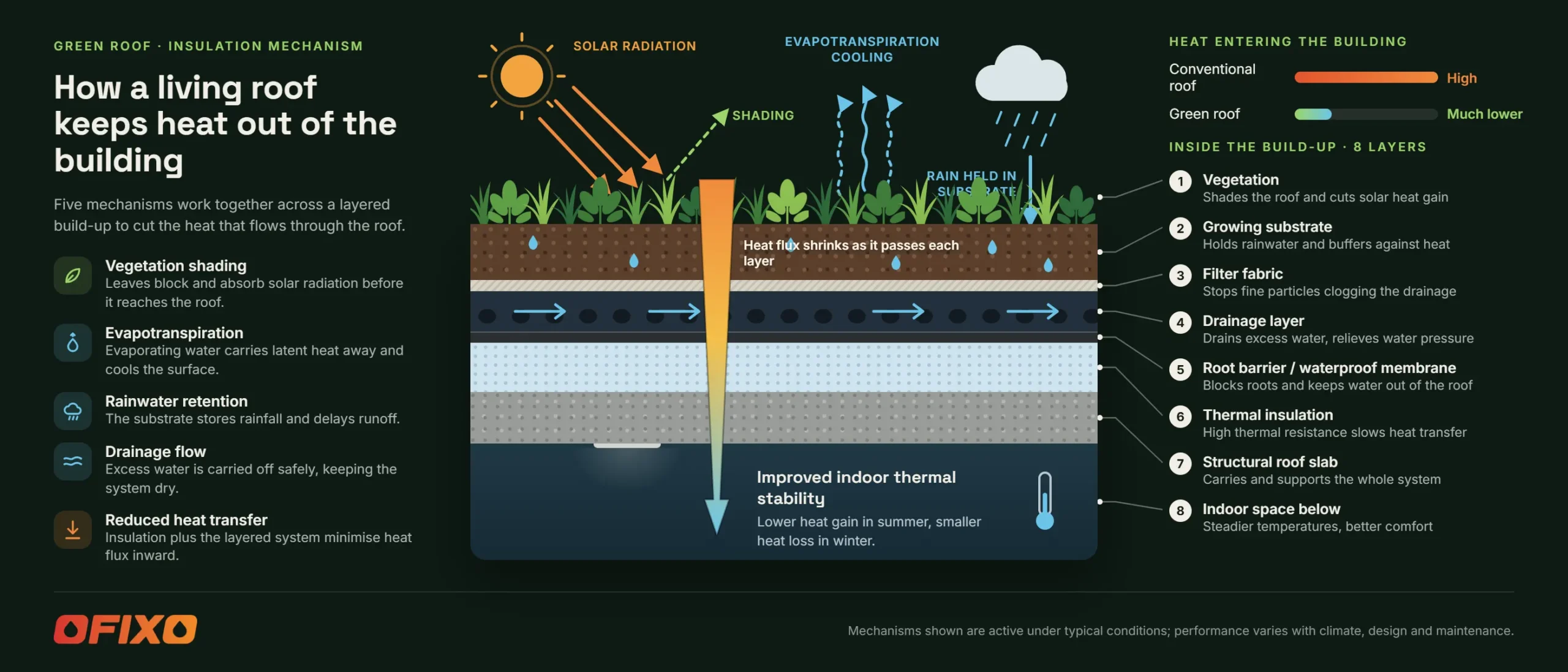
The thermal argument is the one that actually sells a green roof in this region. Nobody signs off six figures of podium landscaping because it looks pleasant from the twelfth floor, but a measurable cut in cooling load changes the conversation entirely. The question clients put to waterproofing companies in Dubai is therefore a fair one: how much does a planted roof really save on the DEWA bill, and does it beat simply adding more roof insulation?
The honest answer has a condition attached, and most suppliers leave it out. A green roof cools a building mainly by evaporating water. In a desert, that means the thermal benefit is bought with irrigation, and a planted roof left to survive on rainfall delivers a fraction of what the brochure promises.
This article sets out how a green roof actually cools, what the measured research shows, where roof insulation and a reflective cool roof beat planting on pure energy numbers, and how to specify a build-up in Dubai that earns its thermal claim.
The Short Answer
A properly irrigated green roof in a hot climate can cut cooling energy demand substantially, but published savings vary enormously with building height, existing insulation and irrigation. The honest range for a well-watered extensive roof over a poorly insulated deck is a meaningful double-digit percentage of cooling load. Over an already well-insulated modern deck it is far smaller.
Two things determine which end you land on. The first is whether the substrate stays moist, because evapotranspiration does most of the work. The second is how good the insulation underneath already is, because a green roof and an insulation layer are solving the same problem and you only get paid once.
How a Green Roof Cools a Building
Four mechanisms operate at once, and they contribute very unequally.
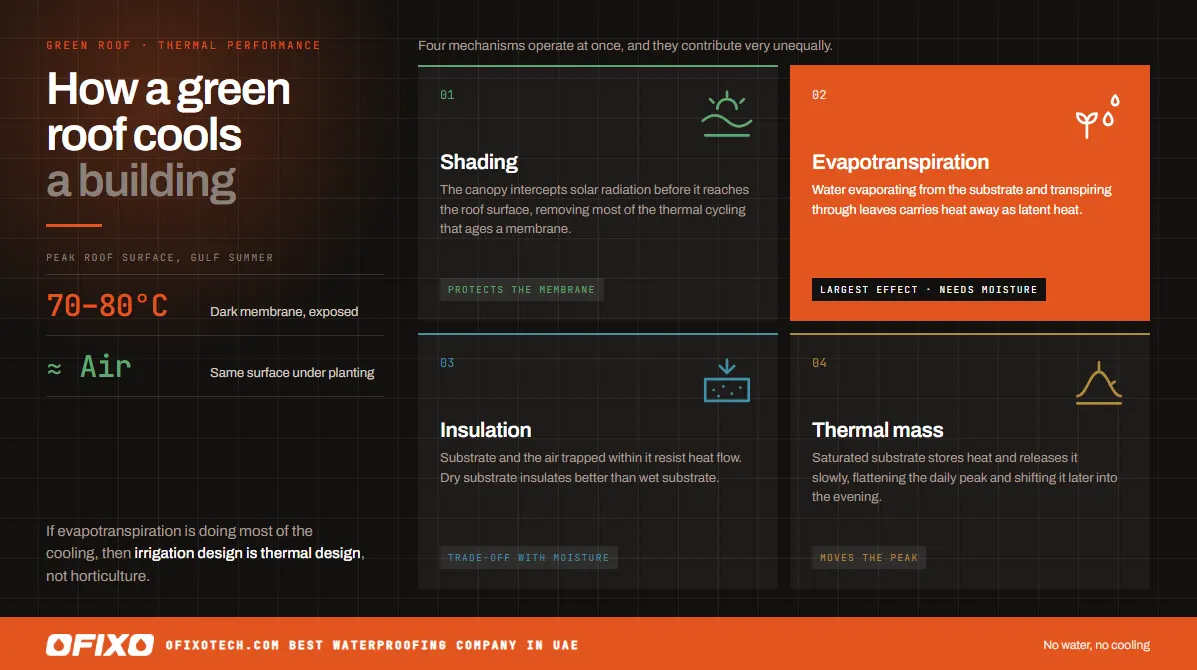
The ordering matters for specification. If evapotranspiration is doing most of the cooling, then irrigation design is thermal design, not horticulture.
What the Research Actually Shows
Published figures range widely, which is itself the most useful finding. A 2024 study in npj Urban Sustainability modelling six cities found mean annual cooling energy reductions of 63.4 to 83.2 per cent for green roofs and 67.2 to 86.7 per cent for cool roofs, with results broken down by local climate zone running from roughly 38 per cent to effectively complete elimination of cooling demand on some low-rise forms.
Three caveats make those headline numbers less useful than they look, and all three matter in Dubai.
Savings fall as buildings get taller. The same study found open high-rise forms at the bottom of the range, around 39 per cent for cool roofs and 38 per cent for green roofs, because the roof is a smaller share of the total envelope. On a forty-storey tower, the roof is almost thermally irrelevant to the building as a whole.
Savings are measured against a baseline. A green roof over an uninsulated 1990s slab transforms its performance. The same roof over a deck built to current Al Sa’fat requirements adds much less, because the insulation is already doing that job.
And critically, the study notes that in desert climates such as Cairo, green roofs were found to be almost dry, so the expected benefits did not materialise. That is the finding most relevant to the UAE and the one least likely to appear in a supplier presentation.
The Dubai Condition: No Water, No Cooling
Strip out evapotranspiration and a green roof becomes a heavy, expensive insulation layer with a maintenance liability.
That is what happens to an unirrigated planted roof here. Substrate dries out within days in summer, the plants shut down transpiration to survive, and the dominant cooling mechanism stops. What remains is the shading effect, which is real and valuable for membrane protection, plus a dry substrate layer with roughly the insulating value of a modest board.
So the thermal case rests on a water budget. Irrigation here runs most of the year, and in energy terms that is the cost of the cooling. The correct way to frame it to a client is as a trade: you are converting water into reduced cooling load, and whether that trade is worth making depends on tariffs, on whether treated sewage effluent is available, and on what the building’s cooling demand actually is.
Water quality enters the calculation too. Treated effluent and desalinated supply both carry dissolved solids, evaporation concentrates them in the root zone, and managing that needs a leaching fraction, which means deliberately over-irrigating so surplus carries salt out through the drainage layer. That only works if the drainage layer discharges. The mechanism is covered in our guide to salt air corrosion on coastal buildings.
Green Roof, Cool Roof or More Insulation?
If the objective is purely energy, a green roof is rarely the cheapest route. It is worth being straight about that.
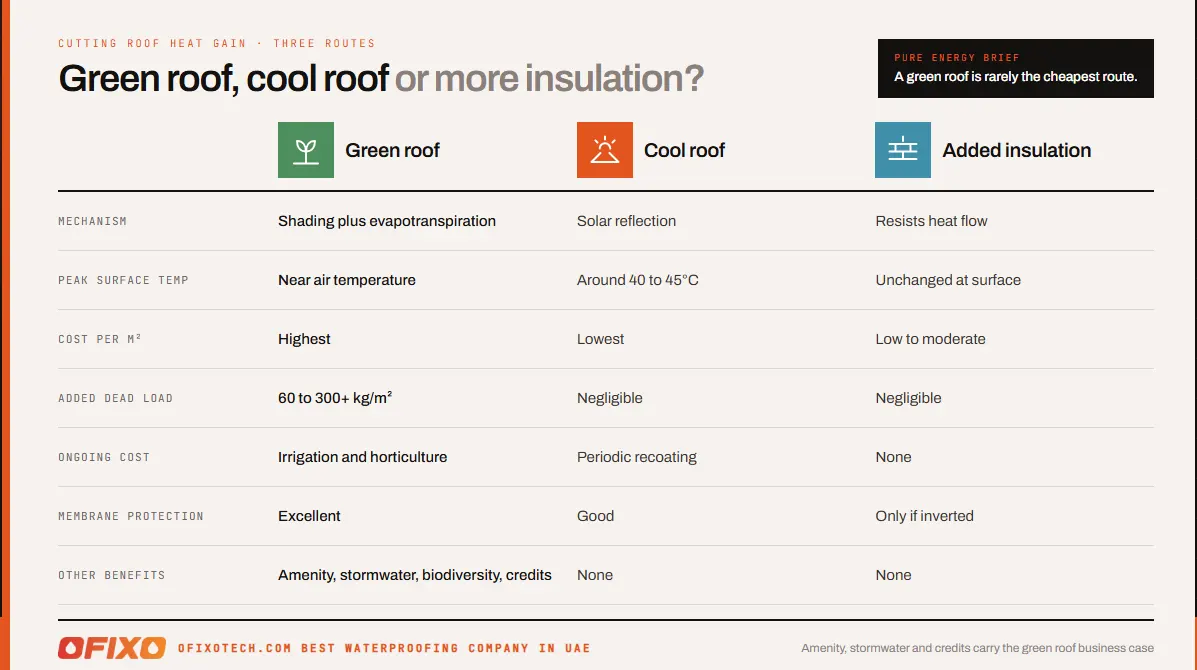
A reflective roof coating is the efficient answer to a pure energy brief. Research summarised by the UNSW High Performance Architecture cluster puts conventional dark roofs at roughly 70 to 80°C peak in hot summer conditions against about 40 to 45°C for white coatings, with building-scale cooling energy savings across climates spanning 2 to 44 per cent. A white single-ply such as a TPO waterproofing membrane delivers reflectivity and waterproofing in one layer.
The honest case for a green roof is therefore not that it is the cheapest way to cut roof heat gain. It is that it delivers amenity space, stormwater attenuation, biodiversity and green building credits alongside the thermal benefit, and that on a podium or terrace people will actually use, those other returns carry the business case. The thermal saving is a strong supporting argument rather than the whole one.
Our overview of how extreme heat affects building structures covers the wider thermal picture, and why UAE buildings need special weather protection sets out the specification argument.
The Insulation Layer Still Does the Heavy Lifting
Whatever sits on top, the roof insulation inside the build-up remains the primary control on heat transfer. Green roof insulation is a supplement to that layer, not a substitute for it.
Position defines the roof type. In a warm roof the insulation sits below the membrane, which keeps the membrane flexible and the insulation dry. In an inverted roof the insulation sits above the membrane, which means closed-cell XPS insulation board because it sits in permanent contact with water.
For UAE green roofs the inverted arrangement is worth real consideration. It puts two protective layers over the membrane instead of one, and it removes most of the thermal cycling that shortens membrane life. Where fire performance or acoustic separation drives the specification instead, rockwool insulation and EPS insulation board are the alternatives, though neither suits the inverted position.
One practical note on thermal insulation performance in this build-up: wet insulation is failed insulation. A green roof is slow to dry once moisture gets into it, which makes the vapour control layer and the waterproofing beneath it more important here than in a temperate climate, not less. Our guide to humidity in UAE properties explains the vapour drive that makes this a live risk.
What Actually Determines Thermal Performance
Four variables move the number more than anything else in the specification.
Irrigation. The dominant factor, for the reasons above. A moisture-retentive drainage layer holding four to eight litres per square metre extends the evapotranspiration window between cycles and reduces total water use.
Substrate depth. Deeper substrate holds more water and provides more thermal mass. An 80 mm extensive build-up and a 300 mm intensive one behave quite differently, and the intensive roof carries a load penalty to match.
Plant selection and canopy cover. Dense foliage shades more surface and transpires more. Sparse planting over exposed substrate loses much of the benefit. A sedum roof is the standard low-water choice internationally, though sedum struggles in UAE summer conditions and regionally adapted succulents and grasses usually perform better.
Existing insulation. The single biggest determinant of how impressive the saving looks. Over an uninsulated deck, dramatic. Over a well-insulated one, modest.
That last point is worth stating plainly to clients before they commit, because a green roof installed over an already efficient deck will underdeliver against expectations set by a brochure quoting savings measured on an uninsulated baseline.
The Build-Up Has to Survive the Irrigation
A thermal specification that ignores the waterproofing produces a cool building with a leak.
Daily irrigation means the membrane sits under near-permanent moisture and the drainage layer runs continuously rather than during occasional storms. That raises the stakes on three layers that are cheap and routinely compromised.
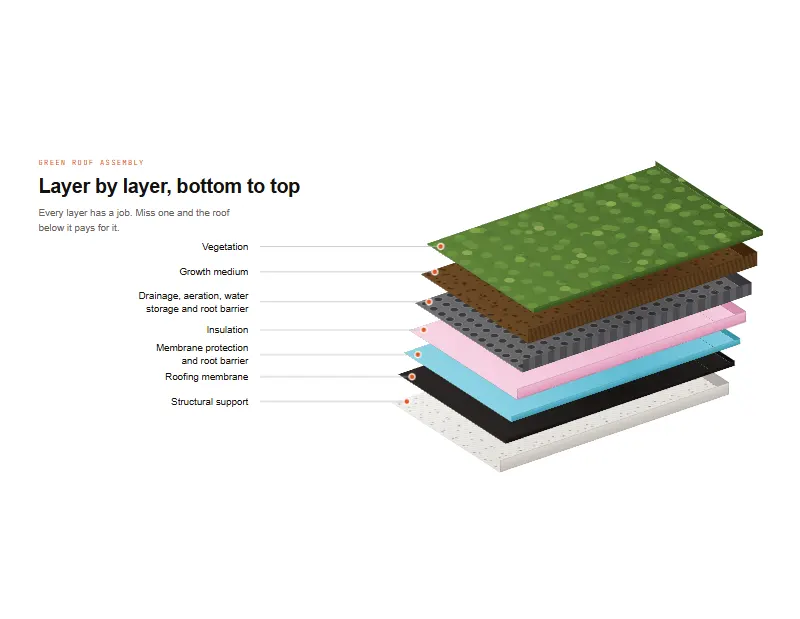
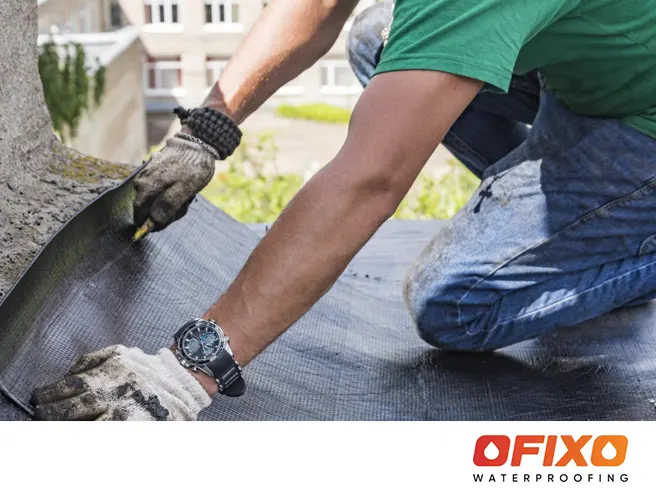
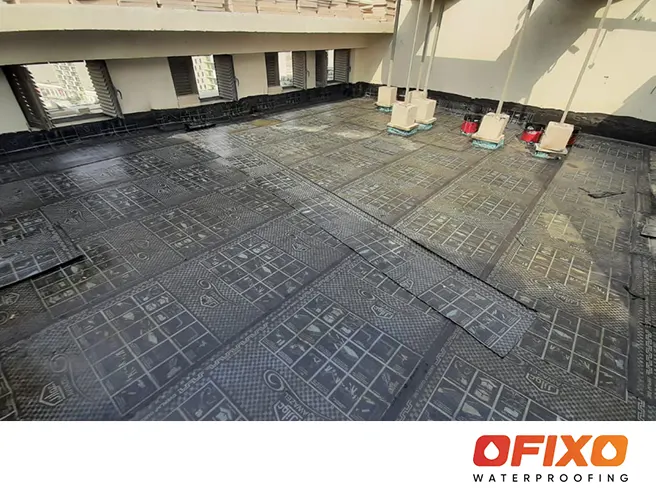
The membrane waterproofing must be root resistant or carry a separate root barrier, flood tested for 24 to 48 hours and signed off before anything covers it. The protection fleece must sit between the membrane and the drainage layer, at 300 g/m² or heavier. And the filter geotextile must sit above the drainage layer, not below it, or fines wash into the void and silt it up within a few years of daily irrigation.
The full sequence is set out in our guide to green roof build-up layers, with the two fabrics covered in detail in drainage cell versus geotextile membrane and the cushioning layer in protection board in waterproofing. Raised beds within a planted terrace follow the same logic, covered in planter drainage in Dubai.
Green Building Credits and Compliance
In Dubai, Al Sa’fat is administered through the building permit process and is mandatory for new construction. Abu Dhabi’s Estidama Pearl Rating System has required a minimum Pearl 1 rating on new development in the emirate since 2010, with Pearl 2 for government-funded buildings.
Both frameworks engage with vegetated roofs, and a green roof can contribute toward credits for thermal performance, stormwater management and heat island mitigation. LEED treats them similarly.
One distinction is worth keeping clear. These systems target energy, water and sustainability outcomes. They do not certify that a build-up is durable or correctly sequenced. A roof can satisfy Al Sa’fat and still fail in six years because the filter fabric went in upside down.
Retrofitting an Existing Roof
Adding a planted roof to an existing building is often feasible, subject to three checks in order.
First, structural capacity for the saturated load, which runs 60 to 150 kg per square metre for extensive systems and past 300 for intensive ones. Verify before anything is ordered. Where capacity falls short, structural strengthening is the route.
Second, the condition and remaining life of the existing waterproofing. Replace rather than overlay if there is any doubt, because everything above the membrane has to come off to reach it later.
Third, drainage that can be reworked so outlets remain accessible without disturbing planting.
For portfolios, the thermal retrofit usually makes more sense folded into a planned building maintenance cycle than as a standalone project, because the membrane is being addressed anyway.
Frequently Asked Questions
How much does a green roof reduce cooling costs in Dubai?
Published studies show wide ranges, from under 40 per cent to near-total elimination of cooling demand depending on building form, with low-rise buildings benefiting most and tall buildings least. The realistic figure for a given project depends overwhelmingly on two things: whether the roof is irrigated, and how well insulated the deck already is. Over a modern well-insulated deck on a high-rise, the saving is modest.
Does a green roof work without irrigation in the UAE?
Not thermally. Most of the cooling comes from evaporation, so a dry substrate loses the dominant mechanism. Research has found green roofs in desert climates remaining almost dry, with the expected benefits failing to materialise. An unirrigated planted roof still shades and protects the membrane, but it should not be sold as an energy measure.
Is a cool roof cheaper than a green roof for saving energy?
Generally yes, considerably. A reflective coating or white membrane costs a fraction of a planted build-up, adds no structural load and needs no irrigation. A green roof earns its cost through amenity, stormwater attenuation and green building credits alongside the thermal benefit, not through energy savings alone.
Does a green roof replace roof insulation?
No. Substrate provides some thermal resistance, but green roof insulation is not a substitute for a specified roof insulation layer, and wet substrate insulates poorly. The insulation board remains the primary control on heat transfer through the deck, and it is what building energy efficiency calculations are based on.
Does a green roof extend membrane life?
Substantially, and this is often the strongest technical argument for one. Burying the membrane removes UV exposure and most of the daily thermal cycling that ages it. The catch is that a buried membrane is also far harder to inspect and repair, which is why flood testing and the protection layer matter so much.
What substrate depth gives the best thermal performance?
Deeper substrate holds more water and more thermal mass, so performance improves with depth, but structural load rises faster than the benefit. For most retrofits an extensive build-up of 100 to 150 mm with reliable irrigation is a better trade than a deeper profile the structure has to be strengthened to carry.
Specify the Water Budget With the Roof
The thermal case for a green roof in Dubai is real, but it is conditional in a way that temperate-climate literature does not prepare clients for. The cooling is bought with water, and a build-up specified without an irrigation strategy is a heavy insulation layer that will underperform its brochure.
Specify both together. Settle the irrigation source, the water budget and the leaching fraction at the same time as the substrate depth and the drainage layer, and the thermal claim holds up. Leave irrigation to the landscape package to sort out later and it will not.
If you are weighing a green combo roofing system against a reflective coating, or want the thermal and waterproofing specifications reviewed together before they are built, our roof waterproofing and wider waterproofing services teams work across both, and our completed project portfolio covers combo roof work across seven emirates. Book a free roof survey and we will take a look.