
Free Zone & Logistics Specialists · Dubai
Warehouse Epoxy Flooring – Heavy-Duty Floor Systems for JAFZA, DSO, and Dubai’s Logistics Hubs.
Specialist warehouse epoxy flooring across JAFZA, DSO, Dubai South Logistics District, Dubai Industrial City, and the wider UAE logistics ecosystem. Heavy-duty floor systems engineered for forklift traffic, racking point loads, and 24/7 operations – delivered with free-zone authority documentation, phased fit-out integration, and the operational discipline 3PL operators, e-commerce fulfilment centres, and cold-chain logistics tenants demand.
- Free zone authority docs
- Aisle / racking / dock zone specs
- 24/7 operational phasing
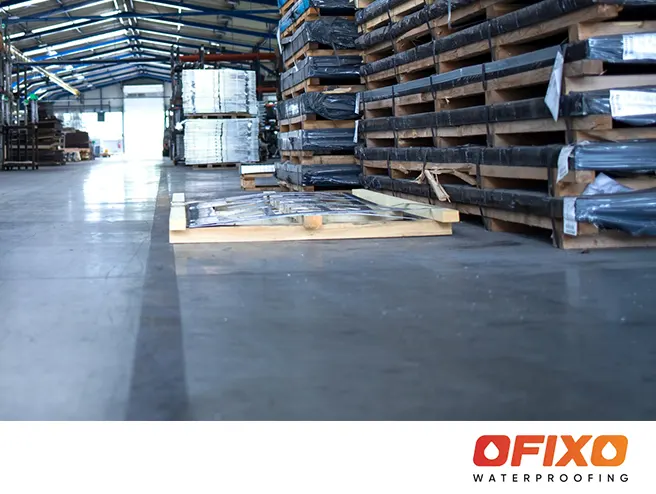
Built for Logistics Operations
What is Warehouse Epoxy?
Warehouse epoxy flooring is the family of heavy-duty epoxy systems engineered specifically for the operational profile of modern logistics facilities – continuous forklift traffic in aisles, concentrated point loads under racking footplates, intensive wheel scuffing at loading docks, and cold-store temperature stability. Build thickness ranges from 2mm solvent-free body coats up to 9mm trowel-applied polymer mortar at dock thresholds, with line marking integrated for aisle wayfinding and safety zoning.
Distinct from general industrial epoxy: warehouse projects live within free zone authority approval processes (JAFZA, DSO, Dubai South), 24/7 tenant operations, and the procurement disciplines of multi-national 3PL operators and e-commerce fulfilment teams. Specifications follow tenant fit-out guidelines; documentation supports handover to free zone operations; warranty packs satisfy global FM standards. Our model is built around those realities – not adapted to them.
The Logistics Operator’s Case
Four Performance Drivers Free Zone Tenants Specify.
Warehouse epoxy isn’t bought for aesthetic – it’s bought because four specific operational demands of modern logistics can’t be met by bare concrete, painted concrete, or commercial-grade systems. These are the drivers that put warehouse epoxy on the tender.
High-Speed Forklift Traffic
Modern logistics warehouses run continuous forklift traffic at 10–15 km/h in main aisles, often with reach trucks pushing 50 kN+ wheel loads. Bare concrete dusts within months; commercial epoxy wears through inside 2 years. Warehouse-grade polymer mortar systems carry the loading without surface degradation.
Racking Point Loads
Selective racking footplates concentrate loads of 6–12 tonnes per leg into 200×200mm contact patches – point pressures well beyond what light epoxy systems can survive. Warehouse-grade systems with engineered bond strength (>1.5 N/mm²) and compressive strength (>85 MPa) carry these loads without crushing or debonding.
Aisle Wayfinding & Safety Zoning
Forklift aisles, pedestrian walkways, hazardous material zones, fire exit routes – modern warehouse operations demand clear visual segregation. Coloured zoning and line marking integrated into the floor system (not painted on top) survives the operational lifecycle without wearing off.
Cold Storage Compatibility
Cold-chain logistics requires floor systems that cure to specification at low ambient temperatures and remain serviceable at −20°C to −25°C operating conditions. Specialist cold-store epoxy systems engineered for the cure window and the operational temperature; standard epoxies fail.
Zone-Specific Specification
A Warehouse Floor Isn’t One Floor – It’s Four Working Zones.
Aisles, racking footprints, loading docks, and cold storage all face different demands. Treating the whole warehouse with one spec wastes money on under-trafficked zones and under-specifies high-wear ones. Our approach: zone-by-zone specification matched to actual operational demands.
Forklift Aisles & Main Traffic Routes
The main aisles between racking, carrying continuous forklift and reach truck traffic at operational speed. Highest cumulative wheel-load exposure in the warehouse. Demands the heaviest-end specification – polymer mortar (5–9mm) or heavy-duty epoxy with maximum compressive strength.
Racking Footprints & Static Storage
The zones under and around selective racking – heavy point loads at footplates (6–12 tonnes per leg), minimal rolling traffic. Demands engineered bond strength to substrate and high compressive strength; static loading is the design driver here.
Loading Docks & Dock Levellers
Where trucks back in and pallet loads are scuffed, dragged, and dropped across the floor 24/7. Heavy localised wear, occasional impact loading, and on outdoor-exposed dock approaches: UV stability. Demands the most aggressive wear specification.
Cold Storage & Chilled Zones
Cold rooms and chilled storage operating at −20°C to −25°C. Floor system must cure at low ambient temperature during installation, then perform at operational temperature throughout service life. Standard epoxies fail; specialist cold-store epoxy required.
Project Scenarios
Four Free Zone Scenarios We Deliver.
Warehouse epoxy is location-aware. JAFZA, DSO, Dubai South, and the wider logistics ecosystem each come with different operational constraints, authority approval requirements, and tenant procurement processes. Here are the four patterns we deliver most.
JAFZA 3PL Warehouse Fit-Out
Typical Location
JAFZA Logistics City / JAFZA North / JAFZA South.
Trigger
Multinational 3PL operator taking new warehouse lease – fit-out scope includes flooring, racking, conveyors. Procurement managed via global FM team with strict tenant fit-out specifications.
Typical Specification
Polymer mortar 5–9mm in aisles, heavy-duty epoxy 2–4mm in racking zones, anti-slip aggregate at dock approaches. Coloured zoning for safety. Aligned to JAFZA fit-out guidelines.
Delivery Profile
Phased to fit-out programme – typically 4–8 weeks for 5,000–15,000 sqm warehouses, coordinated with main fit-out contractor, racking installer, and authority handover.
Dubai Silicon Oasis Distribution
Typical Location
Dubai Silicon Oasis / Dubai South Logistics District.
Trigger
Regional distribution hub operator commissioning new facility – high-throughput operation, automation-ready floor flatness requirements, integrated WMS systems.
Typical Specification
Self-levelling epoxy 3–6mm in pick-and-pack zones for AGV compatibility, polymer mortar in heavy traffic, FM150-grade flatness on automation aisles. Line marking integrated to operational layout.
Delivery Profile
Tight programme integration with mechanical, automation, and WMS commissioning. Typically 6–12 weeks for facilities 10,000–25,000 sqm; phased to support handover gates.
Cold Chain & Frozen Logistics
Typical Location
JAFZA / DSO / Dubai Industrial City cold storage.
Trigger
Cold-chain operator (food, pharma, frozen distribution) commissioning new cold rooms – operating temperatures −20°C to −25°C with strict food-grade or pharma-grade compliance.
Typical Specification
PMMA (methyl methacrylate) systems for ultra-low-temp cure inside cold rooms, food-grade epoxy with coved skirtings, integral drains where wash-down required. ISO 22196 anti-bacterial certification.
Delivery Profile
Coordinated with refrigeration commissioning – installation typically before cold-room insulation panels go in, OR after with specialist cold-curing systems. 3–8 weeks per facility.
E-Commerce Fulfilment Centre
Typical Location
DSO / Dubai South / Dubai Industrial City.
Trigger
E-commerce operator launching or expanding fulfilment centre – high-density picking, conveyor systems, robotic sorters, packing stations. Operational floor that supports automation.
Typical Specification
Self-levelling epoxy 3–6mm throughout pick zones (flatness for conveyor and robotic compatibility), polymer mortar in receive/dispatch aisles, anti-slip in pedestrian walkways, ESD-rated coatings in automation control rooms where specified.
Delivery Profile
Programme-critical phasing aligned to operational launch dates. 6–16 weeks depending on scale; phased with mechanical, conveyor, racking, and automation installation.
Scenarios drawn from typical project patterns we deliver across Dubai’s free zone ecosystem. Real project references available under NDA at quote stage; tenant references supplied to genuine prospects after initial site survey.
Step by Step
Our 6-Step Warehouse Floor Installation Process.
Warehouse projects live inside tight fit-out programmes, free zone approval gates, and operational launch deadlines. Our process is built to deliver inside those constraints, not negotiate around them.
-
01
Tenant & Free Zone Coordination
Survey the warehouse, review tenant fit-out specifications, free zone authority requirements (JAFZA / DSO / Dubai South), and operational layout. Method statement aligned to authority approval pack. Submitted before mobilisation.
-
02
Programme & Fit-Out Integration
Phasing plan coordinated with main contractor, mechanical, racking, conveyor, and automation installers. Critical-path gates identified – floor before or after racking, conveyor anchoring strategy, line marking sequence.
-
03
Substrate Preparation
Diamond grinding or shot-blasting across the warehouse to manufacturer specification. Substrate moisture testing (must be <4% before coating). Crack and pit repair using epoxy mortar. Surface profile CSP-3 to CSP-5 per system specified.
-
04
Primer & Body Coats
Two-component epoxy primer applied. Body coats per zone specification – polymer mortar trowelled in heavy zones, self-levelling poured in flatness-critical zones, solvent-free rolled in standard zones. Multiple coats with manufacturer-specified cure between each.
-
05
Line Marking & Wayfinding
Coloured zoning, aisle line marking, safety markings, rack-bay numbering, and hazard zoning applied during topcoat stage. System-compatible paints. Operational layout aligned to WMS or warehouse SOP requirements.
-
06
Cure, Authority Handover & Documentation
Full 7-day cure before forklift traffic; 24–72 hours for foot traffic. Handover pack: batch records, datasheets, daily QC logs, photographs, pull-off bond test results, manufacturer warranty paperwork. Free zone authority documentation submitted.
Why Ofixotech
Six Reasons Logistics Tenants Specify Ofixotech.
Warehouse projects test contractors on fit-out programme integration, free zone authority documentation, and operational launch discipline. Here’s why 3PL operators, e-commerce, and cold-chain tenants across Dubai’s free zones work with us.
Free Zone Authority Documentation
JAFZA, DSO, Dubai South, Dubai Industrial City – we know the approval gates, the documentation format, and the tenant fit-out guideline structure. Method statements submitted in the right format the first time.
All 4 Zone Specs In-House
Aisle polymer mortars, racking-zone epoxies, dock wear courses, cold-store PMMA systems – all delivered by one specialist team. No subcontracting handovers between zones; one accountable contractor for the whole warehouse floor.
Cold Storage Capability
Specialist PMMA (methyl methacrylate) cold-cure systems for −20°C / −25°C cold rooms. Food-grade and pharma-grade variants with coved skirtings, integral drains, and anti-bacterial certification per ISO 22196.
Programme-Critical Delivery
We work inside tight fit-out programmes – coordinated with main contractor, racking installer, conveyor mechanical, automation commissioning. Floor handover dates hit on schedule because we treat them as operational launch dates.
Manufacturer Partnerships
Sika Sikafloor, Fosroc Nitoflor, BASF MasterTop, Mapei Mapefloor warehouse systems – direct manufacturer relationships, technical support, batch records, warranty backing. Manufacturer-certified installers on critical specifications.
FM-Ready Documentation
Multinational 3PL and e-commerce tenants have global FM standards. Batch records, daily QC logs, photographs, datasheets, manufacturer paperwork – assembled into compliance packs that satisfy any global audit requirement.
JAFZA, DSO, or Dubai South Warehouse Project?
Free warehouse floor survey – we'll walk the facility, map zone-by-zone requirements, integrate with your fit-out programme, and quote within the week. Free zone documentation ready.
or WhatsApp +971 55 770 5568
Answered
Warehouse Epoxy Flooring FAQs.
The questions 3PL operators, e-commerce tenants, cold-chain logistics, and warehouse fit-out main contractors ask most about warehouse epoxy in Dubai’s free zone ecosystem.
How does this differ from industrial epoxy flooring?
Same product family, different operational profile. Industrial epoxy targets factories and manufacturing – heavy static loading from machinery, chemical exposure, often production-line context. Warehouse epoxy is engineered for logistics-specific demands: continuous high-speed forklift traffic, racking point loads, 24/7 operations, free zone tenant procurement, and increasingly cold-chain compliance. Specifications, delivery model, and documentation pack are different. Our Industrial Epoxy Flooring page covers factory and manufacturing scope; this page is warehouse-specific.
Do you work in JAFZA / DSO / Dubai South?
Yes – extensively. We’re set up for free zone work: authority documentation in the right format, tenant fit-out specifications followed, programme-critical delivery aligned to operational launch dates. JAFZA Logistics City, JAFZA North/South, Dubai Silicon Oasis, Dubai South Logistics District, Dubai Industrial City, KIZAD – operational across all major Dubai and UAE free zones.
What specifications do you typically install?
Zone-dependent. Aisles see polymer mortar (5-9mm) or heavy-duty solvent-free epoxy (2-4mm) with anti-slip. Racking zones get solvent-free epoxy (2-4mm) with engineered bond strength. Loading docks need polymer mortar with UV-stable topcoat on exposed sections. Cold rooms require specialist PMMA cold-cure epoxy systems. E-commerce automation zones often want self-levelling for AGV/conveyor compatibility. We specify per the operational reality.
Can you handle cold storage facilities?
Yes – cold-chain logistics is a specialist scope we deliver. PMMA (methyl methacrylate) systems for ultra-low-temp cure inside operating cold rooms, food-grade and pharma-grade variants with coved skirtings, integral drains where wash-down required, ISO 22196 anti-bacterial certification where specified. We coordinate with refrigeration contractors on installation sequence and operational temperature gates.
How do you handle phasing for 24/7 operations?
Phased section-by-section delivery with operational coordination. For active warehouses: typically one zone or aisle at a time, with overnight or weekend windows for the most disruptive stages (substrate prep, primer). For new fit-outs: aligned to main contractor’s fit-out programme, typically before racking installation or coordinated with racking installer. Method statements include disruption profile at quote stage.
What’s the typical timeline for a warehouse fit-out?
Highly variable by size and complexity. 5,000 sqm 3PL warehouse: 4-6 weeks. 15,000 sqm distribution centre: 6-12 weeks. 25,000+ sqm e-commerce fulfilment: 10-16 weeks. Cold storage adds complexity due to coordination with refrigeration contractors. Programme-critical fit-out projects get accelerated delivery models with larger crews and parallel work-fronts where feasible.
What about flatness for AGVs and conveyor systems?
Critical for e-commerce automation and high-density distribution centres. We specify and install to FM150 / FM200 flatness standards where AGV (automated guided vehicle), AMR (autonomous mobile robot), or conveyor compatibility is required. Self-levelling epoxy systems on flatness-prepared substrate; floor levelness surveyed and documented at handover. Critical conversation at survey stage – automation flatness drives substrate prep cost.
What manufacturers and warranties?
Sika Sikafloor, Fosroc Nitoflor, BASF MasterTop, Mapei Mapefloor warehouse and cold-store ranges. Manufacturer product warranty: typically 10-25 years on cured warehouse systems (period varies by system and exposure). Our written workmanship guarantee: typically 2 years on installation. Combined warranty pack at handover with batch records, daily QC logs, pull-off bond test results, photographs, datasheets, and authority documentation. Audit-ready for global FM standards.