
Concrete Crack Injection · Specialist Waterproofing · Dubai
Preventive Waterproofing of Structural Cracks – Before They Become Leaks.
Crack injection is a planned, preventive waterproofing service – not an emergency leak fix. Low-viscosity epoxy and polyurethane resins are pressure-injected into structural cracks (slabs, columns, retaining walls, podium decks, basement walls) to seal them against future water ingress, bond the crack faces for monolithic behaviour, and protect embedded steel from chloride attack. Specified during scheduled waterproofing campaigns, defect remediation phases, or consultant-led inspections – well before water starts coming through.
- Epoxy LV & structural epoxy
- PU foam & PU resin
- Consultant-spec QA pack
The Technique
What Crack Injection Actually Is.
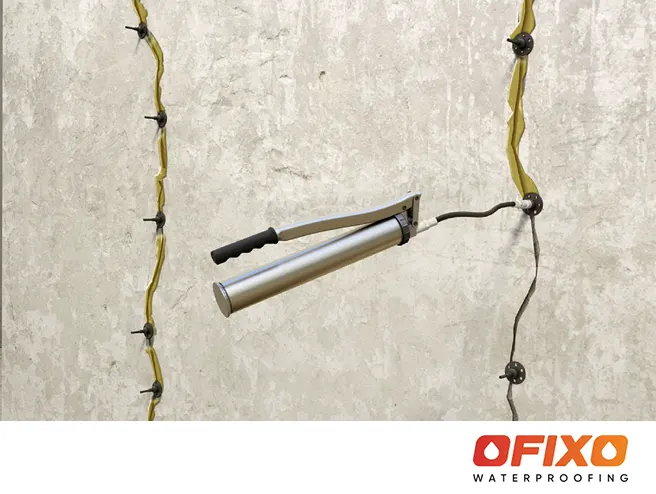
Concrete crack injection is the pressure-driven introduction of low-viscosity resin (epoxy or polyurethane) into a concrete crack via mechanical packers drilled along its length. The resin penetrates the full depth of the crack, seals it against water and chloride ingress, and – depending on resin choice – either bonds the crack faces structurally (epoxy) or remains flexible to accommodate further movement (PU resin).
The distinction worth holding: this is a preventive waterproofing service performed on cracks that exist but aren’t actively leaking. The decision to inject is made by a consultant, FM team, or contractor based on visual inspection, condition surveys, or scheduled defect remediation – not by water dripping onto a floor. Injecting before water finds the crack is dramatically faster, cheaper, and more controllable than chasing a live leak through a saturated substrate later on.
Disambiguation
Four Adjacent Services. Four Different Triggers.
Concrete Crack Injection often gets confused with three nearby services. The differences matter – wrong choice means wrong material, wrong contractor team, and wrong timing in the project programme.
Concrete Crack Injection
This page · Preventive Waterproofing- Trigger
- Visible crack on inspection. No active leak. Consultant or FM team specifies preventive seal during scheduled waterproofing campaign.
- Timing
- Planned. Programmed into project schedule or remediation phase.
- Materials
- Epoxy LV (structural seal) · PU resin (flexible seal) · Hybrid
← You are here
Live Leakage Injection
Adjacent · Reactive Leak Remediation- Trigger
- Active leak with visible water ingress. Emergency or urgent response required. Substrate already wet and pressurised.
- Timing
- Emergency dispatch. Same-day or 24–48hr mobilisation.
- Materials
- PU foam (curtain seal) · PU resin (permanent seal after foam)
PU Injection Waterproofing
Adjacent · Method / Chemistry Page- Trigger
- Project specifies PU injection as the chosen technique – covers both preventive and reactive PU applications across slab, wall, joint, and tank scopes.
- Timing
- Either preventive or reactive – depends on project context.
- Materials
- PU foam · PU resin (hydrophilic & hydrophobic variants)
Concrete Crack Repair
Adjacent · Structural Restoration- Trigger
- Crack indicates load-path or durability concern. Structural engineer’s assessment requires bonding of crack faces to restore monolithic behaviour. Waterproofing is secondary outcome.
- Timing
- Engineering-led. Follows structural assessment and remediation plan.
- Materials
- Epoxy LV (structural bonding) · Repair mortars · CFRP if combined with strengthening
Calling the wrong service wastes time and money. Crack Injection is the planned, preventive service – book it before water finds its way in.
Decision Matrix
Match the Crack to the Resin. Five Scenarios.
Picking the wrong resin is the most common preventable failure on injection projects. Use this matrix to brief consultants, validate spec sheets, or check a contractor’s proposal against the crack profile on site.
| Crack Profile | Substrate State | Recommended Resin | Why | Typical Application |
|---|---|---|---|---|
| Hairline cracks |
Dry to slightly damp | Epoxy LV |
Capillary penetration into hairline cracks needs ultra-low viscosity. Epoxy bonds the faces structurally and produces a permanently rigid, watertight seal. Best long-term result for static cracks. | Slabs, columns, beams, walls – non-moving cracks identified during scheduled inspection. |
| Structural cracks |
Dry | Epoxy LV (structural grade) |
Structural cracks need monolithic restoration of the concrete section. Structural-grade epoxy bonds the faces with tensile strength matching parent concrete. Effectively restores load path. | Post-construction defect remediation, structural assessment follow-up, beam/slab integrity. |
| Moving cracks |
Dry to damp | PU resin (flexible) |
Rigid epoxy would re-crack as the structure moves. Flexible PU resin stretches with thermal and structural movement, maintaining the watertight seal under cycling stress. | Expansion-joint adjacent cracks, thermal-cracked slabs, exposed walls subject to daily thermal cycling. |
| Wet or pre-saturated cracks |
Damp to wet | PU foam → PU resin (sequence) |
Epoxy won’t cure in the presence of water. PU foam expands on contact with moisture, displaces the water, and creates a temporary curtain seal. PU resin is then injected to permanently waterproof the crack. | Below-ground walls, lift pits, basement walls with retained dampness, retaining walls in marine zones. |
| Wide structural cracks |
Dry, structural assessment required first | Hybrid: structural epoxy + repair mortar |
Cracks above 2mm with displaced faces often indicate broader structural defect requiring conventional repair (cutting out, dowelling, mortar repair) before – or instead of – injection. This crosses into Concrete Crack Repair territory. | Cracks identified during a structural condition survey, settlement-related cracks, post-impact damage. |
If the substrate is actively leaking water at the time of survey, this isn’t a Crack Injection job – it’s Live Leakage Injection. Different team, different chemistry, different timing.
Applications
Eight Elements We Routinely Inject.
Crack Injection touches almost every concrete element in a building. Listed below are the eight element types we most often inject across Dubai residential, commercial, industrial, and infrastructure projects.
Suspended Slabs
Crack injection in suspended floor slabs above basements, MEP risers, plant rooms, and parking decks. Sealed from the dry side to prevent water tracking through to floors below.
Retaining Walls
Below-ground retaining walls in basements, lift cores, and substructures where hydrostatic pressure means small cracks become big leaks fast. Sealed before water finds the crack.
Podium Decks
Cracks in podium slabs above parking, lobbies, or retail. Critical to seal before they propagate through waterproofing membranes and produce ceiling stains below.
Basement Walls
Cast-in-situ basement walls with hairline cracks from concrete shrinkage, formwork pressure, or thermal stress. Sealed during fit-out or scheduled remediation.
Columns & Beams
Structural cracks in columns and beams identified during condition surveys. Often pairs with structural strengthening (CFRP wrap, steel plate). Sealed first; strengthened second.
Water Retaining Structures
Cracks in concrete water tanks, swimming pool shells, reservoirs, and septic structures. Pure-grade resins certified for potable water contact where required.
Expansion Joint Zones
Cracks running parallel to expansion joints, often from differential movement. Requires flexible resin choice to survive ongoing thermal cycling without re-cracking.
Car Park Decks
Decks with cracks subject to wheel loads, salt spray, and thermal cycling. Often combined with deck waterproofing and traffic-grade coatings as a full system.
The Method
Six Steps. Repeatable. Documented.
Every crack injection campaign follows the same six-step method. Each step is documented with photographs and recorded against the consultant’s spec – so the QA pack at handover is comprehensive and audit-ready.
-
01
Crack Survey & Mapping
Engineer survey to map every crack across the area: width, length, depth, movement classification (static vs moving), substrate state (dry/damp/wet). Photographs and condition diagrams generated. Output is the spec for resin choice and packer layout.
-
02
Substrate Preparation
Crack surface cleaned of dust, laitance, and debris. Any loose concrete adjacent to the crack carefully removed. For wet substrate cracks, pre-bleed test confirms water flow direction so PU foam can be staged correctly.
-
03
Surface Sealing
Crack face sealed with a fast-cure epoxy paste along its length. This is what contains the injection pressure – without it, resin would just bleed back out of the crack face rather than penetrate into the depth.
-
04
Packer Drilling & Installation
Mechanical packers drilled into the concrete at a 45° angle so they intersect the crack mid-depth. Packer spacing scales with crack depth (typically 100–250mm). Each packer is tightened to seal against the concrete.
-
05
Pressurised Resin Injection
Resin injected through each packer at calibrated pressure (typically 50–200 bar depending on resin type and crack profile). Injection proceeds bottom-to-top for vertical cracks, one packer at a time. Adjacent packers monitored for resin flow-through, which confirms full penetration.
-
06
Packer Removal & Finishing
Once resin has cured (24–48h depending on chemistry), packers removed, drill holes filled with matching repair mortar, and surface sealing paste removed by grinding. Final inspection records crack profile post-injection. QA pack handed over to consultant.
Why Ofixotech
Six Reasons Consultants and FM Teams Choose Ofixotech.
Crack Injection is a specialist service – material choice, packer spacing, and injection pressure all need engineering judgement. Here’s why consultants and main contractors across Dubai trust Ofixotech with these campaigns.
Engineer-Led Material Selection
Every campaign starts with an Ofixotech-engineered crack survey. We don’t apply a default resin to every job – we match resin chemistry to crack profile, substrate state, and movement classification, recorded against the consultant’s spec.
Consultant Spec-Ready
Method statements, MSDS sheets, manufacturer certifications, and QA records prepared upfront – to the standard your consultant expects. We’ve worked with most major UAE consultancies and understand spec adherence.
Multi-Resin Capability
Epoxy LV, structural epoxy, hydrophobic PU resin, hydrophilic PU resin, PU foam, hybrid systems – all in regular use, not a one-system shop. Crack profile determines material; we hold the inventory and the training across all four.
Documented QA Pack
Per-crack photographic record: pre-injection survey shot, packer layout shot, mid-injection shot, post-cure inspection shot. Output is a campaign-level QA pack signed off by Ofixotech engineer and ready for consultant audit.
Programme-Compatible
Crack injection often sits inside a wider waterproofing or refurbishment programme. We mobilise around your sequence – slabs first, walls later, joints last, or whatever the spec demands. Phased delivery is normal.
Warranty & Re-Injection
Written workmanship warranty on every injected crack. If a crack reopens within the warranty period, we re-inject at no charge. This is rare with epoxy on static cracks; somewhat more common with PU on moving cracks – and the warranty accounts for it.
Cracks Identified? Seal Them Before They Leak.
Free crack survey, engineer-led material selection, written method statement before any drilling starts. Consultant-ready QA pack at handover – the cheaper, faster, more controllable side of injection.
or WhatsApp +971 55 770 5568
Answered
Concrete Crack Injection FAQs.
Specifier and contractor questions about scope, materials, timing, and the boundary with adjacent services.
What is the difference between concrete crack injection and live leakage injection?
Both use the same delivery technique (packer drilling and pressure injection) but the goal is different. Concrete crack injection targets dry or non-active cracks where the priority is restoring structural integrity by bonding the crack faces back together – typically with a structural epoxy. Live leakage injection targets actively flowing leaks where the priority is sealing the water path – typically with a hydrophobic polyurethane that reacts on contact with moisture.
On the same project the two often follow each other: a hydrophobic PU stops the active leak today, then a structural epoxy is injected once the substrate has dried to recover the load path.
Epoxy or polyurethane – which resin do you specify, and when?
The choice is dictated by the crack’s behaviour and the design intent:
- Structural epoxy – rigid, high-modulus, used for static cracks where you need to recover the structural bond. ASTM C881 Type IV/V for load-bearing applications. Will fail if the crack continues to move.
- Polyurethane (hydrophobic) – flexible, water-reactive, used for active leaks regardless of movement.
- Polyurethane (hydrophilic gel) – elastic, used for moving joints and cracks under continuing thermal or live cycling, where rigid resin would re-crack.
Our crews carry all three families and switch selection on site if the crack behaviour differs from the spec assumption.
What crack widths can be injected?
Practical injection range is 0.1 mm to 10 mm. Below 0.1 mm the resin cannot penetrate even under high pressure – those hairlines are addressed with surface-applied capillary sealers instead. Above 10 mm the defect is no longer a crack in the engineering sense; it’s a delamination or void and is addressed with mortar grouting or section repair instead.
For the typical specifier range (0.2 to 2 mm cracks in beams, slabs, and walls) low-viscosity epoxy will fully penetrate and bond the faces in a single injection pass.
Does crack injection restore structural integrity?
Yes – when correctly specified. A structural epoxy injection bonds the crack faces with a cured tensile strength that exceeds the tensile strength of the parent concrete. Failure under subsequent load occurs in the substrate, not at the bond line. This is the basis on which crack injection is accepted in structural repair specifications (ACI 224.1R, EN 1504-5).
Important caveat: structural integrity is only restored if the crack is stable. If it is still moving from a live cause (settlement, thermal cycling, design overload), epoxy will re-crack within months. The cause must be addressed before specifying epoxy – we provide that assessment as part of our scope.
How is injection different from surface crack sealing or routing-and-sealing?
Surface sealing is cosmetic – a sealant is applied to the visible face of the crack. It does not penetrate, does not bond the crack interior, and offers no structural recovery. Useful for non-structural hairlines on architectural surfaces where the only goal is visual or moisture exclusion at the surface.
Crack injection is a structural repair. The resin penetrates the full depth of the crack under pressure (typically 200 to 1,000 psi), filling the entire defect volume from the back face forward, and cures to a continuous monolith with the parent concrete.
Can you inject cracks that are still moving (live or dynamic cracks)?
Yes, but the material selection changes. For live cracks – those with on-going movement from thermal cycling, structural settlement, or vibration – we specify a flexible polyurethane (hydrophilic or hydrophobic depending on whether water is present) rather than rigid epoxy. The cured PU absorbs subsequent movement without re-cracking.
If the structural function of the cracked element matters (load path, code compliance), we also recommend addressing the cause – additional restraint, expansion joint introduction, or strengthening – in parallel with the injection. Injection alone is rarely the complete answer for a moving structural crack.
Can injection be done from one face only – i.e. when only one side is accessible?
Yes. Injection is a one-side technique by design. Packers are drilled at a 45-degree angle from the accessible face, intersecting the crack plane at depth. Under pressure the resin travels through the crack to the far face. We typically observe resin “bleed” appearing on the opposite face within seconds, confirming through-thickness fill.
This makes injection the right specification for retaining walls, basement walls, water tanks, and any element where the back face is buried or submerged. We do not need access to the back of the element.
What is the typical timing – lead time, installation window, and re-occupation?
Lead time from quote acceptance: 5 to 7 working days for typical projects (single beam, room, or wall). Faster on emergencies.
Installation window: a single typical crack of 2 to 4 metres is injected and completed in one day. Larger projects (multi-room basements, distributed cracking) typically run 3 to 7 days.
Re-occupation: epoxy reaches structural strength in 24 to 48 hours, full chemical cure in 7 days. Polyurethane reaches sealing performance in minutes, full cure in 24 hours. The space can be returned to service the next day in both cases – no extended down-time required, which is why injection is the preferred specification on occupied buildings and live facilities.