
ESD Flooring Specialists · Dubai & UAE
Anti-Static / ESD Flooring – Conductive Epoxy Systems for Electronics, Data Centres, and Critical Operations.
Specialist anti-static and ESD (electrostatic discharge) flooring across Dubai and the UAE – conductive copper-grid epoxy systems engineered for environments where uncontrolled static destroys electronics, contaminates pharma processes, or risks ignition in critical operations. Three resistance tiers – Anti-Static, Static-Dissipative, Conductive – specified to ANSI/ESD S20.20, IEC 61340, and ATEX where required.
- 3 resistance tiers
- Copper grid earthing
- Resistance testing & certification
Engineered to Earth
What is ESD Flooring?
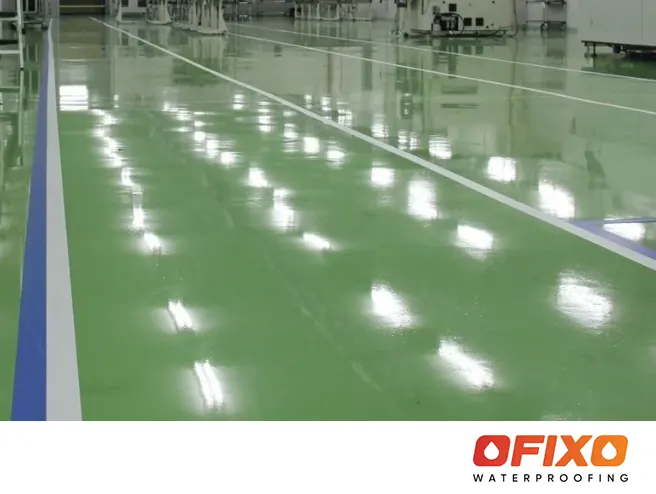
Anti-static or ESD (electrostatic discharge) flooring is a specialist epoxy system engineered to safely dissipate accumulated static electricity from people, equipment, and trolleys to earth – preventing the silent damage that uncontrolled static causes to sensitive electronics, the contamination risk in pharmaceutical processes, and the ignition risk in explosive atmospheres. A copper earthing grid is bonded to the substrate and embedded in conductive epoxy; the grid is connected to the building earth bonding system at multiple points.
Distinct from general industrial or commercial epoxy: ESD systems are specified by electrical resistance – measured in ohms (Ω) – not by thickness or aesthetic. Three resistance tiers cover the range from gentle charge dissipation (anti-static) through to high-speed earthing for explosive atmospheres (conductive). Specifications follow ANSI/ESD S20.20, IEC 61340-5-1, and where ATEX zones apply, the additional standards for equipment installation. Resistance is tested at handover with calibrated megohmmeters and the certificate forms part of the warranty pack.
The Compliance Case
Four Reasons Electronics, Pharma, and Data Centres Specify ESD Flooring.
ESD flooring isn’t aesthetic – it’s a controlled-environment compliance requirement. Four specific operational realities drive the specification, each with auditable consequences if uncontrolled static reaches sensitive equipment or processes.
Electronics Damage Prevention
Even 50V of accumulated body static (well below the 3,500V humans typically feel) destroys modern semiconductor components silently – failures appear days or weeks later as field returns. ESD flooring is the foundation layer of an electronics manufacturer’s ESD-protected area (EPA). Specified by quality teams and audited by OEM customers.
Pharmaceutical Process Integrity
Static attracts and holds airborne particulates – contaminating dispensing operations, sterile filling lines, and tablet press environments. Conductive flooring is a GMP and ISO 14644 clean room compliance requirement. Specified by pharma QA teams; audited by regulatory inspectors during plant certification.
ATEX Ignition Risk Control
Solvents, fuels, fine dusts, and pyrotechnic materials need static-controlled flooring to prevent ignition from accumulated charge. ATEX zone classification drives the requirement; the floor is treated as electrical equipment for purposes of ignition risk assessment. Specified by HSE teams in chemical, defence, and petrochemical operations.
Data Centre & Server Hall Hygiene
Equipment moved on trolleys, server-rack handling, and personnel walking past racks all generate static that can damage server components or trigger nuisance equipment trips. Static-dissipative flooring is a Tier III / Tier IV data centre design standard and frequently a tenant fit-out requirement for colocation facilities.
Resistance-Specific Specification
Three Tiers. Three Levels of Static Control.
ESD flooring is specified by electrical resistance to earth, measured in ohms. Three engineering tiers cover the full operational spectrum – from gentle static reduction through to high-speed earthing for explosive atmospheres. Choosing the right tier is a compliance decision, not a budget decision.
Anti-Static Flooring
The lightest tier – reduces static accumulation without aggressive earthing. Suitable where some static control is needed but full ESD compliance is not. Often specified in offices adjacent to ESD-controlled areas, light electronics handling, and general clean office environments.
Static-Dissipative Flooring
The mainstream ESD specification – balances controlled dissipation speed with personnel safety (slow enough not to be a shock risk, fast enough to prevent ESD damage). The default for electronics manufacturing, data centres, and most pharma applications.
Conductive Flooring
The highest-conductivity tier – engineered for ATEX-classified zones, munitions handling, pyrotechnic operations, and any environment where rapid earthing of static is required to prevent ignition. Specified where ignition risk drives compliance.
Compliance-Driven Scenarios
Four Environments. Four Different Compliance Stacks.
ESD flooring sits inside very different compliance frameworks depending on the industry. Each environment brings its own standards, testing protocols, and audit expectations. Here’s how we scope each one.
Data Centres & Server Halls
Standards
- Tier III / Tier IV design
- BICSI
- TIA-942
Typical Specification
Static-dissipative epoxy (10⁶–10⁹ Ω), 2–3mm self-levelling. Copper grid earthing at 2–3m intervals bonded to building earth. Coloured zoning for hot/cold aisles. Operating around live equipment.
Testing & Documentation
Resistance testing per IEC 61340-4-1 at handover. Periodic re-testing scheduled into FM regime. Certificate per zone.
Typical Projects
Colocation facilities, hyperscale tenants, telecom carrier hotels, enterprise private data centres.
Electronics Manufacturing & Assembly
Standards
- ANSI/ESD S20.20
- IEC 61340-5-1
- EPA design
Typical Specification
Static-dissipative epoxy (10⁶–10⁹ Ω), 2–3mm self-levelling or solvent-free body coat. Copper grid earthing throughout EPA. Coloured boundary marking at EPA perimeter.
Testing & Documentation
Floor surface resistance testing, point-to-ground resistance, walking voltage tests per ANSI/ESD STM7.1 and ESD STM97. Documentation pack for OEM customer audits.
Typical Projects
Semiconductor assembly, PCB manufacturing, electronics OEMs, component handling, medical device assembly.
Pharmaceutical & Cleanroom
Standards
- GMP
- ISO 14644
- USP <797>
- MHRA / FDA
Typical Specification
Static-dissipative or conductive (10⁴–10⁹ Ω per process), 2–4mm self-levelling. Food-grade or pharma-grade resin chemistry. Coved skirtings, integral drains in wash-down areas. Low-VOC for cleanroom.
Testing & Documentation
Resistance testing per IEC 61340; particle generation testing; coating outgassing certificate. Aligned to GMP qualification packs (DQ/IQ/OQ).
Typical Projects
Pharma manufacturing, sterile filling, tablet press rooms, dispensing, R&D labs, clinical sample handling.
Munitions, Defence & ATEX
Standards
- ATEX
- IEC 60079
- MIL-STD
- OSHA explosives
Typical Specification
Conductive epoxy (10⁴–10⁶ Ω), 3–5mm. Dense copper grid earthing on tight spacing. Anti-spark aggregate broadcast where required. Method statement reviewed by competent person under DSEAR/ATEX framework.
Testing & Documentation
Resistance testing per IEC 61340; bonding continuity verification across the earthing grid; documentation for ATEX zone equipment register.
Typical Projects
Munitions handling, pyrotechnic manufacturing, defence depots, paint manufacturing, solvent storage, fuel handling.
Not sure which compliance framework applies to your project? Our ESD specialists meet with your QA, HSE, or facilities engineering team and align the floor specification to your specific audit and certification requirements before any work commences.
Step by Step
Our 6-Step ESD Floor Installation Process.
ESD systems are unforgiving – wrong earthing grid spacing, wrong primer, wrong topcoat, and the resistance numbers fail at handover testing. Our process is built around the testing certificate, not just the visual finish.
-
01
Survey & Standards Review
Meet with your QA / HSE / IT / engineering team to confirm the applicable standard (ANSI/ESD S20.20, IEC 61340, ATEX, GMP), the required resistance tier, EPA boundaries, earthing bond points, and any client-specific audit requirements. Method statement aligned to compliance framework.
-
02
Substrate Preparation
Diamond grinding to remove laitance, oils, and existing coatings. Substrate moisture testing (must be <4%). Crack and pit repair using epoxy mortar. Surface profile CSP-3 to CSP-5. Foundation for the conductive system above.
-
03
Copper Earthing Grid Installation
Adhesive-bonded copper tape grid laid out at manufacturer-specified spacing (typically 2–3m, tighter for conductive tier). Earthing tails routed to building earth bond points at multiple locations. Continuity tested across the grid before priming.
-
04
Conductive Primer Application
Two-component conductive epoxy primer applied to the prepared substrate, encapsulating the copper grid and providing the conductive bond layer. Strict moisture and temperature control. Curing window confirmed before topcoat.
-
05
Conductive Body Coat & Topcoat
Conductive body coat applied – solvent-free system formulated with conductive carbon or metallic additives that maintain the resistance specification throughout the build. Topcoat seal applied. Total build typically 2–4mm depending on tier.
-
06
Resistance Testing, Certification & Handover
Calibrated megohmmeter testing per IEC 61340-4-1 (surface resistance) and ESD STM7.1 (point-to-ground). Multiple test points per zone, results documented per location. Certificate of compliance issued. Handover pack includes batch records, datasheets, photographs, earthing grid drawings, and warranty paperwork.
Why Ofixotech
Six Reasons Critical Environment Buyers Specify Ofixotech.
ESD flooring projects are won and lost on the resistance certificate at handover. Here’s why electronics manufacturers, data centre operators, pharma QA teams, and HSE managers across Dubai work with us.
Standards Literacy
ANSI/ESD S20.20, IEC 61340-5-1, IEC 61340-4-1, ATEX, MIL-STD, GMP – we know which standard applies to which environment, and the testing protocol that goes with it. Method statements written in the compliance language your audit team expects.
Three Tiers In-House
Anti-static, static-dissipative, and conductive systems – delivered by one specialist team. Tier selection driven by the actual compliance requirement, not by the contractor’s default specification.
Manufacturer-Backed Materials
Sika Sikafloor ESD, Fosroc Nitoflor anti-static, BASF MasterTop conductive, Mapei ESD ranges. Direct manufacturer relationships with technical witnessing on critical projects, batch records, and warranty support.
Resistance Testing Capability
Calibrated megohmmeter testing equipment, technicians trained on IEC 61340 and ESD STM7.1 protocols. Resistance certificate at handover with multiple test points per zone – not a single representative number.
Live-Environment Phasing
Data centres run 24/7. Pharma facilities cannot interrupt batch cycles. Electronics assembly lines plan shutdowns months in advance. We work inside those constraints – night work, weekend phases, sectioned isolation, dust and odour control.
Audit-Ready Documentation
Quality, compliance, and audit teams need paper trails – method statements, batch records, daily QC logs, earthing grid drawings, resistance test results, manufacturer paperwork. Compliance pack assembled at handover.
Data Centre, Electronics, or Critical Environment Project?
Free ESD survey – we meet your QA/HSE/engineering team, confirm the applicable standard, recommend the resistance tier, and quote with documentation aligned to your audit framework.
or WhatsApp +971 55 770 5568
Answered
Anti-Static / ESD Flooring FAQs.
The questions QA managers, electronics engineers, data centre operators, pharma compliance teams, and HSE officers ask most about ESD flooring in Dubai.
Which resistance tier do I need: anti-static, static-dissipative, or conductive?
Driven by the applicable standard for your environment. For ANSI/ESD S20.20 compliance (electronics manufacturing EPAs): static-dissipative (10⁶-10⁹ Ω) is the default. For Tier III/IV data centres: static-dissipative. For pharma and GMP cleanrooms: static-dissipative typically, conductive where process-specific. For ATEX zones and munitions handling: conductive (10⁴-10⁶ Ω). Anti-static (10⁹-10¹¹ Ω) is the lightest tier – suitable where some control is needed but full ESD compliance isn’t required. We confirm tier in writing during the survey based on your specific compliance framework.
Will the floor pass our audit / OEM customer inspection?
That’s the entire point of the testing-and-certification stage. We test resistance to IEC 61340-4-1, ESD STM7.1, and STM97 protocols at handover, with multiple test points per zone, and issue a certificate of compliance with the results. The certificate forms part of the warranty pack and is sized to satisfy OEM electronics audits, pharma regulatory inspections, ATEX competent-person reviews, and data centre tier certification. If a specific audit body requires a particular testing protocol, flag it at survey stage and we align.
How does the copper grid earthing work?
Adhesive-bonded copper tape is laid in a grid pattern on the prepared substrate before priming – typical spacing 2-3m for static-dissipative systems, tighter (1-2m) for conductive. The grid is encapsulated by the conductive primer and body coats; resistance from any surface point on the finished floor flows through the conductive system to the grid, then via earthing tails to your building earth bonding system. Multiple tails per zone provide redundancy. Earthing diagram included in handover pack.
Can you work in operational data centres / 24/7 facilities?
Yes – that’s a core part of the brief. Live-environment phasing means isolating one zone (or one rack row) at a time, working around operational shifts, controlling dust and noise during substrate prep, and protecting adjacent live equipment with hoarding. Method statements include access control, dust suppression, and emergency stop protocols. We’ve supported this delivery model for data centre operators and pharma facilities running 24/7.
How long does the resistance hold up over time?
Properly installed conductive epoxy maintains resistance specification for 10-20 years under normal use. The conductivity comes from carbon or metallic additives dispersed through the resin; these don’t deplete with wear. Surface contamination (especially polishes, waxes, oily residues) can mask the conductivity – which is why we recommend a maintenance regime that avoids these. Periodic re-testing (typically annual or biennial) is standard FM practice and confirms the floor still meets spec.
What if my substrate isn’t sound?
Then it needs Concrete Resurfacing or Concrete Restoration before ESD goes down. ESD systems assume sound, level concrete substrate. We flag substrate condition at survey and quote a combined scope if substrate work is needed. The earthing grid and conductive layers depend on a stable, properly-prepared base; cutting corners here means failing resistance at handover testing.
Can ESD flooring be installed in cleanrooms with low VOC requirements?
Yes – manufacturer-formulated low-VOC ESD systems are available from Sika, BASF, Mapei, and Fosroc for cleanroom and pharma applications. The outgassing certificate is provided as part of the handover documentation pack, supporting cleanroom qualification (IQ/OQ) and GMP audit. Application protocols include extra ventilation and cure-time management to minimise residual outgassing.
What warranty and certification do you provide?
Manufacturer product warranty: typically 10-15 years on cured ESD systems (period varies by system and exposure). Our written workmanship guarantee: typically 2 years on installation. Resistance certificate of compliance issued at handover with measured values at multiple test points. Combined warranty pack: batch records, earthing grid drawings, daily QC logs, resistance test results, datasheets, manufacturer paperwork. Audit-ready for QA, regulatory, and certification body review.