
Movement-Joint Specialists · Dubai & UAE
Expansion Joint Waterproofing – Sealing the Gaps That Stop Your Building Cracking.
Specialist waterproofing for expansion joints, movement joints, construction joints, and seismic joints in roofs, podiums, basements, car parks, façades, and pavements. Engineered to flex 25%+ in any direction while staying watertight – handling thermal movement, settlement, and seismic shift without failure.
- Roofs · Podiums · Basements
- Façades · Pavements
- 25%+ movement tolerance
About the Service
What is Expansion Joint Waterproofing?
An expansion joint is a deliberate gap built into a structure – designed in by the engineer, not a defect – to allow concrete and steel elements to expand, contract, settle, and shift without cracking the structure. Every building over a certain size has them. Dubai’s extreme thermal cycling (25°C nights to 55°C+ rooftop surfaces) makes them especially important.
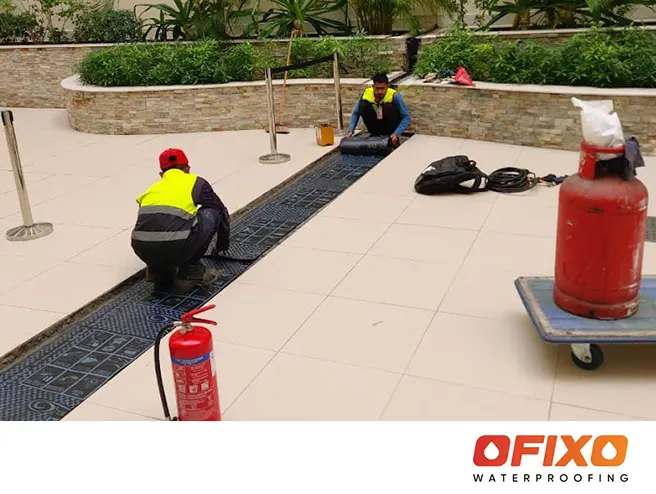
Expansion joint waterproofing is the specialist sealing of these gaps – using flexible sealants, joint profiles, and cover systems engineered to flex with the building while staying watertight. Unlike standard waterproofing (which seals a static surface), joint waterproofing handles continuous movement of 25% or more in any direction. Used across roofs, podium decks, basement walls, car park slabs, façades, and concrete pavements.
Why It Matters
Four Reasons Joint Waterproofing Can’t Be Skipped.
Standard waterproofing fails at expansion joints because it can’t handle the movement. The joint is the part of the structure most likely to leak – and the part most often done badly.
Handles Thermal Movement
Dubai concrete expands and contracts daily as surface temperatures swing 30°C+ between night and noon. The joint absorbs this movement – but only if the sealant can flex 25%+ without tearing.
Accommodates Settlement
Buildings settle as foundations consolidate over the first years of occupancy. The joint allows controlled differential settlement between adjacent structural blocks – without cracking walls and slabs above.
Single Biggest Leak Risk
Expansion joints are the most common leak source on rooftops, podiums, and basement walls. Get the joint right and you eliminate the dominant failure mode in below-grade and above-grade waterproofing.
Required by Code
Dubai Municipality and structural design standards require expansion joints in all buildings over a certain footprint – and require the joints to be sealed against water ingress. Non-compliance fails inspection.
Four Joint Types
Different Gaps. Different Movements. Different Solutions.
Not every gap in a building is the same. Each joint type has a different function and movement profile – and the right sealant system depends on which type you have.
Movement Joint
Routine thermal cyclingThe general-purpose joint that handles daily thermal expansion and contraction of concrete elements – typically 10–25mm wide, repeating every 6–9 metres in a roof slab or pavement. The most common joint type by volume.
Construction Joint
Cold joints between poursCreated where concrete pours stop and restart – between separately cast slabs, walls, or beams. Not designed for ongoing movement, but susceptible to shrinkage cracking. Sealed with waterstops embedded during the pour, then surface sealants for redundancy.
Expansion Joint
Major structural breakA full structural break separating adjacent buildings or large building sections – sometimes 50–100mm wide. Allows independent thermal and settlement movement between blocks. Requires heavy-duty joint profiles plus flexible sealant.
Seismic Joint
Earthquake & seismic shiftThe widest joint type – designed to accommodate large lateral movement during seismic events. Particularly relevant for taller Dubai towers and buildings over certain heights. Specialised joint cover assemblies that telescope during seismic shift.
Inside the Joint
Anatomy of a Properly Sealed Expansion Joint.
A properly waterproofed joint is a 4-component system – not just sealant in a gap. Get any layer wrong and the joint fails within years.
-
01
Joint Faces Prepared
The concrete faces inside the joint are cleaned, sound, and primed. Loose material is removed and any spalled edges are repaired. Bad preparation is the #1 cause of joint failure within 12 months.
-
02
Backer Rod Installed
Closed-cell polyethylene backer rod (foam cylinder) pushed into the joint to control sealant depth and create the correct hourglass profile. Sets the sealant thickness – too thin and it tears, too thick and it can’t flex.
-
03
Bond Breaker / Tape
Polyethylene tape on the bottom of the joint prevents the sealant from sticking to the backer rod. Allows the sealant to flex freely on its two sides only – three-sided adhesion causes early tearing.
-
04
Flexible Sealant Applied
Polyurethane or silicone sealant applied to the correct depth and tooled to the correct hourglass profile. Cures elastically – flexes 25%+ in extension and compression without losing adhesion to the joint faces.
Locations We Work
Six Building Locations Where Joints Need Waterproofing.
Expansion joints aren’t just a roof concern – they exist throughout every commercial building. Wherever there’s a joint, water finds it first.
Roof Slabs
Daily thermal cycling makes roof slab joints the most movement-active in the building. The single most common failure point on flat roofs across Dubai.
Podium Decks
Joints in trafficked podium decks above basement car parks – heavy traffic loads combined with thermal movement demand robust joint systems with cover plates.
Car Park Slabs
Joints in suspended car park slabs see traffic loading, water spray, and thermal movement. Specialised traffic-grade joint covers required.
Basement Walls
Vertical joints in below-grade basement walls – under permanent hydrostatic pressure, require waterstops embedded during the pour plus surface sealants.
Building Façades
Joints between adjacent buildings or between different façade systems – must accommodate movement while maintaining the visual line of the elevation.
Concrete Pavements
Joints in concrete driveways, plazas, and external pavements – exposed to UV, traffic, and rainwater. Often the most neglected joints on a property.
Step-by-Step
Our 6-Step Joint Waterproofing Process.
Every joint follows the same disciplined sequence – only the specific products vary between joint types and locations. Skipping any step shortens service life dramatically.
-
01
Joint Inspection & Sizing
Measure joint width across multiple points, identify joint type, assess current condition and sealant failure mode. Document joint geometry photographically.
-
02
Remove Existing Sealant
Cut out and remove the failed sealant back to sound concrete. Mechanical removal preferred over chemical – leaves a clean surface for new sealant adhesion.
-
03
Joint Face Preparation
Clean joint faces with wire brush or grinder. Repair spalled edges with polymer-modified mortar. Apply manufacturer-specific primer to joint faces.
-
04
Install Backer Rod
Push closed-cell polyethylene backer rod into the joint to the correct depth – typically half the joint width. Creates the hourglass sealant profile.
-
05
Apply Bond Breaker
Lay polyethylene tape over the backer rod at the joint base. Prevents three-sided adhesion of sealant – critical for long-term flex performance.
-
06
Apply & Tool Sealant
Inject polyurethane or silicone sealant from the bottom up to avoid air entrapment. Tool to the correct hourglass profile. Cure 24–72 hours before traffic or water exposure.
Why Ofixotech
Six Reasons Dubai Specifies Ofixotech for Joints.
Joint work demands specialist contractors who understand sealant chemistry, joint mechanics, and the difference between a joint that lasts 15 years and one that fails in 18 months.
All 4 Joint Types
Movement, construction, expansion, and seismic joints – a single specialist contractor across every joint type we encounter in Dubai construction.
Correct Sealant Selection
We specify the right sealant chemistry for your joint type, exposure, and movement profile – polyurethane for trafficked areas, silicone for façades, hybrid for special cases.
Correct Joint Geometry
Backer rod sizing, bond breaker placement, hourglass profile depth – done right, every time. Most joint failures come from incorrect geometry, not bad sealant.
Every Building Location
Roofs, podiums, basements, façades, car parks, pavements – same crew, same standards. No need to subcontract between specialists for different joint locations.
15+ Year Service Life
Quality sealants properly installed last 15+ years. Cheap sealants or poor installation last 18–24 months – then you pay twice. Specify it properly the first time.
Workmanship Warranty
Every project includes both manufacturer product warranties (typically 10–20 years on premium sealants) and our written workmanship guarantee.
Joints Cracked, Leaking, or Failing?
Book a free joint survey – we'll inspect every joint on your structure, identify which need resealing, and quote within 24 hours.
or WhatsApp +971 55 770 5568
Answered
Expansion Joint Waterproofing FAQs.
The questions Dubai facility managers, building owners, and main contractors ask most about expansion joint waterproofing and re-sealing.
What exactly is expansion joint waterproofing?
Expansion joint waterproofing is the sealing of deliberate gaps designed into a building’s structure – gaps that allow concrete and steel elements to expand, contract, settle, and shift without cracking. The waterproofing uses flexible sealants, backer rods, and (for larger joints) joint cover assemblies to seal these gaps while allowing them to keep moving. Standard waterproofing fails at joints because it can’t handle the movement.
Why do expansion joints fail most often?
Three causes account for the majority of joint failures: (1) wrong sealant chemistry for the joint type – silicone where polyurethane was needed, or vice versa, (2) incorrect joint geometry – wrong backer rod depth or three-sided sealant adhesion that tears under movement, (3) substrate preparation failure – sealant applied to dusty, contaminated, or unprimed joint faces. We address all three by using the right product, the right geometry, and proper preparation.
Can sealant be replaced without full joint reconstruction?
Yes – in most cases. Re-sealing involves cutting out the old failed sealant, cleaning the joint faces, replacing the backer rod and bond breaker, and applying new sealant. This is a fraction of the cost and disruption of full joint reconstruction. Full reconstruction is only needed when the joint geometry itself is wrong (e.g. joints created too narrow) or when underlying waterstops have failed.
How often should expansion joint sealant be replaced?
Quality polyurethane and silicone sealants typically last 15+ years before requiring replacement – varying by joint type, exposure, movement intensity, and original installation quality. Trafficked joints (car park slabs, podiums) age faster than façade or roof joints. We recommend inspection every 5 years and re-sealing on a cycle of 12–15 years for high-quality systems.
Polyurethane vs silicone – which sealant is better?
Both are excellent – choice depends on application. Polyurethane is more durable under abrasion and chemical attack, paintable, and the default for trafficked horizontal joints (car park slabs, podiums, pavements). Silicone has superior UV resistance and longer service life, but is not paintable – the default for façade and roof joints where weathering matters more than abrasion. Hybrid sealants combine properties for specialised applications.
What about trafficked joints – car park decks, podiums?
Trafficked joints require traffic-grade joint cover assemblies – typically aluminium or stainless steel cover plates that bridge the joint while allowing movement underneath. Below the cover, the actual waterproofing seal is provided by the sealant. Cover plates protect the sealant from direct traffic damage and extend service life significantly.
Does Dubai code require expansion joints?
Yes – Dubai Municipality and standard structural design codes require expansion joints in buildings exceeding certain footprint dimensions (typically 30–40 metres in any direction without a joint). The joints must also be sealed against water ingress as part of the building’s waterproofing package. Non-compliance fails inspection and risks handover delays.
Do you provide warranty?
Yes – every project includes both manufacturer product warranties (typically 10–20 years on premium polyurethane and silicone sealants) and our written workmanship guarantee. Warranty documentation is provided at handover along with maintenance recommendations.