
Substrate Renewal Specialists · Dubai & UAE
Concrete Resurfacing – Substrate Renewal for Worn, Damaged, and Uneven Concrete.
Specialist concrete resurfacing across Dubai – rebuilding worn, damaged, or uneven concrete floors with polymer-modified overlays from 3mm thin sections up to 25mm structural lifts. NOT a coating – this is substrate renewal that gives you a new working surface to live with, work on, or coat afterwards. Six specialist systems matched to substrate condition, traffic loading, and finished appearance.
- 6 Resurfacing Systems
- 3–25mm Overlay Range
- Industrial or Decorative Finish
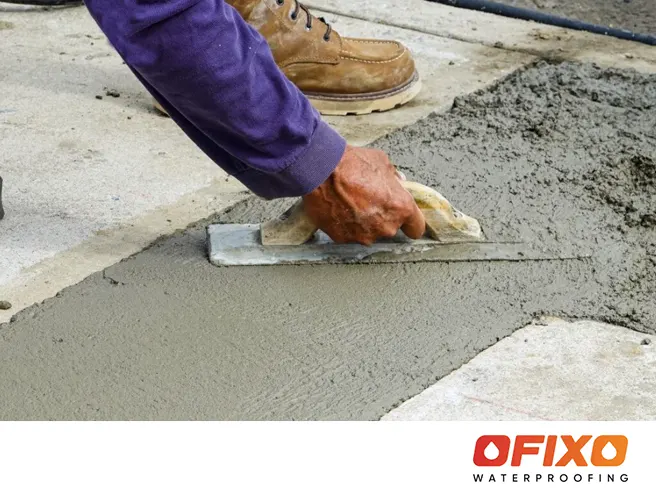
Rebuilding the Substrate
What is Concrete Resurfacing?
Concrete resurfacing is the application of polymer-modified cement or resin overlays to existing concrete substrates – rebuilding worn, damaged, pitted, or uneven floors with a new structural layer that becomes part of the substrate itself. Overlay thicknesses range from 3mm (decorative micro-toppings) to 25mm (heavy-duty industrial floors), specified per the substrate condition and the use case.
Critically distinct from epoxy flooring (a separate Ofixotech service): epoxy coatings sit on top of sound substrate as a thin (1–3mm) protective finish – they assume the concrete underneath is in good condition. Concrete resurfacing REBUILDS that substrate when it isn’t sound. The two often combine on the same project: resurface to restore the substrate, then coat with epoxy for the finished face. If your concrete is worn, cracked, pitted, or uneven, this scope comes first.
Why It Matters
Four Signs Resurfacing Is the Right Scope.
Different concrete failures point to different repair scopes. These four signs tell you resurfacing is the answer – not coating, not patching, not full replacement.
Surface Wear & Abrasion
Years of foot traffic, vehicle wear, or heavy equipment have worn the surface aggregate exposed and ground the original finish away. Coating over this won’t restore the surface; it’ll just thinly paint over a worn substrate that keeps wearing through.
Pitting, Spalling & Pop-Outs
Surface defects from impact damage, freeze-thaw cycles (Dubai winter chillers), or aggregate failure leaving pits and holes across the floor. Resurfacing fills these back to a continuous flat surface; coating leaves the holes visible.
Uneven or Out-of-Level Floors
Slabs that have settled differentially, original screeds that weren’t laid flat, or floors that have moved over decades. Self-levelling resurfacing overlays restore flatness without demolishing the substrate. Critical for tenant fit-out scopes.
Substrate Wants a New Face
Aesthetic refresh of tired concrete – warehouses being repositioned as showrooms, parking decks becoming retail, industrial spaces converted to commercial. Resurfacing gives the substrate a new identity, ready for whatever finish comes next.
Technical Breadth
Six Distinct Resurfacing Systems – Specified to Substrate and Use.
Not one system fits every substrate or every use case. We carry six – from 3mm decorative micro-toppings to 25mm structural overlays. Diagnostic survey determines which one applies to your floor.
Polymer Thin Overlay
3–6mm · Light Traffic
Thin polymer-modified cement overlay for cosmetic refresh of sound substrates with surface wear. Restores a flat, paintable, coatable surface without major substrate intervention.
Typical use: Light commercial floors, office areas, light retail.
Self-Levelling Underlayment
5–10mm · Flatness Priority
Free-flowing polymer-modified overlay that self-levels to flat under gravity. The default specification when finished flatness is critical – retail fit-outs, hospitality, anywhere tile or LVT will follow.
Typical use: Pre-finish substrates for tile, vinyl, LVT, or epoxy coating.
Heavy-Duty Mortar Overlay
10–25mm · High Wear
Structural-grade polymer-modified mortar for warehouse, parking, and industrial floors subject to heavy vehicle, forklift, or pallet loading. Trowel-applied in multiple lifts for the thicker sections.
Typical use: Warehouses, parking decks, industrial production floors, loading bays.
Decorative Micro-Topping
2–4mm · Architectural Finish
Pigmented, polishable polymer-modified topping designed as the finished face – colour, texture, and pattern integral to the material. The architectural specification for showrooms, retail spaces, and residential lofts.
Typical use: Showrooms, retail, hospitality, premium residential interiors.
Diamond Grinding & Polishing
Mechanical · Densified Finish
Mechanical resurfacing through progressive diamond grinding (40-grit through 1500+ grit), combined with chemical densifiers, producing a polished concrete finish from the existing substrate. No overlay material added.
Typical use: Architecturally exposed concrete, polished industrial floors, showrooms.
Hybrid Crack Repair + Resurface
Injection + Overlay
Combined scope: structural epoxy injection of cracks first (coordinated with our Concrete Crack Repair team), then overlay applied across the full area to deliver both structural restoration and a renewed surface in one programme.
Typical use: Cracked substrates needing both structural repair AND surface renewal.
The Big Misunderstanding
Resurfacing Is Substrate Renewal. Coating Is a Finish.
Most enquiries we get for concrete resurfacing are actually asking about epoxy coating – and vice versa. The two scopes solve different problems. Here’s the rule for picking the right one.
Resurfacing
Concrete Resurfacing
Polymer-modified cement or resin overlay applied to existing concrete that REBUILDS the substrate. Adds new material; gives you a new working surface. Coats can be applied afterwards on top.
Use when
- Substrate is worn, pitted, spalled, or uneven
- Floor is out of level and needs flattening
- Coating alone won’t solve the problem
- Goal is a NEW working surface
Epoxy Flooring
Epoxy Coating
Epoxy or polyurethane resin coating system applied to SOUND concrete substrates as a protective and decorative finish. Sits on top of the concrete; doesn’t rebuild it. Assumes substrate is good.
Use when
- Substrate is sound (intact, level, undamaged)
- Need a hygienic, sealed, decorative finish
- Industrial floor needing chemical resistance
- Goal is a PROTECTED, FINISHED face
Both services often combine on the same project: resurface the substrate first, then coat with epoxy for the finish. We deliver both – diagnosed and scoped accurately before quoting.
Step by Step
Our 6-Step Concrete Resurfacing Process.
Every project follows the same disciplined sequence – adjusted only for the system specified, the substrate condition, and the finished appearance required.
-
01
Substrate Survey
Walk the floor, hammer-test for delaminated areas, measure flatness deviation, identify pits and cracks, classify wear pattern. Determines which of the 6 systems applies and what surface preparation is needed.
-
02
Substrate Preparation
Mechanically prepare via diamond grinding, shot-blasting, or scarifying – opening the concrete pore structure to receive the overlay. Critical bond surface; the overlay is only as good as the prep below it.
-
03
Crack & Defect Repair
Treat structural cracks (coordinated with our Concrete Crack Repair team where applicable), fill larger pits and pop-outs with patch repair mortar, address any active spalling. Substrate must be sound before overlay.
-
04
Bonding Primer
Apply polymer-modified bonding slurry to the prepared substrate. Creates the chemical bond layer between old and new – what makes the overlay become part of the substrate rather than just sitting on top.
-
05
Overlay Application
Mix and apply the specified system per manufacturer’s spec – trowel-applied, pump-placed, or self-levelling depending on the system. Multiple lifts for thicker sections with proper cure between lifts.
-
06
Finish & Cure
Final finishing per the system: power-trowelled for industrial, diamond-polished for architectural, screed-flat for under-tile, decorative-textured for micro-toppings. Full 7-day cure before heavy traffic. Documented handover.
Why Ofixotech
Six Reasons Architects Specify Ofixotech.
Resurfacing scope is unforgiving on bond integrity – get the prep wrong and the overlay delaminates within a year. Here’s why we’re the specialist subcontractor for substrate renewal across Dubai.
Diagnostic Survey
On-site flatness measurement, hammer-sound testing, moisture meter readings – we specify the right system per actual substrate condition, not a generic ‘overlay everything’ approach.
All 6 Systems In-House
Polymer overlays, self-levellers, heavy-duty mortars, decorative toppings, diamond polishing, and hybrid crack-and-overlay scope – under one specialist team. No subcontracting between trades.
Diamond Prep Equipment
Industrial diamond grinders, shot-blasters, and scarifiers carried in-house. Substrate preparation is the unsung step that determines bond integrity – and the equipment most general contractors don’t own.
Architectural Finish Capability
Pigmented micro-toppings, polished concrete, decorative joints, and pattern work – we coordinate with architects on finish samples and approvals before specification finalisation.
Manufacturer-Grade Materials
Sika, Fosroc, BASF Master Builders Solutions, Mapei system specifications – manufacturer datasheets, batch records, and warranty support documented for every project.
Documented Warranty
Manufacturer product warranty (10–15 years typical on premium polymer systems) plus our written workmanship guarantee – combined warranty pack at handover for asset register, fit-out documentation, and insurance records.
Worn, Damaged, or Uneven Concrete Floor?
Free floor inspection – we will diagnose the substrate condition, recommend the right system from our six-system portfolio, and quote within 48 hours.
or WhatsApp +971557705568
Answered
Concrete Resurfacing FAQs.
The questions Dubai facility managers, architects, and tenant fit-out contractors ask most about concrete resurfacing.
What’s the difference between resurfacing and epoxy flooring?
Different scope, different purpose. Concrete RESURFACING adds new substrate material (3-25mm polymer-modified overlay) to rebuild worn or damaged concrete – the goal is a new working surface. Epoxy FLOORING is a thin (1-3mm) protective coating applied on top of SOUND concrete as a finished face – the goal is a sealed, decorative, or chemical-resistant surface. The two often combine: resurface first to restore the substrate, then coat with epoxy for the finished face. If your concrete is worn, pitted, or uneven, resurfacing comes first. If it’s just tired-looking but structurally sound, epoxy coating alone may be all you need. Free inspection determines which applies.
What’s the thinnest and thickest overlay you apply?
System dependent. Thinnest: 2-3mm decorative micro-toppings (architectural finish, light traffic). Standard: 5-10mm self-levelling underlayments for under-tile or pre-coating prep. Heavy-duty: 10-25mm industrial mortars for warehouse, parking, and production floors. For lifts above 25mm, we move into structural screed territory which is a different specification – coordinated with a structural consultant.
How long does resurfacing take?
Depends on area, system, and finishing requirements. Small retail unit (50-100 sqm): 2-4 days. Mid-size commercial floor (500 sqm): 1-2 weeks. Large warehouse or industrial (2,000+ sqm): 3-6 weeks including phased works. Cure time before traffic is the timeline driver – typically 24 hours for foot traffic, 72 hours for vehicle traffic, 7 days for heavy loading. Diamond-polished finishes add 1-3 days for the polishing programme.
Can you resurface over an existing coating or finish?
Sometimes – depends on what’s underneath. Most existing coatings need full mechanical removal (diamond grinding or shot-blasting) before resurfacing – the overlay needs to bond to bare concrete, not paint. Sound existing tiles can sometimes be overlaid with a self-levelling underlayment, but it’s case-by-case. Decision made on-site after substrate testing.
Will the resurfaced floor look like new concrete or like an overlay?
Depends on the system. Decorative micro-toppings and polished concrete look like premium architectural concrete – often better than the original. Self-levelling underlayments are designed to be COVERED by a final finish (tile, LVT, epoxy) and have a utility-grade appearance. Industrial mortars have a working-floor look – flat, hard, and ready for heavy use. We provide finish samples per system before specification.
Can you handle resurfacing in occupied spaces?
Yes – most resurfacing projects happen in live buildings or operational warehouses. We coordinate with FM teams on phasing, dust control, working windows, and access. Industrial warehouse work often runs at night or on weekends to keep operations going; retail fit-outs typically work to handover deadlines with dedicated work windows.
What’s the cost vs replacing the slab?
Resurfacing typically costs 25-40% of full slab replacement – and avoids the structural complexity, demolition cost, programme impact, and waste generation of a tear-out. For substrates that are STRUCTURALLY sound but surface-failed (the typical case for resurfacing), the economics strongly favour resurfacing. Full replacement only makes sense when the underlying slab itself has structural failures.
What manufacturers and warranties?
Sika, Fosroc, BASF Master Builders Solutions, Mapei – manufacturer-grade polymer-modified overlay systems with documented bond strengths, abrasion resistance, and warranty support. Combined warranty pack at handover: manufacturer product warranty (10-15 years typical) plus our written workmanship guarantee (1-2 years on installation). Documented for asset register, fit-out records, and insurance.